Traditional risk software vs nPlan
A guide to the differences between traditional risk software and nPlan’s AI-driven Schedule Risk Analysis (AI-SRA). Learn how to differentiate between the two and which works best for your projects and objectives.
.jpg)
If you’re delivering a large capital project, you already know the questions that matter:
- When will we most likely finish?
- Where is the schedule risk coming from?
- How confident should we be in the plan we’re presenting?
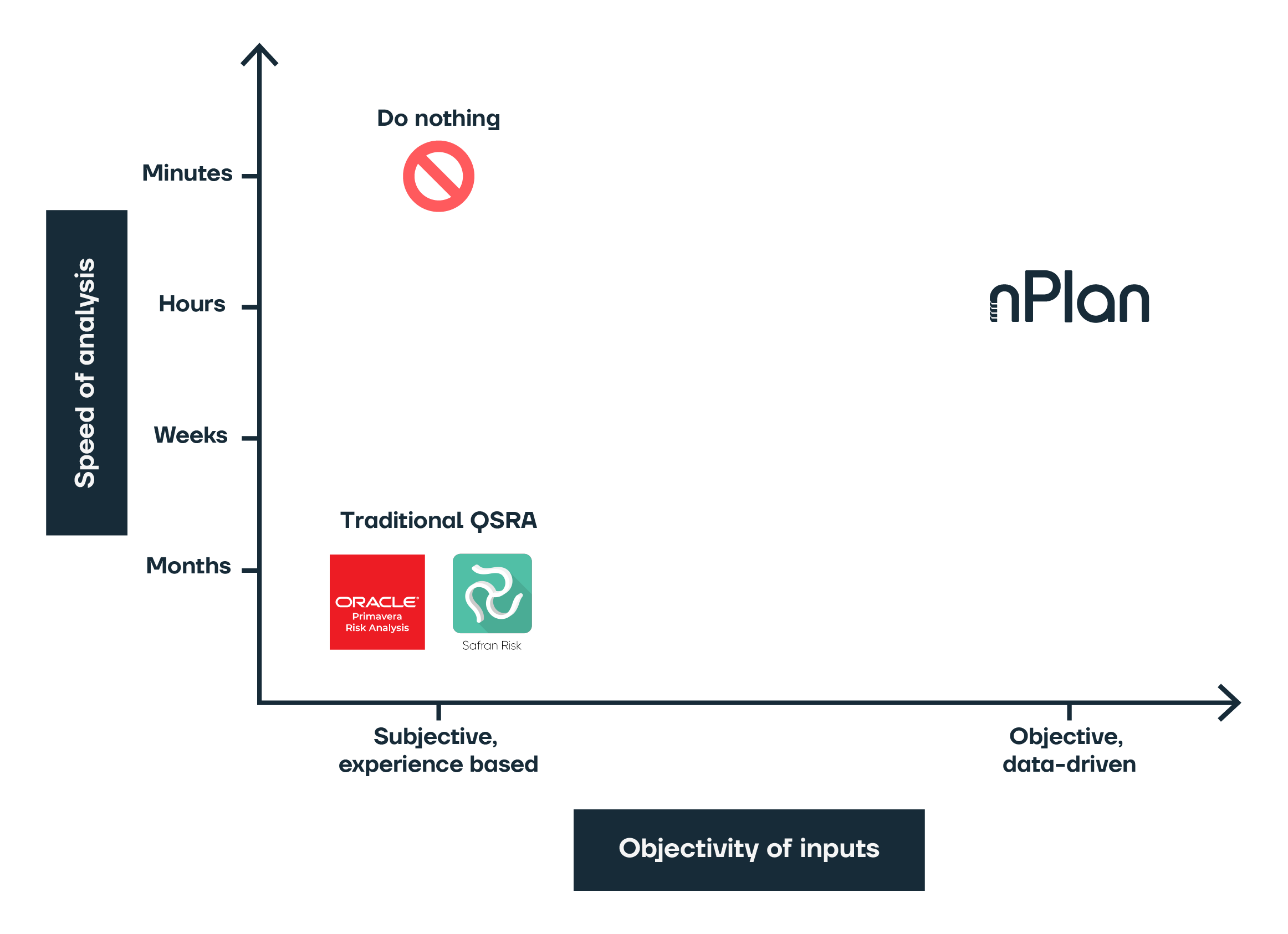
For decades, the industry’s answer to these questions has been Quantitative Schedule Risk Analysis (QSRA), supported by tools like Safran Risk, Deltek Acumen Risk, and Oracle Primavera Risk Analysis. These tools formalised probabilistic thinking in project controls and became embedded as best practice across major programmes.
Now a different approach has emerged: AI-led Schedule Risk Analysis (AI-SRA). Not as a replacement for probabilistic thinking, but as a response to a constraint that has existed until now: the dependence on limited, biased opinion for the quantification of risk and the inability to analyse complex schedules to gain insights from them. If you want a detailed explanation about nPlan vs traditional risk software - download our whitepaper.
At a high level, the difference can be summarised simply:
- Traditional QSRA asks: “What outcomes are plausible, given what we think we know?”
- AI-SRA asks: “What outcomes are likely, based on the data and augmented by our experience?”
QSRA evolved to cope with limited data and computational power. AI-SRA exists because those constraints no longer apply.
nPlan vs traditional risk software: Key Differences
.png)
nPlan’s models are trained on more than 750,000 historical schedules, learning patterns in activity sequencing, duration growth, logic structure, and delivery outcomes. When a new schedule is uploaded, every activity is analysed in context, not in isolation.
The output is a probabilistic forecast for each activity, which then rolls up into a project-level view of schedule risk.
Crucially, this forecast can be regenerated every time the schedule changes, without repeating workshops or rebuilding models from scratch.
Why This Matters for Teams Already Using QSRA Tools
For teams already using Safran Risk, Acumen Risk, or Oracle PRA, the question is rarely “Should we abandon QSRA altogether?”
More often, it is:
- Why do our QSRAs feel disconnected from day-to-day delivery?
- Why do we only revisit schedule risk periodically?
- Why do the same issues keep surprising us during execution?
- How can we use our time managing risk rather than just quantifying it?
- Why don’t I trust what my teams are telling me?
AI-SRA does not challenge the value of probabilistic thinking. It challenges the idea that uncertainty must be estimated manually and infrequently.
Wrap up
Traditional QSRA has played an important role in improving how major projects think about risk. It introduced probabilistic language, formal governance, and discipline into schedule forecasting.
AI-SRA represents the next step in that evolution: continuous, data-driven schedule assurance grounded in how projects actually behave, not just how we think they might. While allowing project experts to utilise their time actually aiding project delivery.
As delivery environments become more complex and schedules change more frequently, the ability to re-forecast risk at the activity level is becoming less of a “nice to have” and more of a practical necessity.