
Assuring the schedule and risks behind a long-term cost estimate
How a European nuclear new-build programme used nPlan's AI-led forecasting to find risks missing from its cost estimate and test its contractors' programmes.
Background
France has committed to building six new reactors, with the first expected to enter operation from 2038, and several other European countries are moving ahead with new-build programmes of their own. Most of these programmes repeat reactor designs that have already been built elsewhere, and the governments and investors behind them expect the new units to avoid the overruns and delays of the first ones.
Much of the money for these programmes now comes from the state or from consumers. In France, a subsidised government loan is set to cover 60% of the programme's cost, and in other markets consumers start contributing through their energy bills while construction is still under way. With public money at stake, the cost estimate behind each programme is examined closely. EDF's estimate for the six French reactors has been revised upwards twice since 2022, and the French state audit office has since put the cost above EDF's latest figure.
Nuclear has the weakest delivery record of any type of energy infrastructure. A 2025 study of 662 energy projects found that the average nuclear power plant overran its construction budget by 102.5%, with the most extreme delays of any project type. Every upward revision makes the next estimate harder to believe, so the organisations delivering these programmes are under pressure to get the figure right before it reaches their board, funders and government.
nPlan works with an organisation delivering a nuclear new-build programme in Europe. The programme's integrated schedule runs to tens of thousands of activities and brings together civil works, the nuclear island, supporting infrastructure and the programmes of hundreds of suppliers and contractors.
The challenge
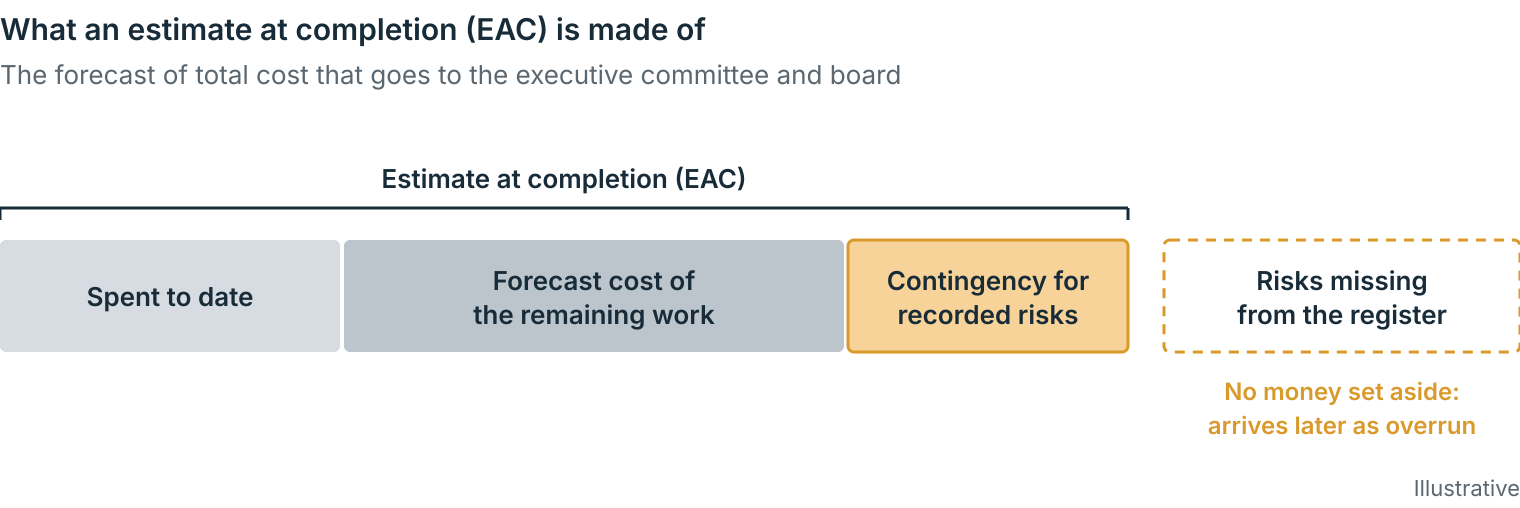
The programme's planning, risk and cost teams use the integrated schedule to produce its estimate at completion (EAC). An EAC is an organisation's current forecast of what a programme will cost in total and when it will finish, made up of the money already spent, the forecast cost of the remaining work and a contingency allowance for the risks that could still occur. The EAC is updated periodically and goes to the executive committee and board, who use it to decide how much funding to commit and how much contingency to hold.
An EAC is only as reliable as the schedule and risk register behind it. A risk that is missing from the register has no contingency set aside for it, so if it occurs, the cost arrives as an overrun, often years later, when the options for absorbing it are fewer and more expensive.
Testing the EAC properly means analysing the full integrated schedule, and conventional quantitative schedule risk analysis (QSRA) cannot handle a schedule of this size. The team had to work from a summarised version, which relies on people deciding what to leave out, and the analysis took long enough that the programme had often moved on by the time the results arrived.
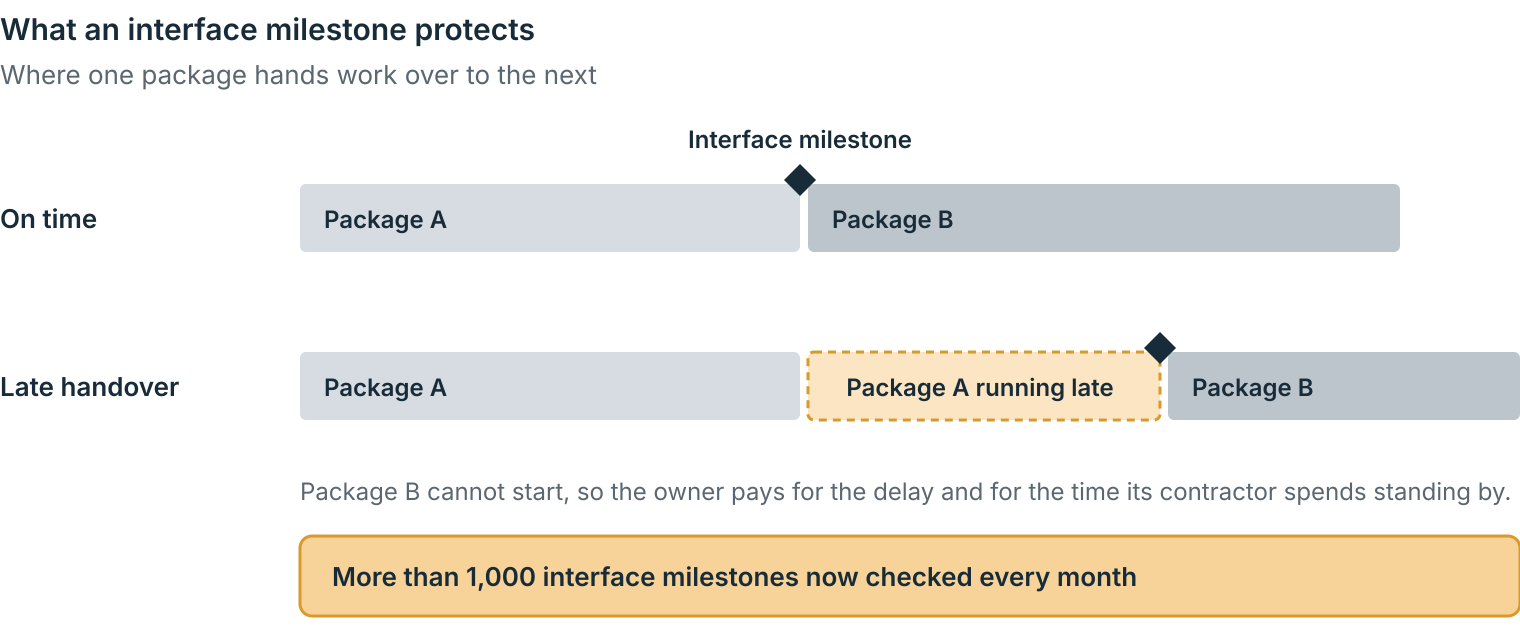
The same problem of scale applies to the programmes coming in from contractors and suppliers. Each submission has to be checked before the owner accepts it, and the handovers between packages have to line up. When one contractor's late handover leaves the next contractor waiting, the owner pays for the delay and for the time the second contractor spends standing by.
Before nPlan
Before nPlan, the view of which activities were most likely to delay each key milestone came from a planner tracing the schedule by float and judgement. The exercise depended on one person, could not be refreshed every month and covered only the top-level milestones. Risk managers had limited access to the schedules underneath the risks they were managing, so planning and risk ran as largely separate processes for most of the year.
The executive committee and board were relying on a cost forecast built on judgement that was difficult to check independently. Checking every contractor submission and every handover between packages by hand was not realistic on a schedule of this size, and problems tended to show up once they had started to affect the programme, instead of while the team still had time to plan around them.
How the team uses nPlan
The planning team uploads the integrated schedule and the major contractor and supplier programmes to Insights Pro each reporting cycle, along with the schedule behind each EAC. Insights Pro forecasts every key milestone using nPlan's dataset of more than 750,000 past project schedules, and the results sit alongside the programme's own schedule and conventional risk analysis as an independent check. Planners, risk managers and project managers all work from the same analysis.
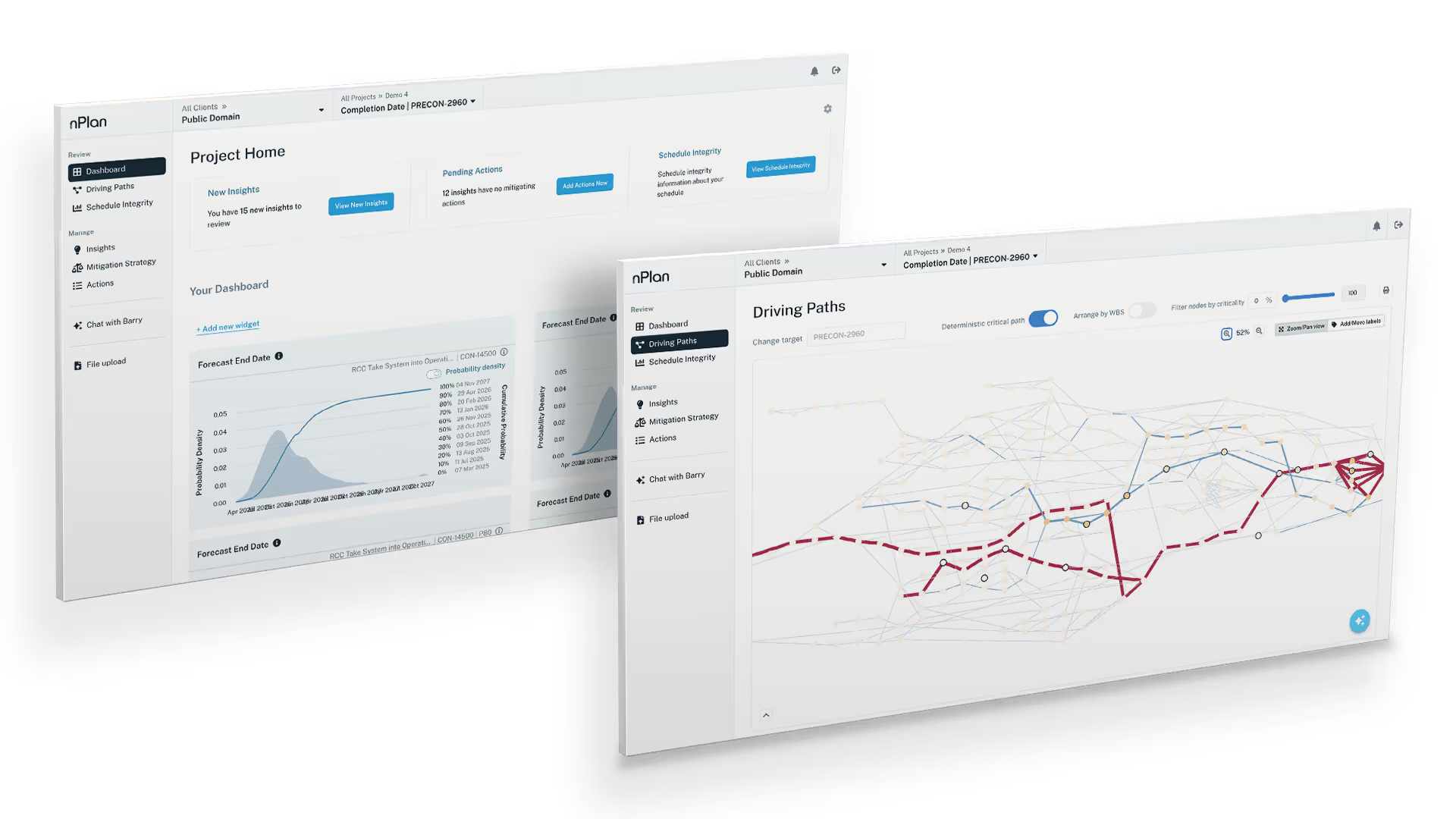
Insights Pro includes Barry, nPlan's AI Project Controls Assistant. The team uses Barry to investigate findings, check large schedules against the programme's own standards and produce reports for project leadership, without needing to work in specialist planning software.
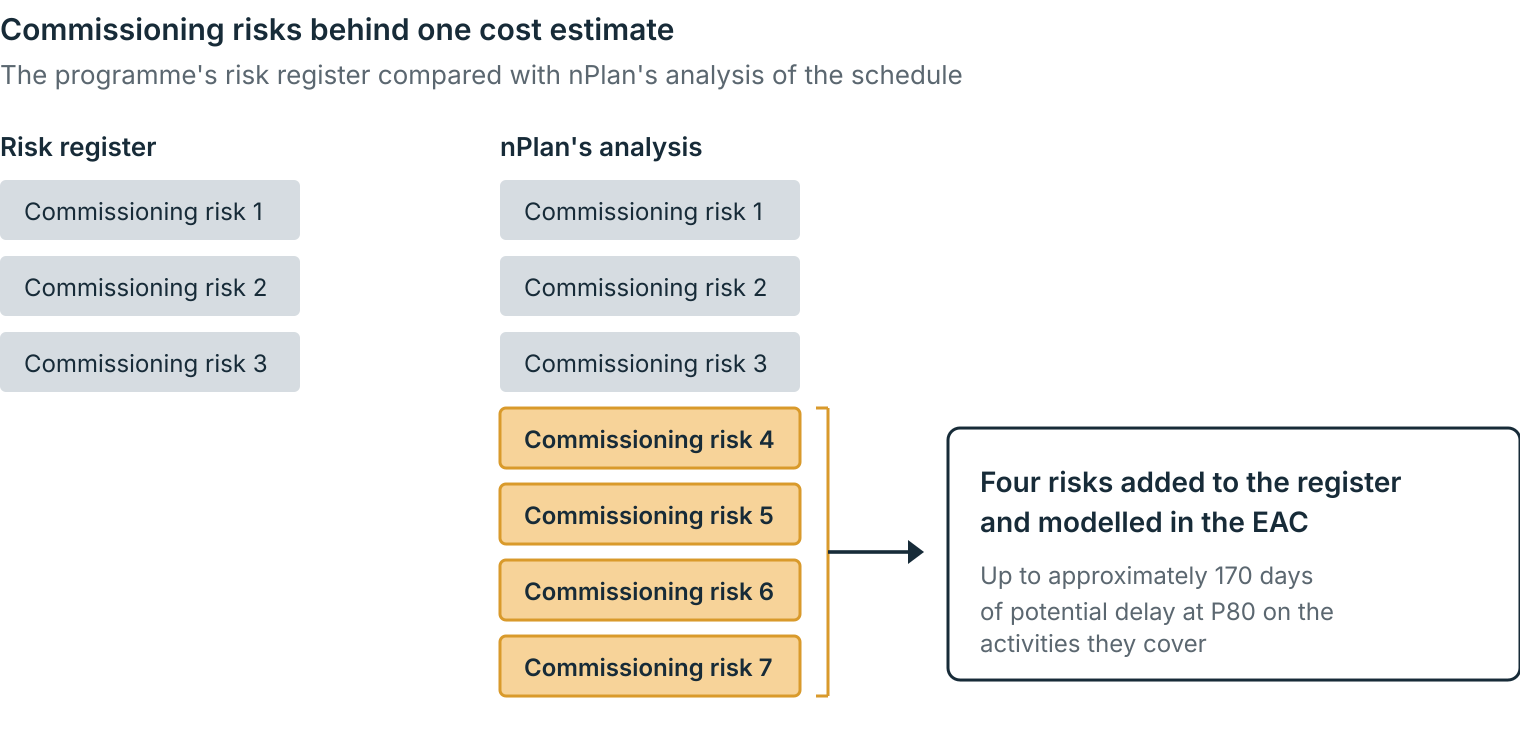
For the latest EAC, the team compared nPlan's analysis of the schedule with the programme's risk register. The register held three commissioning risks, while nPlan's analysis pointed to seven, with more detail on where each one sat in the schedule. The additional risks were added to the register and modelled in the EAC, covering activities where the potential delay at P80 ran to approximately 170 days. The same exercise flagged a civil works productivity risk that the register did not include, which has since been added.
nPlan checked the critical path behind the EAC's target completion date and identified the points in the schedule most likely to stand in the way of that date, the largest worth approximately 165 days of potential delay. One of them was an access constraint the programme's own team had already challenged, which gave the executive committee independent confirmation of that challenge. nPlan's findings are being incorporated into the EAC pack for the executive committee, alongside the programme's conventional risk analysis.
The programme is working to bring a major milestone forward by more than a year, and the team has used Driving Paths in the delivery reviews for that milestone to test whether the faster plan can be delivered, showing which chains of activities have to hold for the earlier date to be achieved.
On one supporting infrastructure package, Schedule Comparison showed problems in a contractor's programme submission that informed the owner's decision to reject it. Every key submission on that package is now reviewed through nPlan before the owner accepts it.
Wherever one package hands work over to another, the integrated schedule records the handover as an interface milestone. The programme had more than 1,000 of them, recorded in three different formats, so there was no consistent way to check that each handover lined up with the work on either side of it. When the planning team asked for every interface milestone to be checked against the programme's own scheduling standards, Barry found and classified all of them and ran the checks in under a day, a review the team considered close to impossible by hand. The check now runs every month, and the programme has set up an interface management team to act on the findings.
The results
The EAC now includes risks that were previously missing from the register, among them commissioning risks with potential delay of up to approximately 170 days at P80, so the contingency the board approves rests on a fuller picture of what could go wrong.
Full probabilistic analysis of the integrated schedule now runs within each reporting cycle, in hours instead of weeks. The findings arrive before each month's schedule is finalised, so the team can act on them while the schedule can still change.
The executive committee receives an independent assessment of the EAC alongside the programme's own analysis, and the team plans to repeat the assurance every quarter. Teams beyond the original planning and risk groups, including supply chain, reporting and delivery, have asked to use nPlan, and project managers can now see schedule risk for their own areas without needing specialist planning software.
What this means for the business
When the board uses the EAC to set the programme's contingency, holding too little means going back to the board and funders for more money partway through delivery and losing credibility each time, while holding too much leaves capital sitting idle that could have funded other work. With nPlan, the organisation sizes contingency against an independent view of how its schedule is likely to perform, based on the outcomes of more than 750,000 past projects, and can defend that figure to its board, funders and government.
The risks that cause the largest overruns are usually the ones nobody has recorded, because a risk missing from the register has no money set aside for it. On this programme, nPlan found commissioning risks with up to approximately 170 days of potential delay before the EAC was finalised. Every extra month on a nuclear programme means another month of running the site, paying the workforce and keeping the supply chain engaged, so finding those risks before the EAC was signed off means the programme can budget for them now, rather than discover them later as an overrun.
The same independent view now supports the programme's biggest decisions. Committing to bring a milestone forward by more than a year is expensive if the faster plan cannot be delivered, and leadership can now see which chains of activities would have to hold before making that commitment. With contractors, accepting a programme makes it the baseline against which future delay and claims are measured, so testing each submission before acceptance protects the owner's commercial position for the rest of the contract.
All of this runs on the full schedule within each reporting cycle, at a scale no team could cover by hand and without adding specialist headcount. For an organisation answerable to a board, funders and government, the result is a cost and schedule forecast it can stand behind, with evidence for every figure in it.
Sources
- oEnergetice, “France approved an energy strategy and is betting on nuclear power”, February 2026
- World Nuclear News, “EDF estimates EPR2 programme cost at EUR72.8 billion”
- World Nuclear News, “Low electricity prices could impact EPR2 programme funding, auditor warns”
- GOV.UK, “Future funding for nuclear plants” (Regulated Asset Base model)
- Boston University Institute for Global Sustainability, “Investment risk for energy infrastructure construction is highest for nuclear power plants, lowest for solar”, May 2025