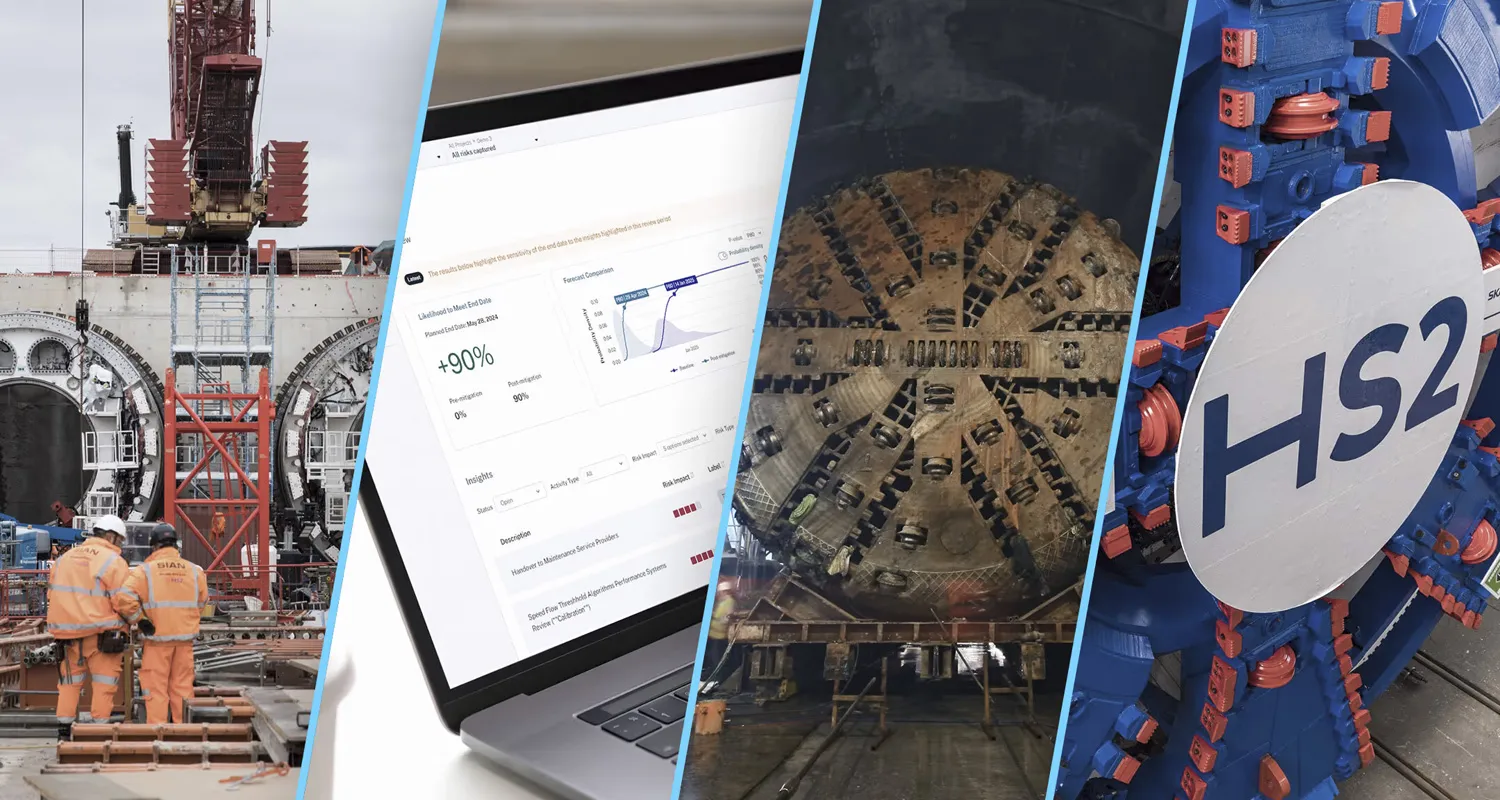
Bringing project controls in-house and holding the contractor to account
How a global manufacturer building a new US production campus replaced external scheduling consultants with a lean in-house team using nPlan's AI-led forecasting.
Background
Construction of manufacturing facilities in the US has grown faster than almost any other part of the construction market this decade. Annual spending on manufacturing construction roughly tripled between 2021 and 2024, according to the US Census Bureau, and remains well above its pre-2022 level as companies build new production capacity closer to their customers. Sites built for automated production often include their own data centres, which adds a dense package of electrical and IT work to programmes that are already complex.
A study of more than 300 industrial megaprojects found that 65% failed to meet their business objectives, whether through cost overruns, late completion or a plant that did not deliver the expected production. Research for the US National Academies found that the amount of evaluation an owner carries out on its contractor's progress is one of the strongest predictors of whether a project succeeds, which puts the owner's own project controls capability at the centre of delivery.
nPlan works with a global manufacturer that is building a new production campus in the US. The campus is made up of several production and warehouse buildings and on-site data centres, delivered in streams by a single main contractor whose programme runs to more than 9,000 activities.
The challenge
A new production facility only starts paying back the investment once it is producing, so every month of delay to the opening is a month of lost output, on top of the extra cost of keeping the project team, the contractor and the site running for longer. The owner carries that cost, but the contractor is the one who builds and updates the programme, and each monthly update can change thousands of activities and the links between them. Tracking those changes takes considerable time and expertise, and without an independent view of the programme, an owner is left relying on the contractor's own account of where the project stands, which a contractor will naturally present in the best light.
The company has traditionally paid external scheduling consultants to give it an independent view, and that approach has drawbacks for an owner. The cost grows with every additional review, and the consultant's view arrives as a periodic snapshot rather than a running forecast the owner can act on. A consultant's incentives are not the same as the owner's, and when the engagement ends, the knowledge of the programme and the contractor leaves with them, so the company starts again on its next site. The company also wanted its own project people to spend their time managing the construction and the stakeholders around it, instead of working through schedule analysis or managing a consultant who does it for them.
With more production facilities in its pipeline, the company could not afford to manage a programme of this scale on the contractor's account of progress or on periodic reports from consultants. It needed a project controls capability of its own, built on this programme and repeatable on the next, with a lean in-house team reviewing the contractor's programme and reporting on it to project leadership and the company's global leadership. The difficulty was scale: reviewing a 9,000-activity programme by hand, across every milestone in every monthly update, is more than a lean team can sustain, and if the in-house model could not keep up, the company would be back to relying on the contractor or on consultants.
Before nPlan
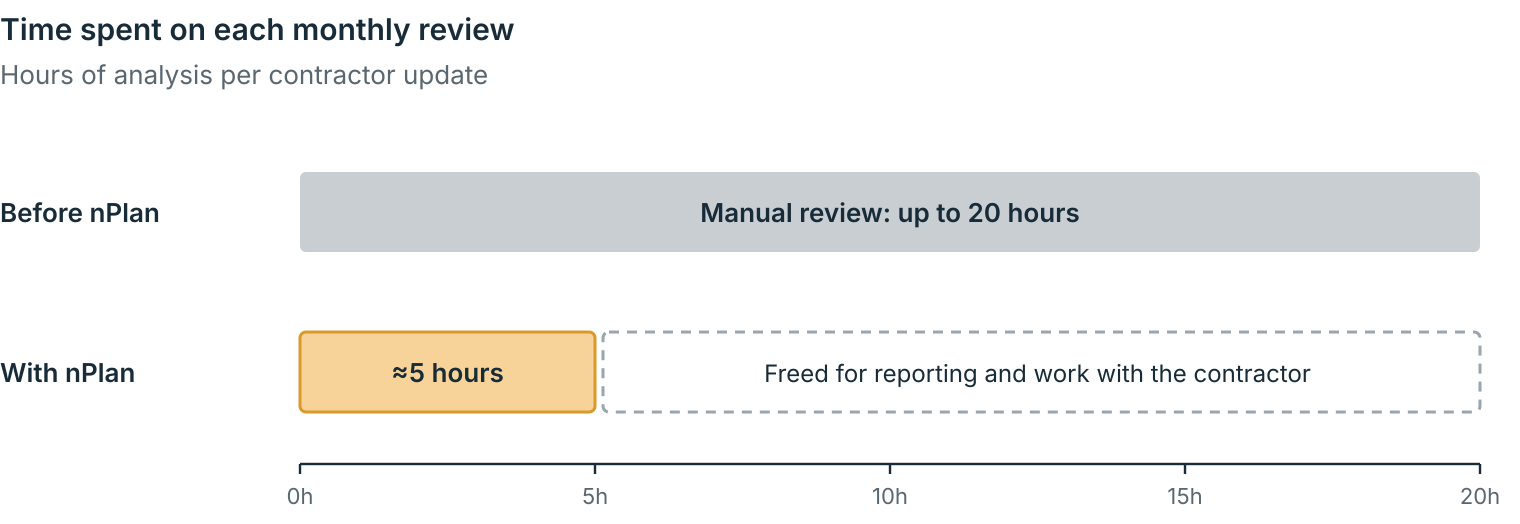
Before nPlan, reviewing the contractor's programme meant working through each monthly update by hand, at approximately an hour per milestone, or up to 20 hours for each update, before any time had been spent on reporting or on the contractor. With more than 130 activities carrying significant risk spread across the full programme, a manual review could realistically cover little more than the critical path, so delay building up on other activities went unnoticed until it reached a milestone.
Beyond the time involved, the owner had no forecast of its own to set against the contractor's dates, so leadership received the dates the contractor reported and had no way to tell how much risk sat behind them. When the contractor said it had mitigated a risk, the owner could not check whether the updated programme supported the claim. Delay tended to surface once it was already happening on site, by which point the options for recovering the time were fewer and more expensive. With the production start date carrying the return on the entire investment, the company needed to see problems months earlier than its process allowed.
How the team uses nPlan
The team uploads each contractor update to Insights Pro, which forecasts every key milestone using nPlan's dataset of more than 750,000 past project schedules. The forecast gives the owner its own view of when each milestone is likely to finish, independent of the contractor's dates, along with the activities that are driving the risk to each one.
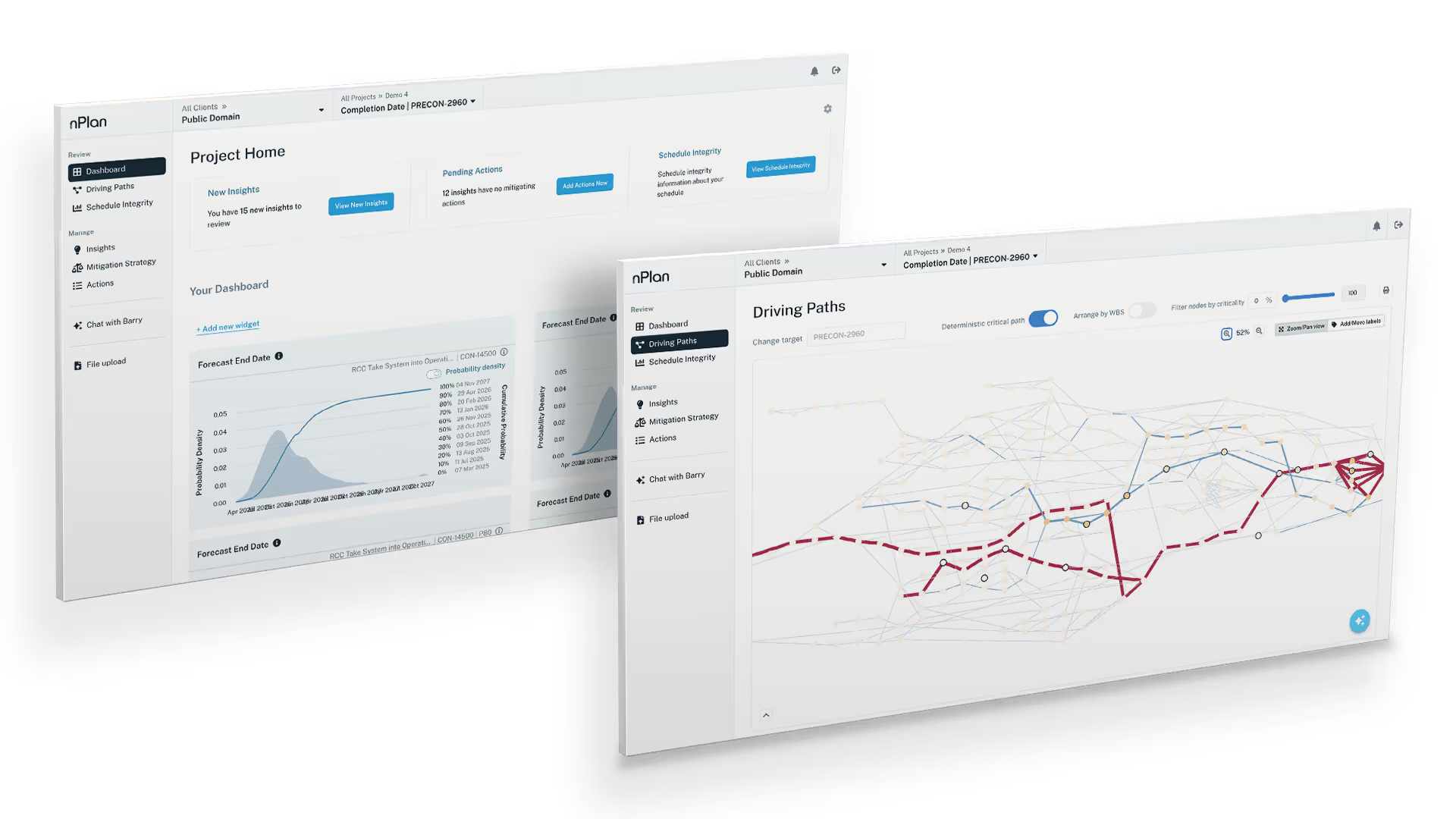
Insights Pro includes Barry, nPlan's AI Project Controls Assistant. The team uses Barry to dig into specific findings, draft recovery options for each milestone and produce a monthly report for project leadership, which sets out the main risks to delivery and the actions agreed with the contractor to reduce each one.
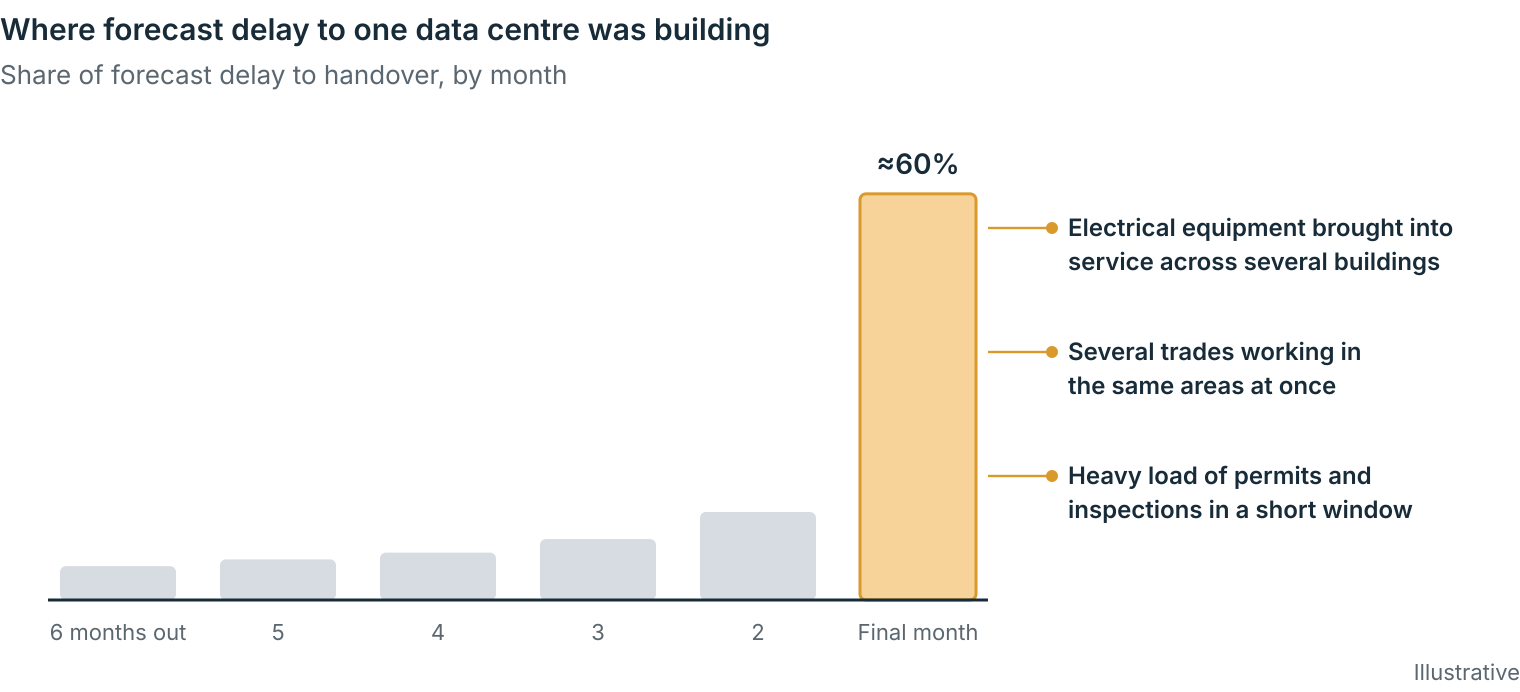
Shortly after the team started using nPlan, Driving Paths showed that approximately 60% of the forecast delay to one of the data centres was concentrated in the final month before handover, when electrical crews would be bringing equipment into service across several buildings within a few weeks of each other. The pattern pointed to several trades working in the same areas at once and a heavy load of permits and inspections in a short window, none of which was visible from the contractor's critical path. The owner's team raised manpower and materials with the contractor and set up a twice-weekly permit meeting with them, looking four to six weeks ahead.
Schedule Comparison gave the owner a way to test each update the contractor submitted. After one update, the team compared it against several earlier versions and found that the contractor had not mitigated the risks to the extent the update suggested, and took the evidence back to the contractor. In other months, Schedule Comparison showed more than 2,000 changes to the links between activities in a single update and 450 deleted links, and the team challenged the contractor to justify them. On one data centre milestone, the analysis uncovered a negative 12-day lag, a link that allowed work to start 12 days before the activity it depended on had finished, which made the completion date look better than it really was.
The results
The team now spends approximately five hours on each monthly review, down from 20. The analysis is finished within a week of each update arriving, which leaves the following week for reporting and for working through the findings with the contractor.
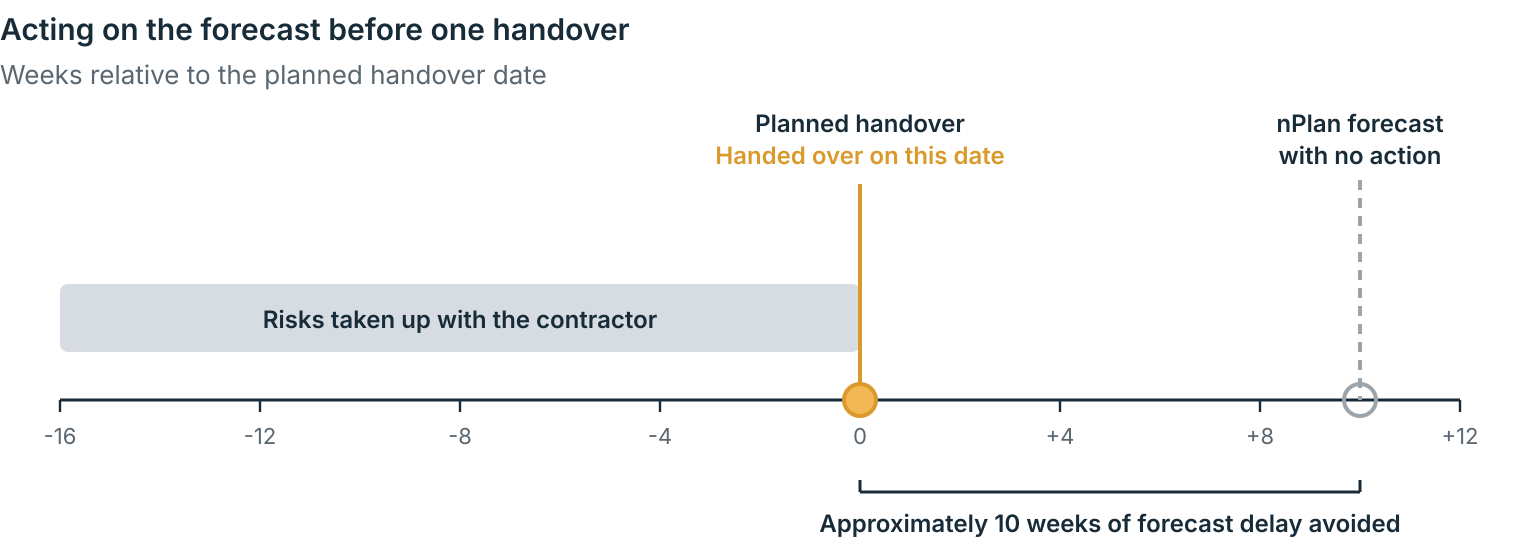
Ahead of the handover of one production area, nPlan's forecast showed that without action the handover would be approximately ten weeks late. The owner's team used the forecast to decide which risks to take up with the contractor in the months beforehand, and the area was handed over on the date in the plan.
Project leadership and the company's steering committee now receive a monthly view of each key milestone based on an independent forecast, along with the main risks to delivery and the actions agreed with the contractor to bring each one under control. The contractor's approach to the owner's reviews has also shifted: comments that once received inconsistent responses are now answered with detailed justification, and the contractor corrects the problems the owner's team identifies.
What this means for the business
For a manufacturer, the date a new facility starts production is the date it starts earning a return on the capital invested in it. The owner now sees delay forming months before it reaches a milestone, while there is still time to deal with it at a reasonable cost, and every month the programme protects is a month of output the business keeps.
The company gets independent assurance on every key milestone in every monthly update from a lean in-house team, a level of coverage it would previously have bought from external consultants at a cost that grew with each review. The hours the team has freed up go into managing the contractor and aligning the programme with the company's wider plans, so the in-house team delivers more than the analysis alone.
The owner can also hold its contractor to account at activity level: what has changed in each update, whether a mitigation the contractor reports is reflected in the programme, and what each issue does to the forecast date. The contractor now explains and corrects its updates in response, which puts more of the work of keeping the programme on track back on the party being paid to deliver it.
Project leadership and the company's global leadership now base their decisions on an independent forecast, so they know how much risk sits behind each milestone and can direct attention and money to the right places before problems become expensive. With the capability held inside the business, the knowledge and the way of working built up on this programme carry over to the company's next facility rather than leaving with a consultant at the end of an engagement.