Challenging contractor delay and cost with evidence
How a UK electricity network operator used nPlan's AI-led forecasting to cut 50 days from a contractor's delay claim.
Background
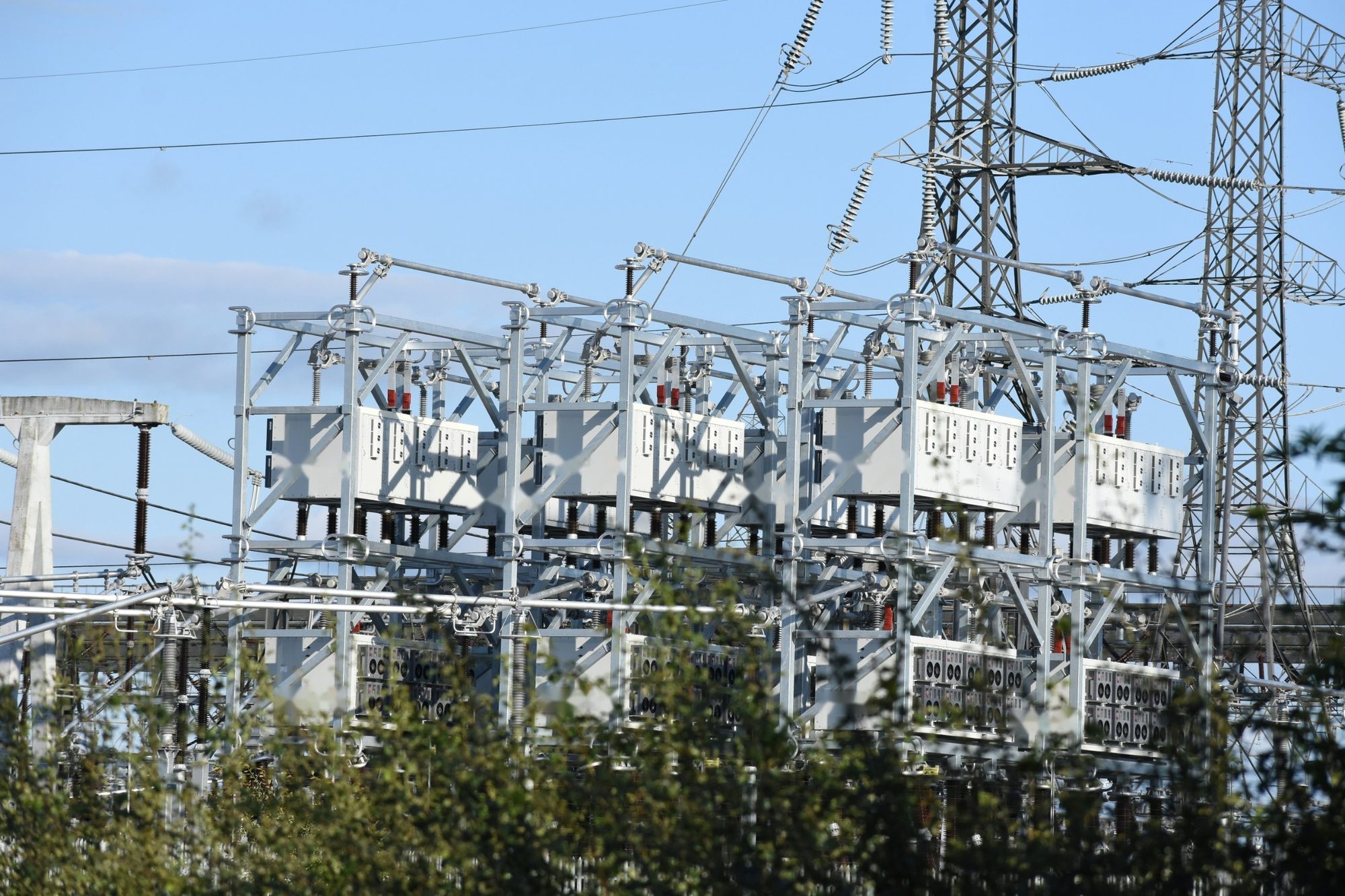
Electricity networks across Great Britain are going through their biggest expansion since the 1960s, as network companies build the capacity needed to connect new sources of generation and meet growing demand for power. For electricity transmission alone, Ofgem's price control for 2026 to 2031, known as RIIO-3, has approved £10.3bn of upfront investment, within a wider pipeline of approximately £90bn across the energy networks over the same period. Much of this work involves building new substations and upgrading existing ones, usually through principal contractors working under NEC contracts.
Building at this pace is stretching the supply chain that network companies rely on, with lead times for transmission-voltage transformers increasing from 30–60 weeks to 120–210 weeks. The National Audit Office has warned that completing all the planned grid upgrades by 2030 will be very challenging because of planning, supply chain and system access risks, and Ofgem has reported that delivery in the early years of the previous price control fell short of expectations, largely because of contractor and supply chain constraints. With contractors stretched and programmes under this much pressure, delay claims and disagreements over progress become more likely, and network owners need evidence to test each one before agreeing to pay for it.
nPlan works with a UK electricity network operator on several of its substation projects, each led by a Project Director. On each project, the project managers are accountable for delivery, while a small planning and controls team checks the principal contractor's programme, manages schedule risk and reports progress to the Project Director.
The challenge
When a substation project runs late, the owner loses out twice: the new capacity comes into service later than planned, and the owner pays the contractor for any delay it accepts through the contract. Under an NEC contract, the contractor can claim extra time and money through a compensation event when something outside its control delays the work, and the project manager then has a limited period in which to assess the claim and respond.
Assessing a claim properly means working out when the delay started, what caused it and how it spread through the programme, which involves comparing several versions of the programme and takes an experienced planner considerable time. When the response deadline is close and planners are already stretched, claims can end up being accepted with only partial analysis behind them.
The same pressure on time affects two other parts of the contract. Monthly payments to the contractor are based on the work the contractor reports as complete, and the NEC contract requires both parties to give an early warning as soon as they become aware of anything that could delay completion or increase cost, so that they can agree how to reduce its impact. Checking valuations against actual progress on site, and putting a figure on the likely impact of each early warning, both depend on the controls team having a current and reliable picture of the schedule.
Before nPlan
Before nPlan, the controls team reviewed each contractor submission by hand in P6, comparing files line by line to find which activities had been added, which durations had changed and how the critical path had moved. On programmes with thousands of activities, the critical path was difficult to interpret, and a quantitative schedule risk analysis took so long to run that the results were often out of date by the time the team could use them.
Reporting ran on a monthly cycle, and producing each report took up most of the controls team's time, which left little capacity for acting on the findings. The Project Director's view of each project came largely from that monthly report, so delay building up on activities away from the critical path could go unnoticed until it reached the end date, by which point the options for recovering the time were fewer and more expensive. When the team raised an early warning with the contractor, it could describe the risk but could not say how many days the risk was likely to add to the completion date, which made it harder to get the contractor to act and harder for the Project Director to judge how much attention each risk deserved.
The effect on the business was clearest in how delay claims were handled. Testing a claim meant collecting several versions of the programme and reconstructing what had happened, which was slow and relied on experienced planners being available. Under an NEC contract, a compensation event can be treated as accepted if the project manager does not respond within the contract's timescales, so a team without the time to test a claim properly faced a choice between accepting a figure it could not verify and challenging it without the evidence to support the challenge. Claims that are not settled on the evidence at the time can return later as formal disputes, and Arcadis puts the average value of a UK construction dispute at approximately £27m, with an average of 12 months to resolve.
Monthly valuations were checked against the progress the contractor reported rather than against an independent view of what was happening on site, which left the operator exposed to paying for work before it had been done. Spend forecasts for cash-flow planning and annual funding applications were built on the planned profile, so delays on site only showed up in the numbers once they had already happened.
How the team uses nPlan
Faced with a sharp increase in the volume of substation work it needs to deliver, the operator brought in nPlan to give its project teams an independent, data-driven view of delivery risk on each project, one that does not rely on the contractor's own programme or on the availability of experienced planners. Some project teams use nPlan as part of their routine monthly assurance, while others have used it to bring a project that was running into difficulty back under control.
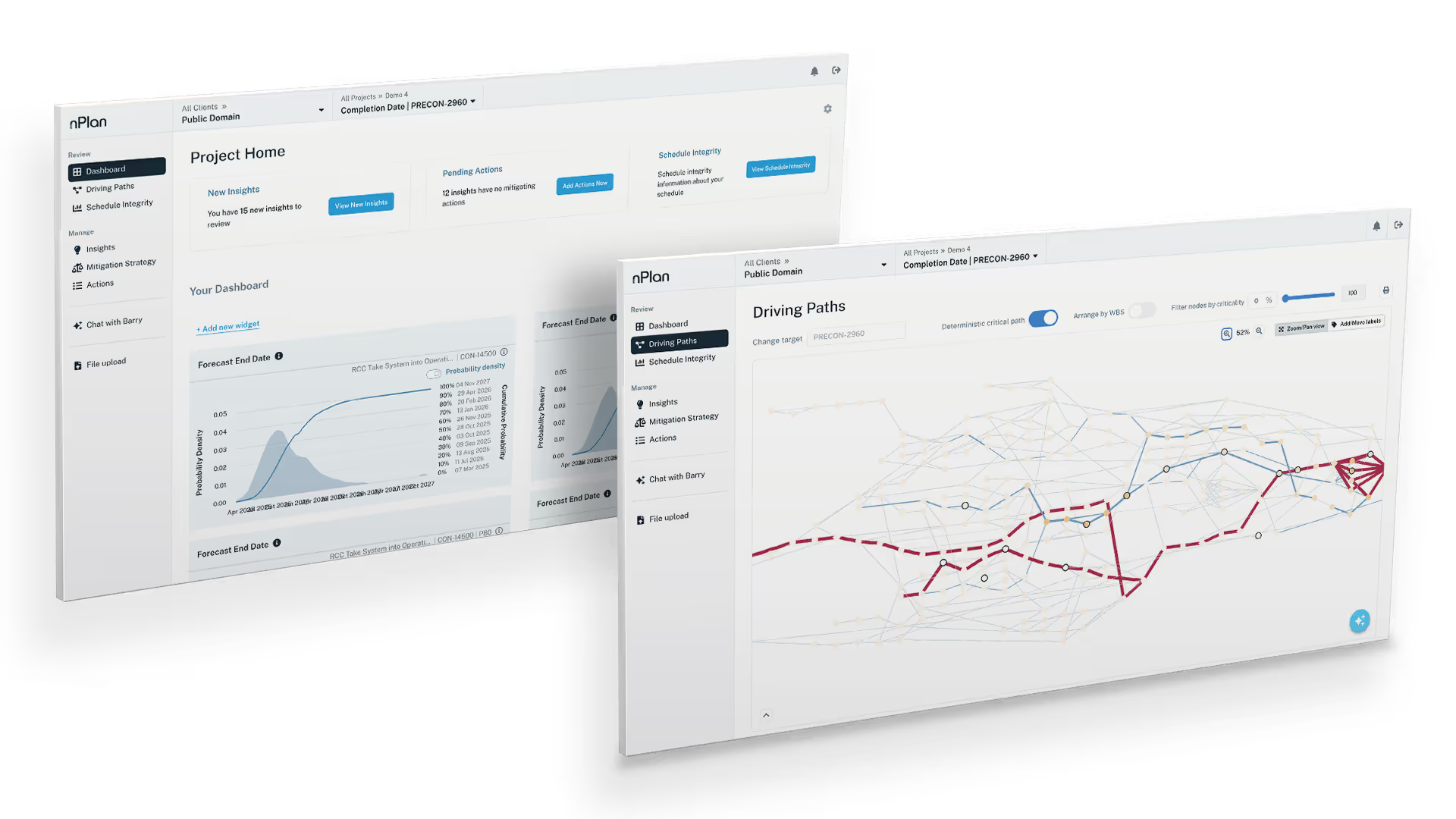
Insights Pro includes Barry, nPlan's AI Project Controls Assistant, which answers questions about a schedule and its forecast and writes a structured summary of each programme update. Project managers can use Barry to investigate a contractor submission themselves, without having to work in P6.
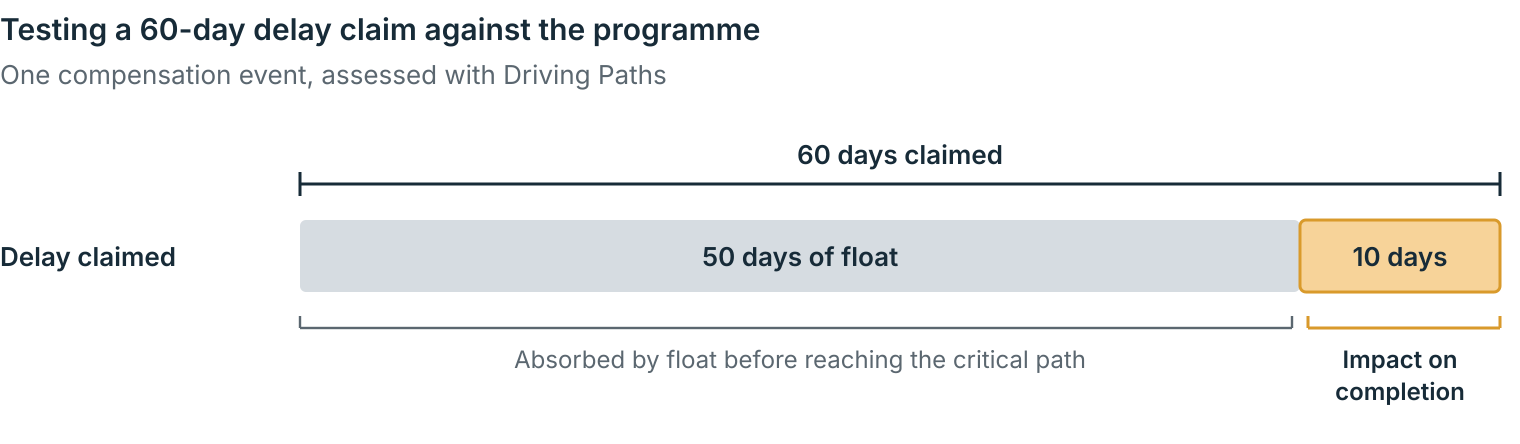
When the principal contractor on one project submitted a compensation event claiming 60 days of delay, the project's planner used Driving Paths in Insights Pro to see how the delayed activity related to the critical path. The activity had 50 days of float before any delay to it would reach the critical path, so only 10 of the 60 days claimed could affect the completion date, and the project team based its response to the contractor on that evidence.
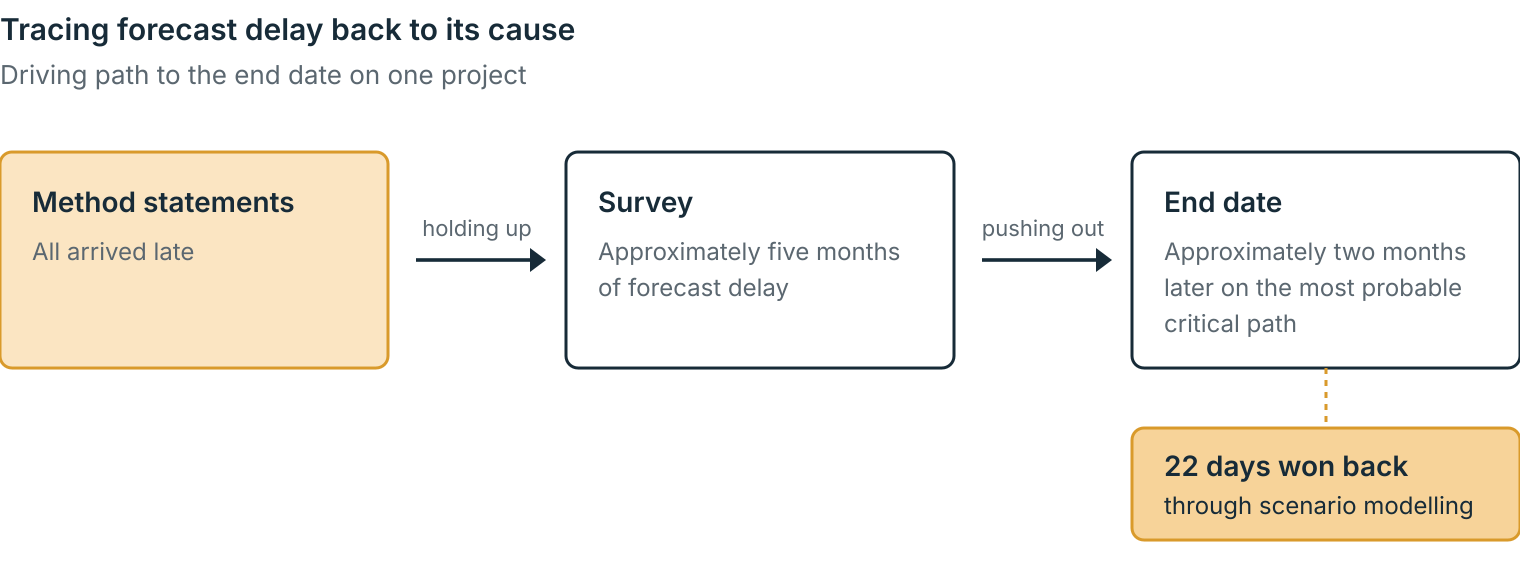
The same team also used Driving Paths to look for delay building up across the programme as a whole. The largest forecast delay, approximately five months, sat on a survey activity, and tracing the driving path back from the survey showed that the survey was waiting on method statements, all of which had arrived late. On the most probable critical path, the late method statements were pushing the end date out by approximately two months. Once the cause was clear, the team used scenario modelling to test ways of recovering the time and found a set of changes worth 22 days, including transformer bay work that could run in parallel instead of in sequence.
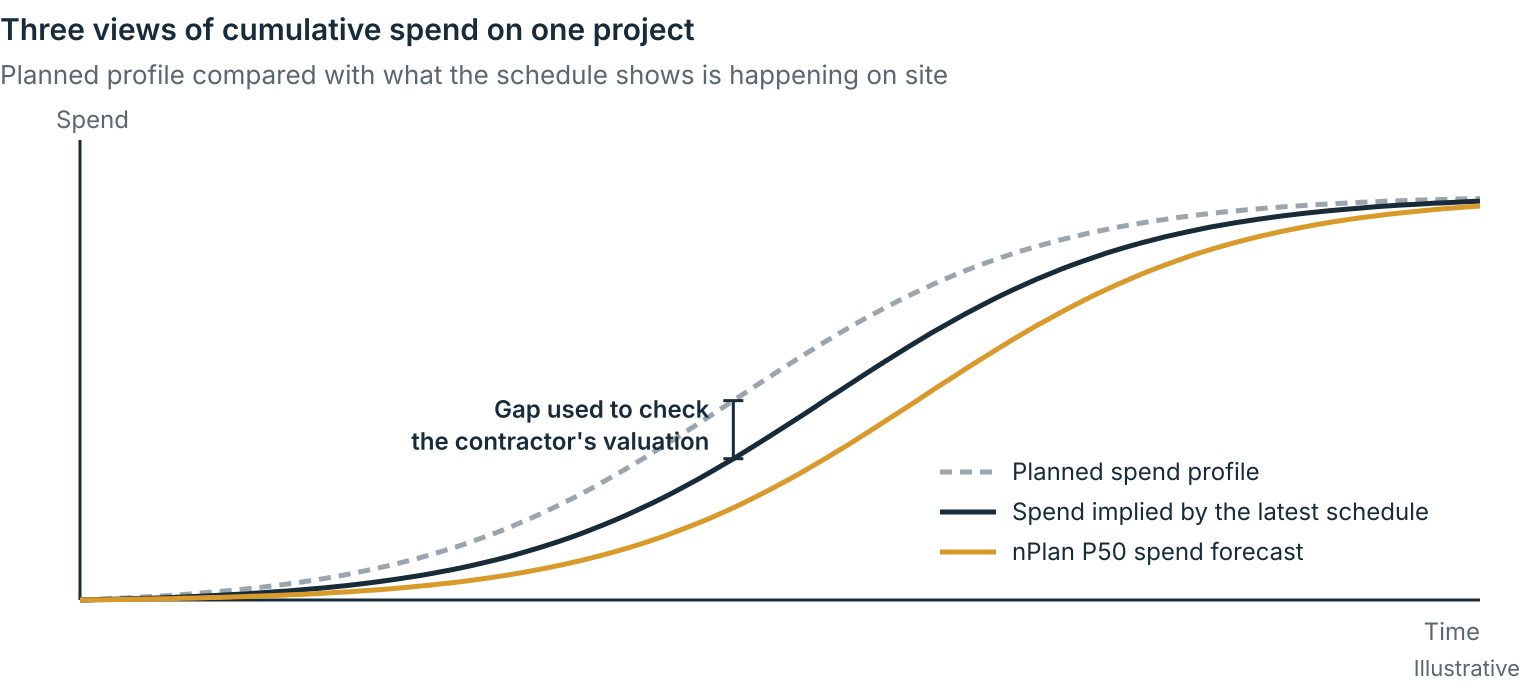
On another project, the team uses nPlan to compare three views of monthly spend: the planned spend profile, the spend implied by the progress the latest schedule shows on site, and nPlan's P50 spend forecast. The project manager takes the Project Director through the comparison each month to show how the cost position is moving, and the team also uses the comparison to check the contractor's invoices against the work actually done.
The results
The compensation event was reduced from 60 days to 10, removing 50 days of delay that the project team estimated to be worth over £1m. On the project using the spend comparison, nPlan's independent view of progress gave the team evidence to back up its own assessment of a monthly contractor valuation and challenge a discrepancy of more than £500k, which avoided an overpayment of the same amount.
Early warnings now go to the contractor with a quantified view of the potential impact on the end date, which has given project teams the confidence to raise risks earlier and escalate them when they need to. On one project, nPlan put a figure of 33 days on a risk that was already on the register, giving the project manager a stronger case for prioritising mitigation.
Project leadership no longer waits for the monthly report to understand where a project stands, because the forecast is updated with each new version of the programme. nPlan has also brought smaller activities to project teams' attention that were not being watched closely but had real potential to disrupt the programme.
What this means for the business
With an independent forecast of each programme behind its decisions on delay, payment and recovery, rather than the contractor's own account of progress, the operator now controls the commercial position on its projects instead of reacting to it.
On delay claims, the operator now pays for the delay the evidence supports. One claim was reduced by 50 days, worth over £1m by the project team's estimate, and because a substation project can generate many claims over its life, the ability to test each one within the contract's timescales protects the capital budget across the whole programme. Settling claims on the evidence at the time also reduces the risk of them returning later as formal disputes, with the cost and management time those involve.
On delivery, project teams now see delay forming months before it reaches the end date, while there is still time to act. On one project, the team traced a five-month delay on a survey activity back to late method statements, which were pushing the end date out by approximately two months, and then found changes to the programme that won back 22 days of that time. Recovering time in this way protects in-service dates, so new substations deliver the capacity the network is waiting for when it is needed.
On cost, the spend comparison gives the business a forecast grounded in what the schedule shows is happening on site, which project teams use for cash-flow planning, annual funding applications and checking contractor invoices. Payments can now follow verified progress rather than reported progress: one project has already avoided an overpayment of more than £500k, and paying only for work that has actually been done keeps cash in the business for longer instead of paying it out ahead of the work.
The existing controls teams carry out all of this analysis themselves, so the operator is assuring its projects more thoroughly without adding headcount, and on one project the project manager no longer needs to recruit an additional planner. Assistant project managers and a risk manager have since joined as users and other project teams have asked to extend their use of nPlan, which gives the operator a consistent way to assure delivery as its substation programme grows.
Sources
- Ofgem, “Ofgem approves initial £24 billion to operate and maintain critical gas networks and upgrade Britain’s electricity supergrid”
- Ashurst, “RIIO-3: Ofgem's Final Determinations at a glance”, December 2025
- techUK, “Ofgem greenlights £28.1bn of grid investment through RIIO-3”, December 2025
- Arcadis, “Electricity transmission owners hold key to UK's energy transition”, 2024
- National Audit Office, “Upgrading the electricity transmission network”, 2026
- Ofgem, electricity transmission annual report, January 2026
- Local Government Lawyer, “Compensation events”
- Pinsent Masons Out-Law, “Construction disputes becoming faster and cheaper, says report” (Arcadis Global Construction Disputes Report)