
Reducing delivery risk across a regulated capital programme
How a UK water company went from assuring 2–5% of its capital schemes each month to assuring all 200+ with nPlan Portfolio and Insights.
Background
Water companies in England and Wales are in the early years of the largest investment programme the sector has undertaken since privatisation. Ofwat's final determinations for 2025 to 2030, the regulatory period known as AMP8, set a total spending allowance of £104bn. A large share of that money is attached to price control deliverables, which set out the specific outputs each company must deliver in return for its allowances, and many of these carry time incentives that reward on-time delivery and penalise late delivery. For a company with hundreds of schemes in progress, schedule risk therefore translates directly into financial and regulatory exposure.
Delivering at this scale is putting pressure on the whole industry. Water and electricity companies are investing at a level that places unprecedented strain on an already stretched supply chain, and Ofwat now requires companies to report on delivery progress every six months because of concerns about whether the enlarged programme can be delivered. In that environment, finding out early that a scheme is drifting has real financial value, because the sooner a problem is identified, the more options a company has for recovering the programme before a regulatory date is missed.
nPlan works with a UK water and wastewater company that has more than 200 capital schemes running across the previous and current regulatory periods, most of them delivered by contract partners under NEC contracts. Each scheme has a project manager who is accountable for delivery, supported by a central planning and project controls team. That team assures the programmes submitted by contract partners, raises risks with project managers and delivery teams, and gives senior leadership a view of where the portfolio stands against its regulatory commitments.
The challenge
Every month, contract partners submit updated programmes for almost all schemes, each with hundreds or thousands of activities. Every one of those programmes needs to be checked for whether its dates are realistic, what has changed since the previous version and where the risks lie. That is skilled work for experienced planners, who are in short supply across the water sector. The company's controls team was small relative to its portfolio, so it could only review a fraction of each month's submissions in detail.
Even a thorough review has its limits, because a contractor's programme shows a single planned date for each milestone and says nothing about how likely that date is to be achieved. Early-stage programmes are also often highly summarised, with construction and commissioning shown as blocks lasting several months, which makes them hard to assure with any real degree of confidence. The controls team's planners work in P6, but most project managers do not, so the people accountable for each scheme had no direct way of investigating their programmes other than spending days scrolling through PDFs of the schedules and depending on their planners to flag any significant risks.
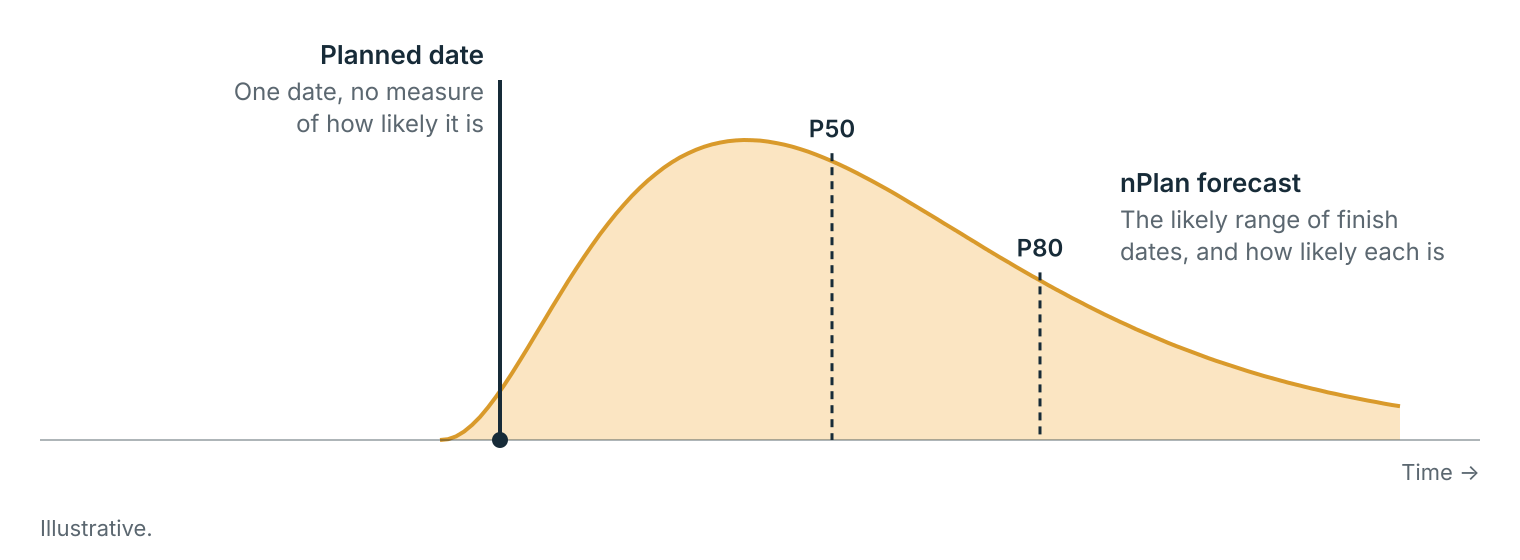
As a result, the company was reporting to leadership, and potentially to regulatory bodies, on deterministic delivery confidence, largely on the basis of the dates its contract partners had planned rather than an independent assessment of whether those dates were realistic and defensible.
Before nPlan
Before nPlan, the project controls team could assure between 2% and 5% of the portfolio in a given month. Each review involved a planner opening the programme in P6, working through the logic and durations by hand, comparing it with the previous version and forming a judgement on whether the key dates were achievable. With that much effort required for each scheme, the team had to decide every month which handful of schemes to review, and the rest went unexamined until their turn came round again.
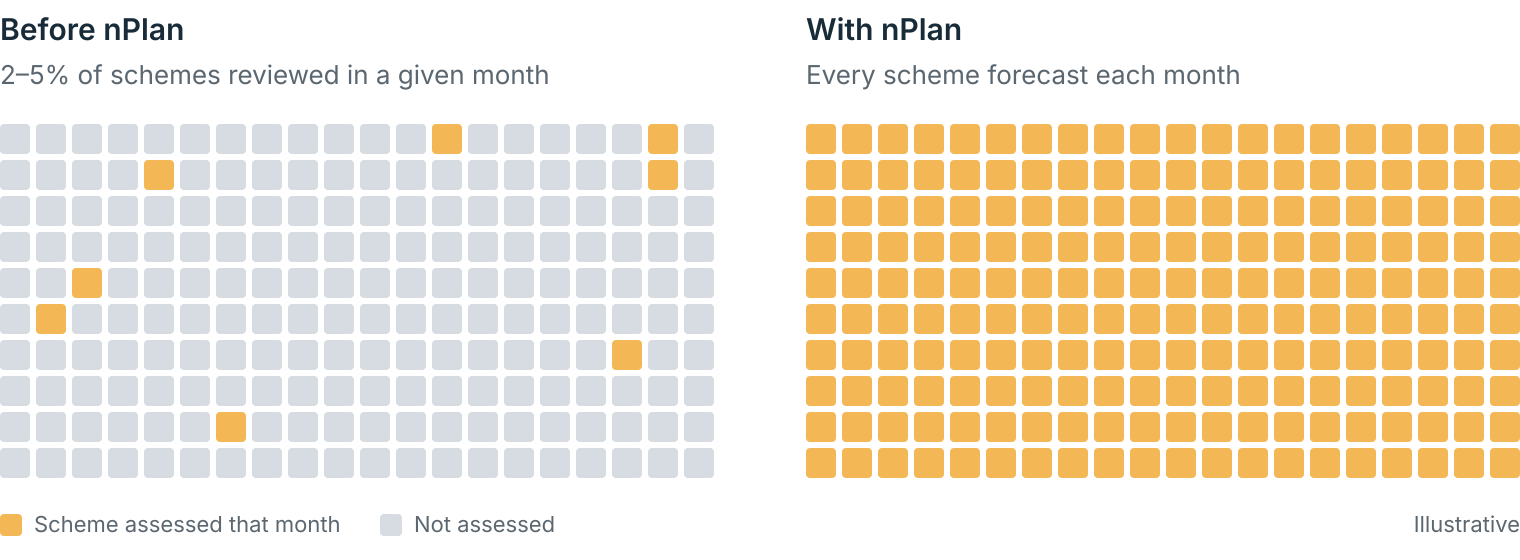
In practice, the schemes that received attention tended to be the ones already known to be in difficulty, while the others were reported on the assumptions behind their planned dates. A scheme could drift for several months before anyone raised a concern, and by the time a problem surfaced through missed milestones or a revised programme from the contract partner, much of the float had gone and the remaining options for recovery were limited and expensive. On schemes with a regulatory completion date, any delay in delivery carries a direct financial cost and a potential reputational cost.
Under the NEC contract, a contract partner submits a revised programme for acceptance (the Clause 32 programme), and the project manager then has two weeks to accept it or set out specific reasons for rejection. Project managers relied on the planning team to interpret each submission, and most of the two weeks went on working out what had changed, which left little time to question the contract partner about the assumptions behind the programme or the mitigation needed to protect the end date.
How the team uses nPlan
The company brought in nPlan to strengthen assurance and project delivery with full visibility of schedule risk across the entire portfolio, and to enable its project controls teams and project managers to investigate their schemes in detail in a fraction of the time manual review used to take.

Portfolio
The controls team uses Portfolio for a monthly health check of every scheme. Each programme is forecast against the recorded outcomes of past construction projects, so schemes can be ranked by how likely they are to meet their key milestones, and the team can see whether each forecast is improving or getting worse from one month to the next.
Insights Pro
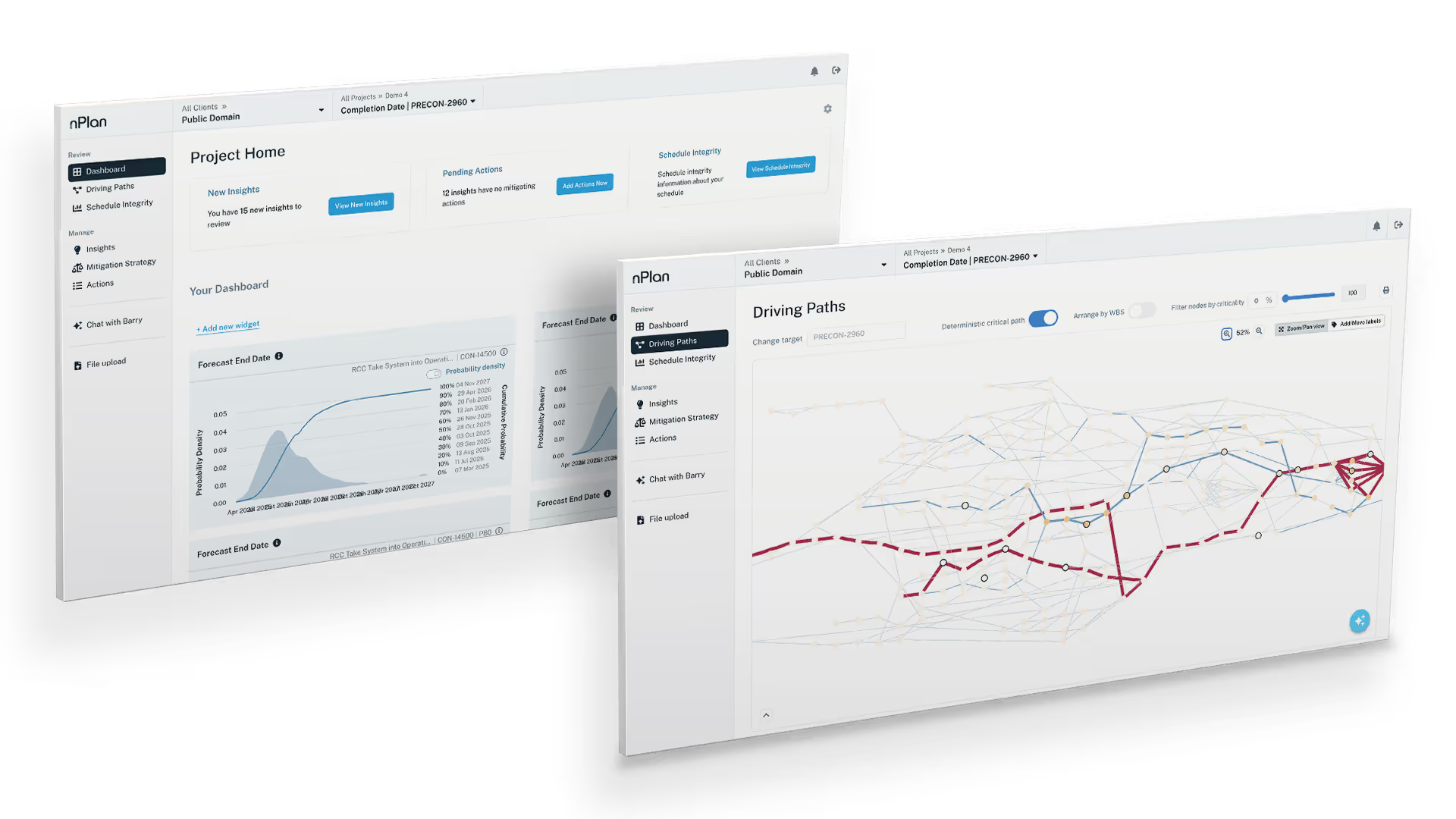
Planners and project managers use Insights to analyse an individual scheme in detail. Schedule Comparison shows what has changed between two versions of a programme, Driving Paths finds the chains of activities most likely to delay a milestone, and activity-level forecasts show where risk is building up before it reaches the end date.
Both products include Barry, nPlan's AI Project Controls Assistant. Users can ask Barry questions about a schedule and its forecast, which means project managers who do not use P6 can investigate a programme themselves. Through Barry, the teams can build monthly reports that bring the forecast, threats and opportunities, schedule adherence, schedule changes and critical paths together in a single view for collaborative planning sessions. Several teams now run these reports automatically each month and use them to track the actions their contract partners have taken, with a month-by-month view of what is being flagged and what is being done about it.
One of the schemes Portfolio flagged as high risk had very little contingency left before its end milestone and was forecast to miss more than 50 of its milestones, with completion moving out by 11 months at P80. The project controls team took the forecast to the scheme's next assurance review and used Insights to understand what lay behind the delay. When they asked Barry whether the delay was being driven by one or two significant activities or by a large number of smaller ones, the analysis pointed to the latter: many activities, both on and off the critical path, were each forecast to finish late, and their combined effect was pushing out the end milestone. As there was no single activity to fix, the sequencing and durations of the programme as a whole needed to be worked through with the contract partner. The scheme's project manager now reviews each Clause 32 submission in Insights, where Schedule Comparison shows which activities have moved and how the critical path has changed, and the activity-level forecasts show what those changes mean for the completion date over the coming months.
Another scheme had a regulatory completion date with a penalty of over £6m attached to missing it. Ahead of a joint programme review, the company's planner shared the outputs from Schedule Comparison, Driving Paths and Barry with the contract partner's planner, so that both sides were working from the same analysis and could act on forward-looking risk rather than only current issues.
The results
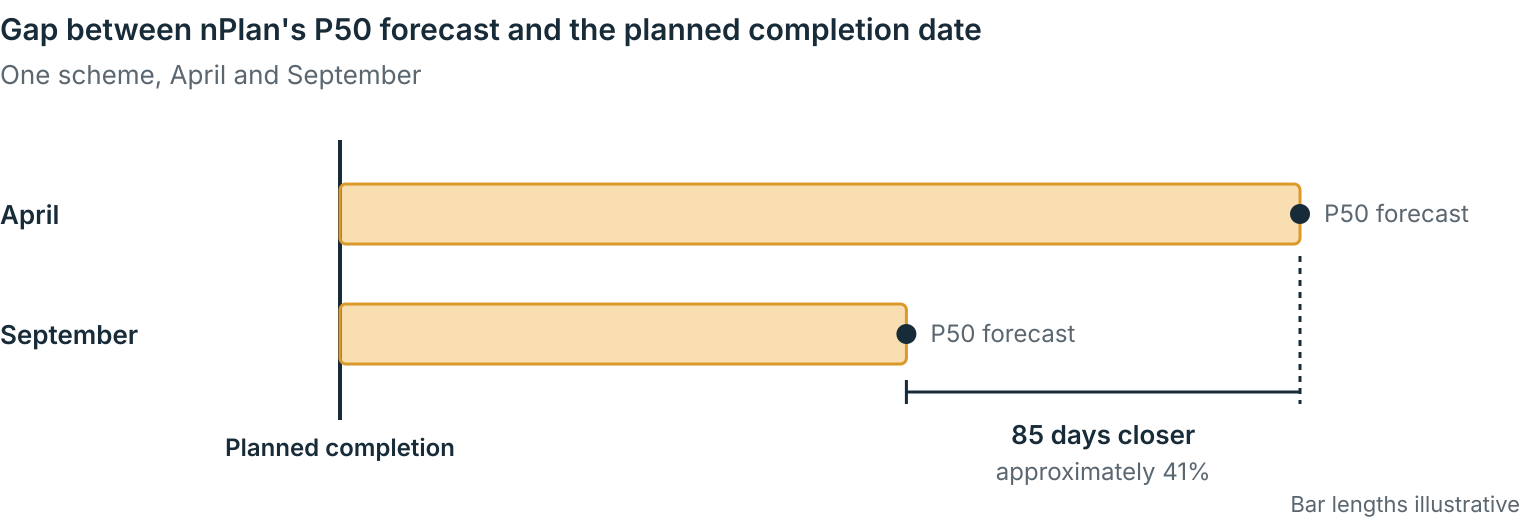
On the scheme with the £6m penalty at stake, the gap between nPlan's P50 forecast and the planned completion date narrowed by 85 days between April and September, a reduction of approximately 41%, while the company and its contract partner worked through the issues the analysis had raised.
The company's planners now use nPlan outputs to lead programme discussions with the delivery teams and use Barry to produce monthly reports on their schemes in minutes rather than days, while project teams continue to revise programme logic and agree mitigations based on what the analysis shows.
Clause 32 reviews that used to take up most of the two-week window now take a fraction of the time in Insights, which gives project managers time to discuss changes with the contract partner and agree mitigation before deciding whether to accept a programme.
The same approach is now being used on other schemes in the portfolio. On one of them, an activity that nPlan had identified as high risk went on to become the actual critical path, and the project team now uses nPlan's criticality rankings to decide which activities to escalate and where to focus their effort.
Across the portfolio as a whole, every scheme is now checked each month, compared with the 2–5% the controls team could previously cover by hand. Schemes that would once have gone unexamined for months now have a current forecast, so risk becomes visible while there is still time to act on it.
What this means for the business
For the company's senior leadership, the value of nPlan comes from two places: the penalties it helps the business avoid, and the cost of assuring a portfolio of this size.
Every scheme with a time incentive that misses its regulatory date costs the company money, and the later a delay is spotted, the harder and more expensive it is to recover. On one scheme alone, a penalty of over £6m was at stake, and nPlan's forecast identified the risk with months still remaining before the regulatory date, which gave the company and its contract partner time to rework the programme instead of discovering the problem when it was too late to change the outcome. With the same monthly forecast now running across more than 200 schemes, the company has an early warning on every scheme where revenue is at risk.
Reaching that level of coverage by hand would require a far larger planning team, at a time when experienced planners are scarce and expensive. With nPlan, the existing controls team can assure the whole portfolio each month and concentrate its effort on the schemes the forecast shows to be most at risk, while project managers can test contract partner programmes themselves before accepting them and have greater confidence that completion dates will be met.
Because delivery confidence across the capital programme is now reported from an independent forecast of every scheme, rather than from the dates contract partners have planned, leadership can decide where to intervene with evidence to support each decision, and the company has stronger assurance over both the programmes it accepts and the delivery progress it reports to the regulator.
Sources
- Building, “How prepared is the water industry for its biggest ever investment programme?”
- Slaughter and May, “Ofwat publishes PR24 Final Determinations”, December 2024
- Ofwat, “PR24 cost change process: price control deliverables appendix”, August 2026
- PA Consulting, “The deliverability divide”
- Envirotech Online, “Is AMP8’s uneven start putting excess pressure on the monitoring supply chain?”, May 2026
- Envirotec, “Water sector needs to think differently about its urgent skills gap, says CIWEM report”, October 2025