
Earned Value Management (EVM) vs. nPlan
This blog explores the critical differences between EVM and nPlan, breaking down why AI-driven forecasting is a game-changer for project controls and how it empowers teams to make proactive, data-driven decisions.
.jpg)
Project controls exist to track past performance and predict future outcomes. Earned Value Management (EVM) has long been the industry standard for forecasting project performance, but its methodology is rooted in extrapolating future outcomes based on that project's past performance. nPlan, on the other hand, uses a large dataset of past project schedules and Predictive AI (in the form of Machine Learning) to forecast and de-risk capital projects.
This blog explores the critical differences between EVM and nPlan, breaking down why AI-driven forecasting is a game-changer for project controls and how it empowers teams to make proactive, data-driven decisions.
How EVM Works: The Traditional Approach
EVM is a performance measurement technique that integrates cost, schedule, and scope to assess project progress. It calculates schedule and cost variances based on planned versus actual performance, offering deterministic insights into how a project is tracking against its baseline.
EVM provides a snapshot of project performance, but it assumes that past trends will continue, which is where its limitations become evident.
How nPlan Works
nPlan flips traditional project forecasting on its head. Instead of using a single project’s history to predict its future, nPlan leverages a dataset of over 750,000 project schedules to generate probabilistic forecasts, accounting for risk, uncertainty, and systemic trends that EVM simply cannot detect.
By understanding patterns across thousands of projects, nPlan provides a dynamic, forward-looking approach that highlights high-risk activities, identifies the true critical and subcritical paths, and offers probabilistic confidence levels for achieving key milestones.
nPlan vs. EVM: Key Differences
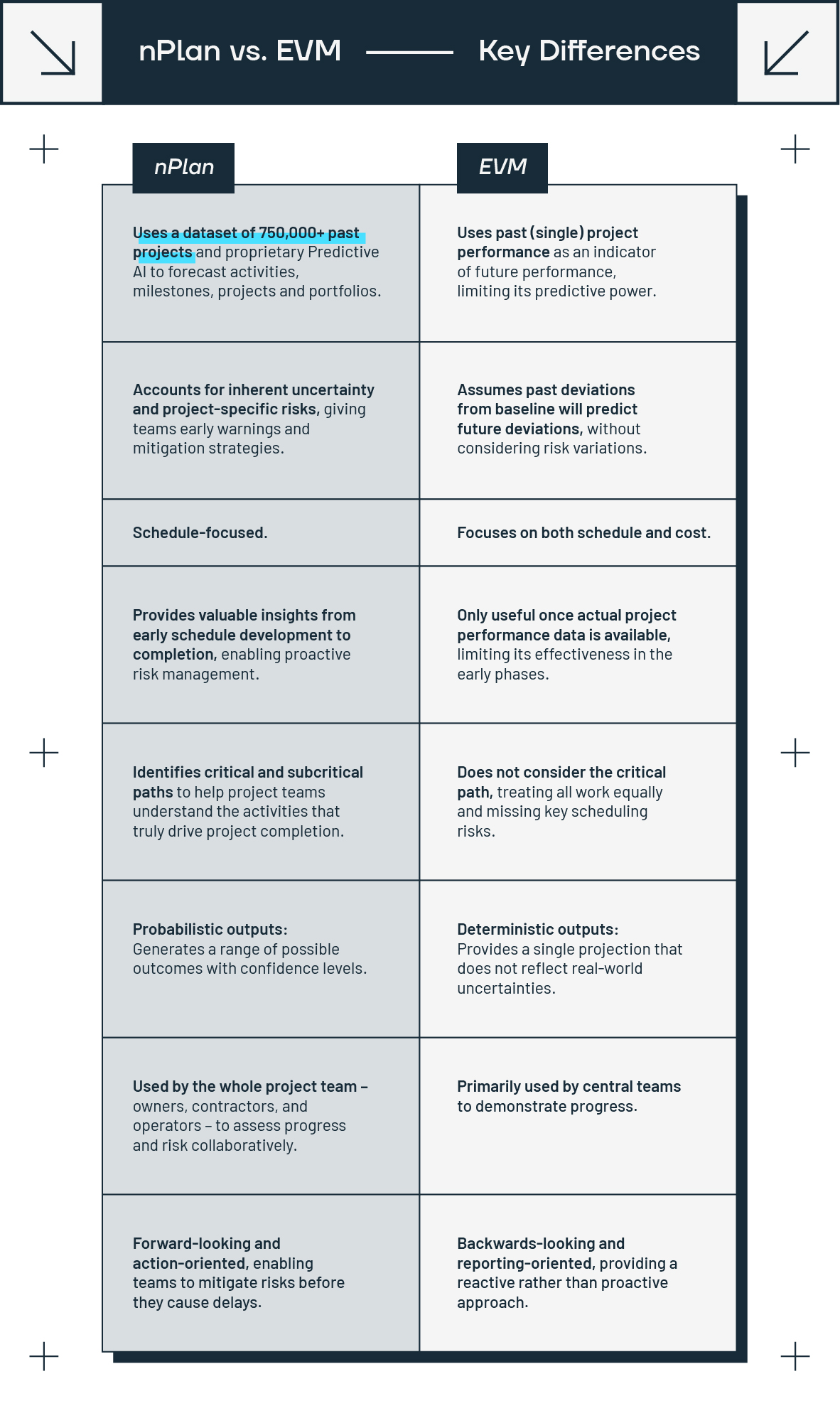
Conclusion: The Shift from EVM to AI-Driven Project Forecasting
EVM has played a valuable role in project controls in providing a measure for what has already happened. Nevertheless, its reliance on past performance as a predictor of future outcomes is no longer sufficient. As project complexity increases, organizations need a forecasting tool that is data-driven, forward-looking, and action-oriented. nPlan offers the next evolution in project risk management, providing AI-powered insights that allow teams to de-risk schedules, improve decision-making, and ensure projects are delivered on time.
The future of project controls is not just about tracking what has happened—but about anticipating what will happen and taking action today to change tomorrow’s outcomes.
If your team is still relying on EVM, it’s time to embrace a smarter way of working.
---
Want to learn more? Get in touch with us to see how nPlan can transform your approach to project forecasting and risk management.

.png)

.png)


