Forecasting the Future: Chevron’s Big Bet on AI for Project Success - Part I

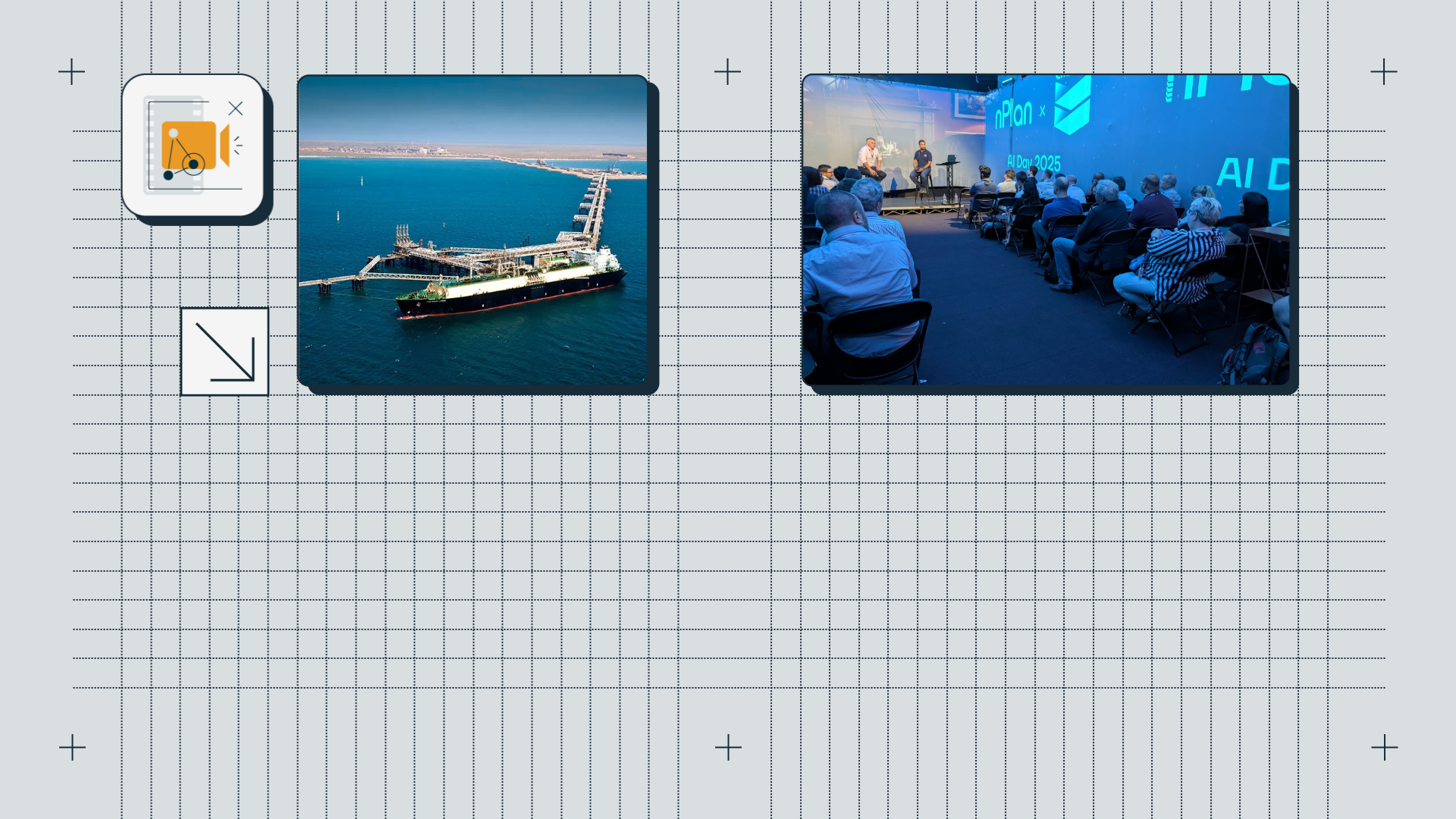
This is the first in a four-part series pulling highlights from a conversation between nPlan CEO and Co-Founder Dev Amratia and Craig Evans, Senior Execution Advisor for Capital Projects at Chevron. The two spoke live on stage at nPlan AI Day 2025, held in London this past June, about how–and why–Chevron is engaging with AI for project controls and delivery.
Craig Evans has been with Chevron for an impressive 35 years, all of it working on the company’s biggest capital projects, which range from $1 billion to $45 billion in value. Chevron is what’s known as a vertically integrated energy company, meaning it does everything from finding oil and gas, to refining it, to selling it at the pump. These days, the company is also putting serious investment into the energy transition, with projects in hydrogen, blue ammonia, carbon capture and storage (CCUS), and other emerging low-carbon technologies. With a presence in 180 countries and an annual capital budget of roughly $14–16 billion, Chevron operates on a scale that’s hard to wrap your head around.
That scale and complexity is exactly what Craig Evans brought to the stage at AI Day 2025, nPlan’s annual showcase of AI in project delivery. After decades steering Chevron’s biggest projects across multiple continents, he now focuses on making investment decisions sharper, delivery more predictable, and AI a practical part of the company’s toolkit. His mix of hands-on project know-how and formal study in AI at Oxford gave the conversation a rare mix of realism and forward thinking.
“It Keeps Happening Again and Again”: Breaking the Cycle in Project Delivery
When Dev asked Craig about the delivery challenges Chevron faces, he didn’t sugarcoat it:
We know we’re not doing a good enough job at the moment in delivering capital projects… we don’t hit cost, we don’t hit schedule… a lot of the time we don’t even hit operability and quality metrics. So, something needs to be done differently.
WATCH:
Craig’s bluntness is telling - he’s not dressing up Chevron’s challenges in corporate language. His admission that “we don’t hit cost, we don’t hit schedule… we don’t even hit operability and quality metrics” is an acknowledgment that these problems aren’t isolated events, they’re recurring patterns. That repetition matters: it suggests the root issues aren’t about individual projects going wrong, but about systemic weaknesses in how the industry delivers capital projects.
The examples he gives: complex global supply chains, remote project locations, high inherent risk, and multi-stakeholder alignment, reveal just how fragile these undertakings can be. Even the comparison to HS2’s challenges hints at a universal truth in major projects: whether the “stakeholders” are governments or commercial partners, misalignment and competing priorities slow things down and raise costs.
The phrase “it still keeps happening again and again and again” is almost an industry confession. Despite decades of lessons learned, the same delivery pitfalls persist. What’s different this time is Chevron’s response: leaning hard into AI, with buy-in from senior leadership right up to the CEO. That’s more than just tech adoption - it’s a cultural shift, signalling that the company is willing to rethink its approach to break free from cycles that have defined oil and gas megaprojects for decades.
Can You Be Fast and Reliable? Chevron Thinks So
So why is Chevron betting big on AI? As Craig explained later in the conversation, it’s about finding a way to be more competitive without trading off predictability. Let's watch:
Craig’s comments make it clear that for Chevron, capital project delivery isn’t just a performance metric - it’s existential. Oil and gas reserves are finite, so the company must keep delivering new projects just to stay in business. If it doesn’t, it can’t pay shareholder dividends, maintain competitiveness, or even remain viable in the long term.
By calling out competitors like Exxon and Shell, Craig frames this as a zero-sum game. The challenge isn’t just to improve internally, it’s to outpace industry peers who are running just as hard.
And yet, he’s candid about the industry’s tendency to treat symptoms rather than causes. When schedules slip, the reflex is to pad them - to add more time into activities or reserves into the plan - but as Craig admits, “the results didn’t really change.” That’s because the root causes - poor forecasting, blind spots in risk identification, and a planned-critical-path-only mindset - were never addressed. His point about the ‘myopic’ attention paid to a project’s planned critical path is a subtle but important critique: by focusing on the deterministic at the expense of the probabilistic, teams ignore other chains of work that can quietly become the real drivers of delay.
Craig also links predictability directly to Chevron’s reputation, market access, and even geopolitical standing. A poor delivery record can shut the company out of future projects or countries entirely - a reality that adds pressure far beyond project KPIs.
Against this backdrop, Craig’s belief that it’s possible to have both competitiveness and predictability is telling. It’s not a throwaway line - it’s the core bet behind Chevron’s embrace of AI. If AI can give the company a clearer picture of real risks before they happen, and the confidence to stick to a plan without over-padding for uncertainty, it could break a decades-long trade-off the industry has learned to accept.
Not Built Here? That’s the Point — Why Chevron Partnered with nPlan
When Dev asked why Chevron chose to work with nPlan, Craig cited three core reasons, as you can see in the next (and final clip):
Craig’s explanation of why Chevron partnered with nPlan reveals a few deeper truths about how large industrial companies adopt new technology. First, there’s the self-awareness to admit what Chevron isn’t. Despite its long history of high-tech engineering—especially in drilling and subsurface analysis—AI simply wasn’t part of its core skill set. For a company that prides itself on building in-house, that’s a cultural shift in itself: recognising that some capabilities are best brought in from outside.
Second, Craig points to a major gap in the industry’s approach to risk: too much of it is still based on opinion and anecdote rather than evidence. In a typical schedule risk assessment, people estimate based on what they “think” is likely, informed by selective past experience. The result is that critical risks can be missed entirely. nPlan’s dataset—drawn from hundreds of thousands of real-world projects—offers Chevron a way to challenge those gut instincts with hard evidence.
Third, Craig frames nPlan not just as a technology vendor, but as a “supplier-led solution.” That’s a subtle but important distinction: in megaprojects, companies often rely on suppliers for physical assets (equipment, materials, specialist services), but here Chevron is treating AI capability in the same way. It’s an acknowledgement that delivering better outcomes isn’t just about adopting tools - it’s about bringing in partners who have already solved similar problems elsewhere.
Finally, he notes that nPlan’s team doesn’t just understand AI - they understand projects. That blend of domain expertise and technology capability means Chevron isn’t starting from scratch in translating business problems into technical solutions. For Craig, that’s what made the partnership credible from the start.
Chevron’s challenges are huge, but so is its appetite for change. In this first part of our AI Day 2025 blog series, we’ve looked at the problems the company is trying to solve and why AI is central to its plan. In part two, we’ll dive into early case studies showing how Chevron is already putting nPlan to work — and what’s happened so far.


