No time to stand and stare - revisiting AI-led forecasting and risk management on the Transpennine Route Upgrade: Part I
Valuable insights and interesting tidbits from nPlan's recent webinar with Richard Palczynski, Chief of Staff at TRU, and Mike Ellis, PMO Head of Risk at TRU - a two-part blog series.

A few months ago now (October 31 last year, to be precise), nPlan hosted a webinar spotlighting the £10.7 billion Transpennine Route Upgrade (TRU) - one of the most ambitious rail upgrade programmes undertaken in the UK in recent decades. Our generous guests for the webinar were Richard Palczynski and Mike Ellis, Chief of Staff and PMO Head of Risk at TRU respectively.
The webinar was one of the most successful we’ve ever run, with nearly 200 project professionals joining the live stream, and many more catching up via our on-demand service in the weeks after the recording was made. Furthermore, feedback on the conversation from the project controls community was almost universally positive.
However, as nPlan’s Marketing Lead, my mind was rather too taken up with producing the webinar to absorb and reflect on what was said. The rest of the quarter was incredibly busy and included preparing a further webinar with Anglian Water–marketers at fast-growing AI companies have ‘no time to stand and stare’–and it’s only recently that I’ve had the chance to watch the TRU webinar back and appreciate how many valuable insights and interesting tidbits it contained.
With that in mind, here's Part I of my review of thehighlights, curated for the project professionals out there who are also lacking the ‘time to stand and stare’ (which seems to be most of you). I hope watching these clips will encourage you to go and watch the whole webinar to put the selections I’ve made into context. Anyway, without further ado, let’s dive in…
Delivering value when you’re spending £2,000,000 per day
We’re in a situation at the moment where we’re spending something mad like two million pounds a day. When you’re talking about those kind of numbers and then you compare it to the wider world of…nurse’s salaries and pay disputes…it really focuses the mind on ‘are you spending the money wisely?’
With introductions to the speakers and the project out of the way, webinar host (and nPlan CEO) Dev Amratia asked Richard Palczynski, Chief of Staff at TRU, to describe the programme’s approach to delivering value. Here was his response:
In order to make sure we’re delivering the right kind of benefit, you have to have a really robust plan in place. That plan means doing the most amount of work in the least amount of time to cause the minimum amount of disruption…We do a phenomenal amount of benchmarking and assurance; we’ve tested our plan over and over and over and over again.
As Richard makes clear, having a detailed plan which has been stress-tested from a number of angles is absolutely critical to both TRU’s delivery of economic value and ensuring taxpayer cash is effectively spent.
“The schedule is king.”
It sounds straightforward enough. But as Richard goes on to say, sticking doggedly to a plan of this complexity is easier said than done. Here he is talking about that specific challenge:
That is the main headache. Protecting the plan, monitoring what’s going on and making sure that our performance is hitting target, period in, period out. And having a look at the escalation of risk, or hopefully the de-escalation of risk as we approach these critical milestones along the route.
Traditional QSRA versus AI-led Schedule Risk Analysis (AI-SRA)
But how does TRU actually monitor what’s going on and look at the evolution of programme risk during delivery? It turns out that one of the key methods used by the project team is AI-led Schedule Risk Analysis - AI-SRA for short - which is where nPlan comes in.
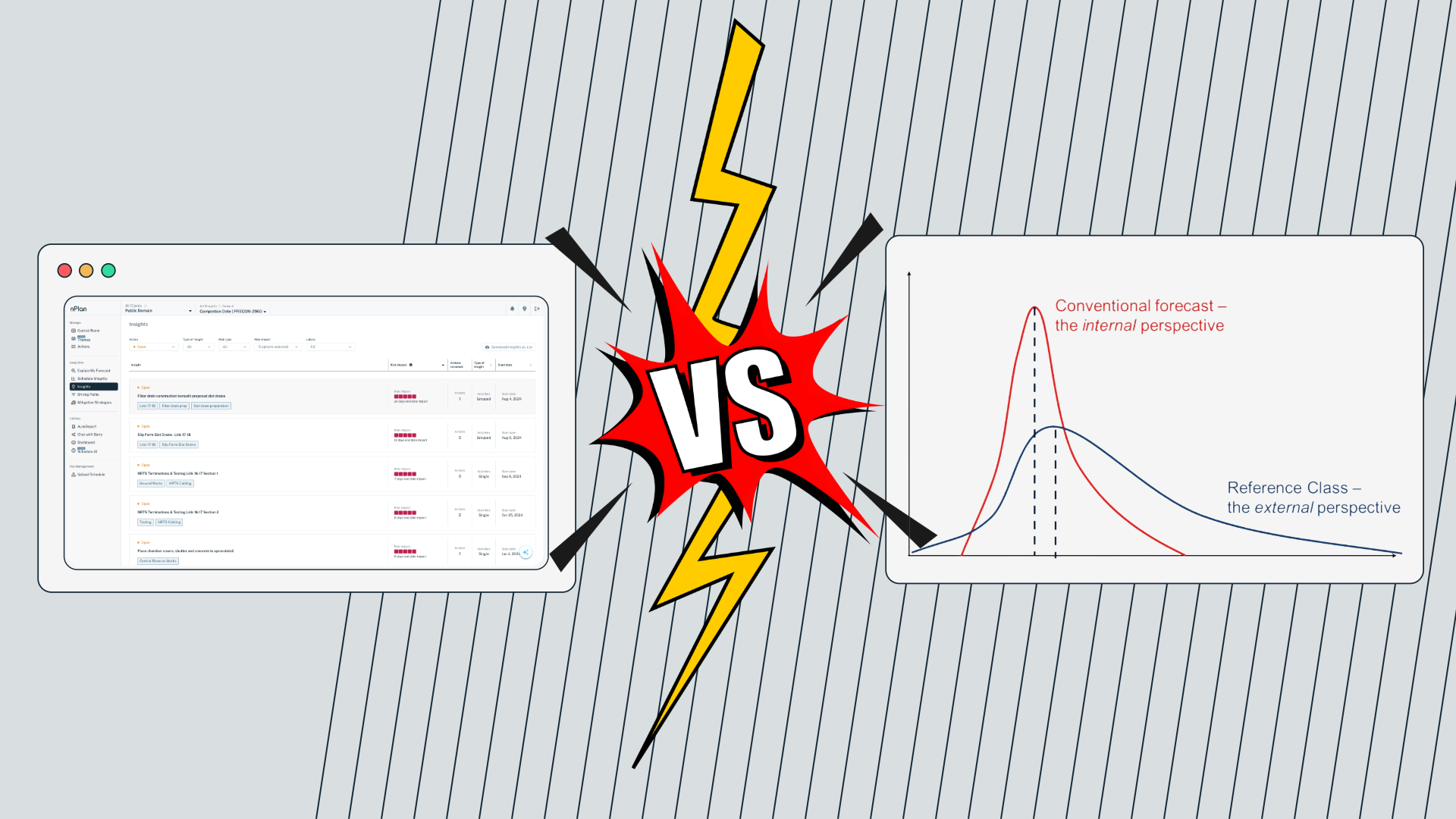
Whereas a traditional QSRA for a large programme can take up to 6 months to complete, inevitably ends up focusing more on quantifying than mitigating risk, and is hopelessly hamstrung by human biases, AI-SRA uses AI and a large dataset of past projects to perform quantification in minutes, neutralising the influence of bias and enabling the project team to focus on proactive risk mitigation.
That’s our take, anyway, which you can read more about by downloading our white paper, From QSRA to AI-SRA: The future of project controls is here - but here is what Richard and Mike from TRU had to say about the pros and cons of AI-led Schedule Risk Analysis:
The one thing that I really loved about this was to use an application that cut out all of that human bias and provided something to put on the table with real evidence for teams to then go discuss.
When we do traditional QSRAs, we tend to have a rolled up schedule. So it's at least a level two schedule. What we can also do, as well as running the nPlan analysis on the level two is run it on the more detailed level three and therefore you've got the additional level of detail of all those smaller activities.
That's it for part I of this recap - in Part II we'll be finding out how TRU uses AI to ensure track possessions start and finish on time, how Rich and Mike are making use of a project controls AI agent, and why it takes a 'lone nut' to drive adoption of AI-led solutions. If you can't wait for Part II, you can head to our webinar platform to watch the full conversation with Richard and Mike, right here.