From Gravity Hazards to Cyclone Recovery: Chevron's Big Bet on AI for Project Success - Part II

This is the second in our four-part blog series drawn from a live conversation between nPlan CEO and Co-Founder Dev Amratia and Craig Evans, Senior Execution Advisor for Capital Projects at Chevron. The discussion took place live on stage at nPlan AI Day 2025 in London.
In part one, we explored the challenges Chevron is tackling with AI. Now we turn to the fun part - how teams are actually putting it to work in the field, improving both the predictability and competitiveness of large-scale energy projects. Let's dive in.
Barry Gets to Work: Smarter Contracts and Safer Sites
When Dev asked Craig to share some of his early experiences with nPlan, his first examples were all about Barry—nPlan’s AI project controls assistant—and just how versatile it becomes when it’s plugged into the right project data:
Craig began with a straightforward test: loading schedules and contract terms into nPlan Insights and asking Barry to identify who was responsible for delays. The answers came back instantly - owner, contractor, etc. - but then Craig flipped the logic. Instead of analysing delays after the fact, what if Barry was given a tender submission before a contract was issued and asked: Which clauses should we change to protect Chevron from the cost of delay? Barry didn’t just highlight the risky clauses; it also suggested alternative wording. It wasn’t intended to replace legal review, but it gave the team an immediate head start and a clear direction - something that could take days of manual review otherwise.
Then came a more unconventional use case, one with direct safety implications. Chevron’s “hazard wheel” lists 10 significant site hazards, from pressure and chemicals to gravity and electricity. Craig asked Barry to scan the schedule for activities over the next three months that could be affected by gravity hazards. Barry returned a list that went beyond the obvious (lifting operations) to include trench backfilling - a less obvious but equally relevant risk. The insight was compelling enough that Chevron’s HES lead wanted safety analysts embedded with the project team using Barry.
These examples show the real advantage of Barry once it’s given access to a project’s full data set: it can connect dots across disciplines - from contract risk to on-site safety - in ways that humans might miss, and do it in seconds. It’s not just a productivity tool; it’s a decision-support system that strengthens both commercial protections and worker safety.
From Work Packs to Phase Gates: How Schedule Studio Builds Plans for Chevron in Minutes
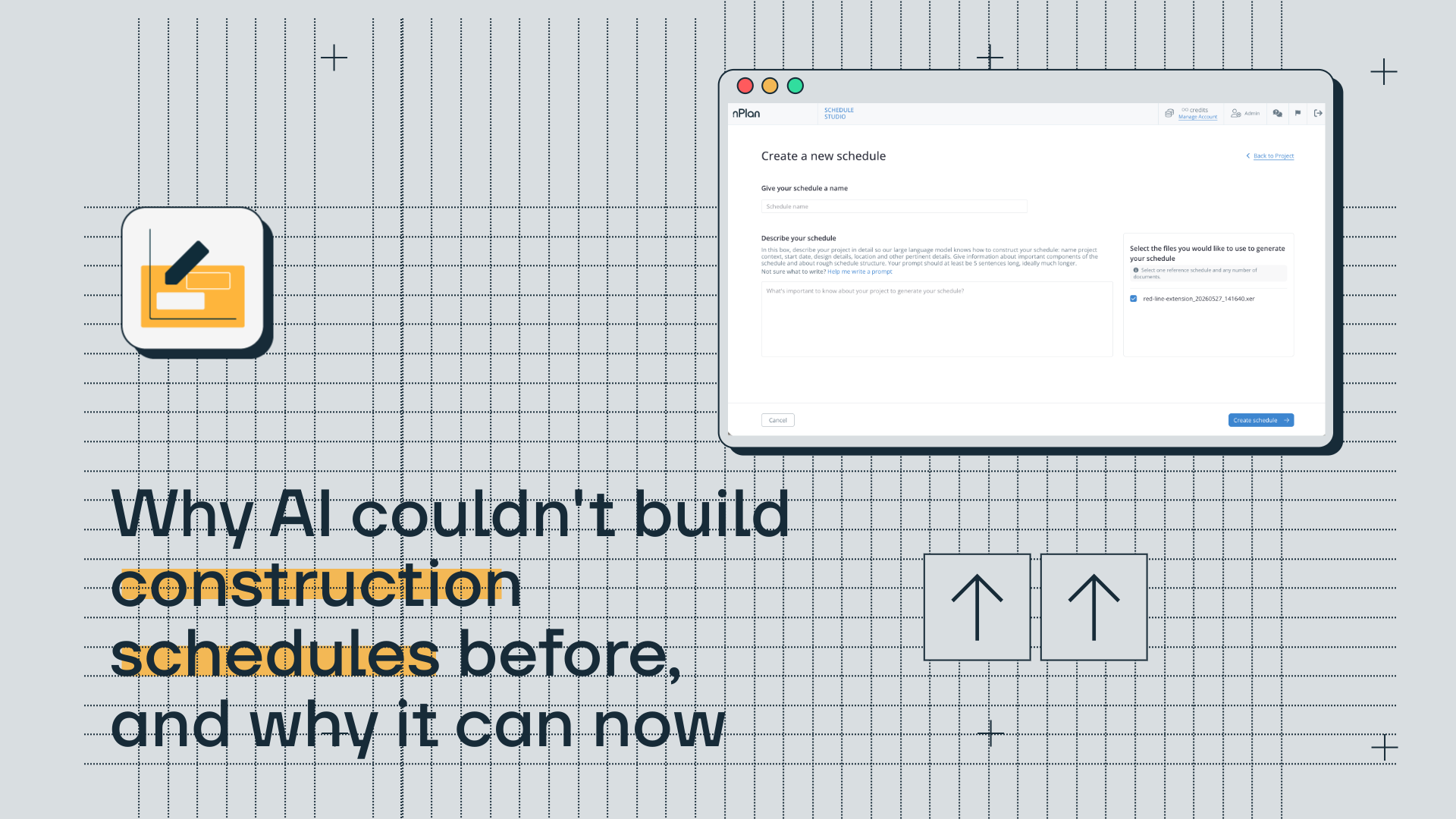
From there, Craig moved to Schedule Studio, nPlan’s tool for generating schedules directly from project documents. He’s used it for something as small as an individual work pack, generating a standardised process plan from just the description, and for something as complex as a “fishbone” diagram for systems completion on a large LNG plant turnaround.
One brownfield turnaround project involved three separate shutdowns. Schedule Studio not only spotted them but sequenced all the necessary pre- and post-turnaround work. And in a telling moment, Craig described how the tool had “learnt” Chevron’s governance process. Even when feeding it documents that didn’t mention the company’s phase-gate stages - IID (Initial Investment Decision) and FID (Final Investment Decision) - the AI automatically inserted them into the generated schedule. This wasn’t a hardcoded feature; it was pattern recognition from earlier interactions, showing how quickly the technology adapts to a client’s specific requirements.
This is where AI starts to feel less like an off-the-shelf product and more like a partner that understands your organisation’s way of working - without having to be told every single time.
Cyclone Chaos Meets Data-Driven Recovery
The third example came from a remote project in northwestern Australia. After three cyclone-related rain events dumped 180mm of water in a day (in a region that normally gets 300mm a year), the team faced a tough call: focus recovery work in Area A, Area B, or split resources between them? Using the Mitigation Scenarios feature in nPlan Insights Pro, they ran the options, tested mitigations, and chose the strategy that recovered the most schedule.
They went further. With the contractor losing electrical resources, they modelled the impact of a 20% cut - the AI predicted a 25% increase in duration, three to four weeks’ delay. Next came a trade-off analysis: if both backfill and electrical resources were cut by 10%, which would hurt more? The answer (backfill was more critical) meant they could protect the schedule by making cuts in the less time-sensitive discipline.
This is where competitiveness and predictability work hand in hand: using data to decide not just how to recover time, but how to do it without destabilising the plan.
The Bigger Picture: AI in Action at Chevron
These aren’t abstract “what AI could do someday” stories. They’re real teams using AI to make decisions faster, with more confidence, and in ways that improve both competitiveness and predictability right now.
A few themes stand out:
- Proactive risk management - From rewriting contract clauses to embedding safety analysts before incidents happen, AI is shifting action from reactive to preventative.
- Adaptability to company context - Schedule Studio’s ability to “learn” Chevron’s governance gates is a glimpse of AI systems tailoring themselves to an organisation’s DNA without explicit programming.
- Data-driven trade-offs - The cyclone project resource scenarios are a perfect example of competitiveness and predictability working together: choose the option that recovers the most time without compromising the stability of the plan.
- Cultural shift - These experiments are coming from the field, not just corporate innovation teams. That signals AI is starting to be seen as a practical, everyday tool in Chevron’s project playbook.
Part three of this series will be a deep dive on Craig’s background and how he’s working within Chevron - join us next time to learn about the making of an AI champion.
.png)