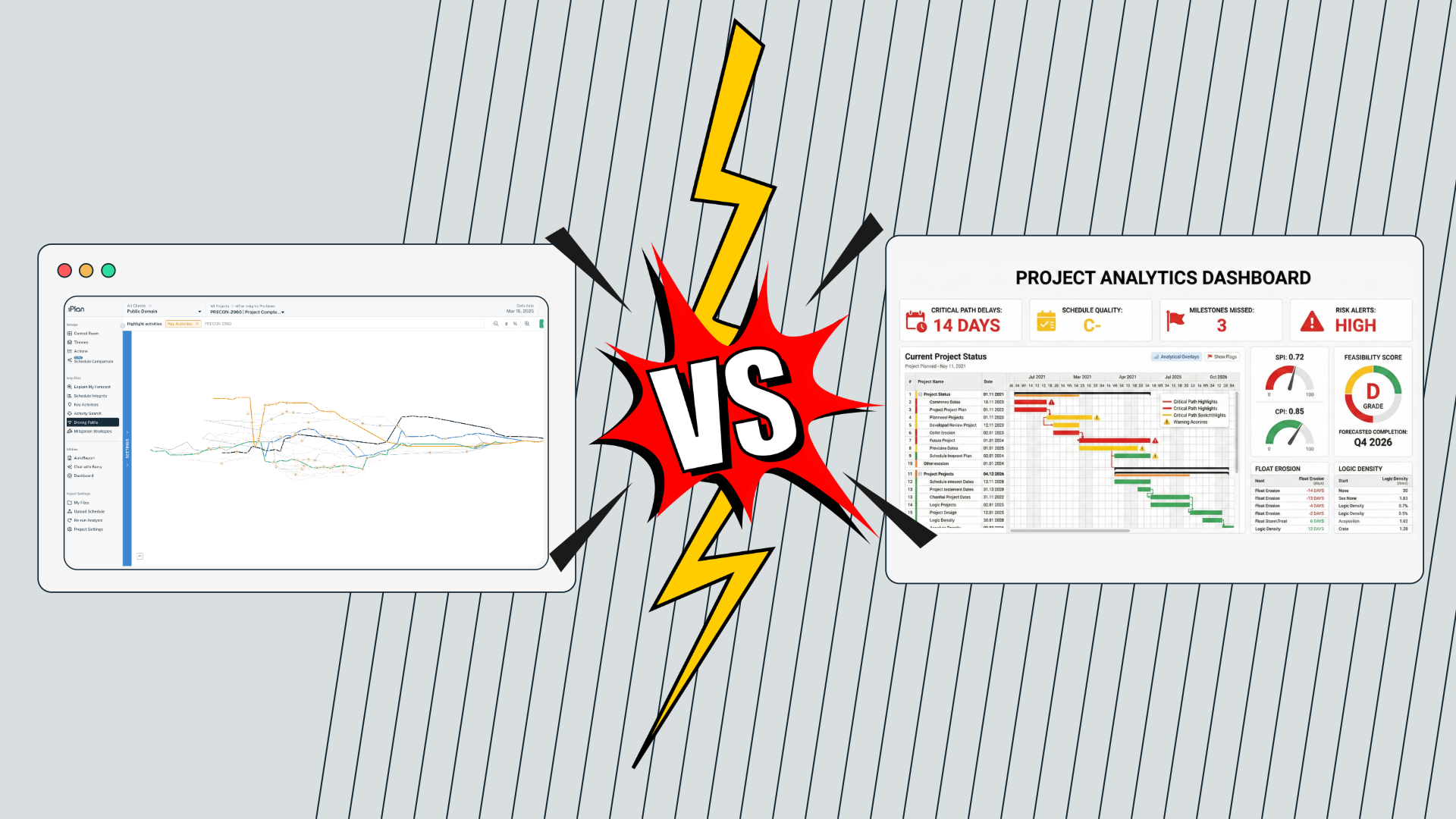
Schedule Analytics vs nPlan
A guide to the differences between Schedule Analytics and nPlan’s AI-driven Schedule Risk Analysis (AI-SRA). Learn how to differentiate between the two and which works best for your projects and objectives.
.jpg)
If you work in project delivery or project controls, you’ve probably heard about a new generation of schedule analytics platforms, tools like SmartPM and Nodes & Links that sit over your planning system and produce dashboards, KPIs, and health indicators.
To the untrained eye nPlan and these technologies can look similar. They all ingest schedules, they all talk about “risk and insight”, and they all use “AI” somewhere in their stack. But they exist for different reasons, respond to different problems, and offer very different types of value.
At a high level, the difference can be summarised simply:
Schedule analytics tools ask: “Is this schedule well-structured, well-maintained, and under control?”
nPlan asks: “How is this project most likely to unfold, based on how similar projects actually played out?”
Schedule analytics evolved to improve planning discipline and visibility. nPlan exists because delivery outcomes depend on more than schedule quality alone.
nPlan vs Schedule Analytics: Key Differences
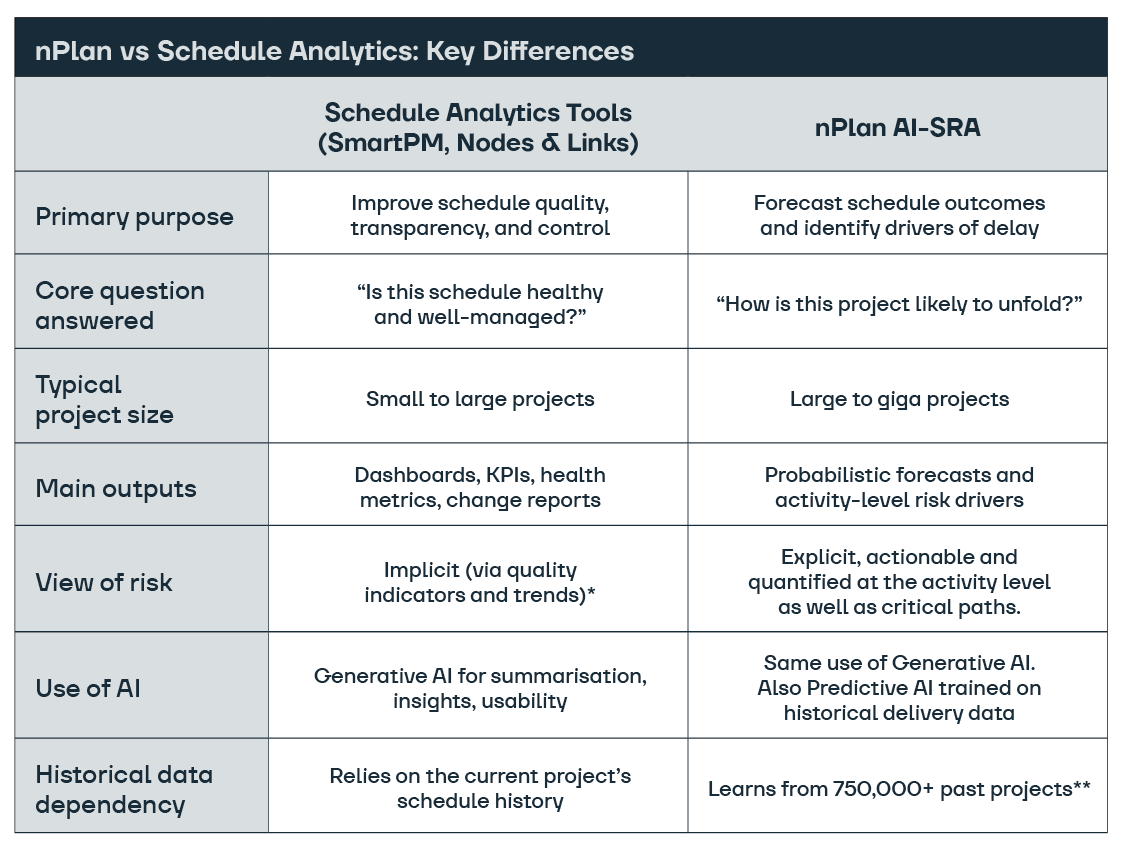
*Nodes & Links does have a QSRA module similar to traditional risk software, so it will rely on biased human inputs. Learn more about nPlan vs traditional risk software.
**nPlan’s core dataset for our forecasting engine consists solely of schedules. These are nPlan’s patented forecasting models, built by NERD. But today, depending on the engagement, we ingest additional documents to enhance outputs, such as risk registers, contracts, and cost reports etc.
How these tools fit together
Schedule analytics tools emerged to solve a very practical problem: as projects progress, this progress becomes hard to update, to track, and therefore harder to trust. Logic degrades, constraints accumulate, changes are difficult to track, and leadership loses confidence in whether the plan still reflects reality. Tools like SmartPM and Nodes & Links address this by sitting over the planning system and continuously assessing schedule quality, change, and control. They help teams see whether the schedule is being updated correctly, where structural issues exist, and how the plan is performing against recognised KPIs.
What these tools do not primarily do is forecast delivery outcomes or suggest the most effective ways to realise them. They are designed to describe the schedule as it exists today, highlight quality issues, and explain how it has changed over time. Even where probabilistic outputs are considered, they are driven by biased human input and only the current schedule structure alone. As a result, they offer limited insight into how likely the project is to finish on time, where delays are most likely to emerge, which activities are most likely to drive those delays, or what to do about it.
This is where nPlan comes in. nPlan was built to answer a different question. Instead of asking whether a schedule is well controlled, it asks how the project is likely to unfold given the schedule's structure and patterns learned from hundreds of thousands of past projects. The schedule becomes an input to a multi-faceted predictive model rather than the object being assessed. By learning from real delivery outcomes across 750,000+ projects, nPlan produces probabilistic forecasts and identifies the specific activities that matter most to the eventual completion date. The result is not better visibility into the plan, but greater confidence, empirically tested and proven, in what is most likely to happen next.
The “AI” confusion and what it really means
One of the biggest reasons people mix up these tools is that they all use the word “AI”. Any product released after 2025 will include AI. So it’s not really a selling point anymore.
- Schedule analytics platforms increasingly use generative AI to summarise metrics, highlight anomalies, or make dashboards more user-friendly. That can be genuinely useful for planners, especially when preparing reports or explaining trends to stakeholders. nPlan also does this with the help of Barry.
- nPlan uses predictive AI, meaning the model has learned from historical project delivery outcomes to forecast what is most likely to happen next, given the structure and context of your schedule.
A simple API call to GPT with a clever system prompt lets you say your product has AI in it.
How executives should think about the choice
Both schedule analytics tools and predictive schedule risk tools play a role, but they are not usually direct substitutes for one another.
If your organisation is focused on:
- Improving planner productivity
- Monitoring schedule health
- Building governance and early warning dashboards
then schedule analytics platforms are often the best fit.
If your organisation is accountable for delivery outcomes on major programmes where cost, time and strategic risk are material to the business. Then predictive forecasting becomes essential. We typically see AI-SRA flourish in these environments:
- Schedules evolve rapidly
- Risks emerge continually
- Leaders need not just visibility, but confidence in what is most likely to occur
Wrapping up
Schedule analytics platforms and predictive schedule risk tools both sit above the planning system, but they do not answer the same question.
- Analytics tools help you understand and control the plan you have.
- Predictive risk analysis helps you understand how the plan is likely to perform.
One looks backwards. The other looks forward.
In modern capital programmes, both perspectives matter. It’s just important to know which problem you’re solving at any given time.



.png)


