Reference Class Forecasting (RCF) vs nPlan
A guide to the differences between RCF and nPlan’s AI-driven Schedule Risk Analysis (SRA) - and how to work out which methodology is needed for a given project phase.
.jpg)
If you’re planning a major project, some of the first questions you’ll ask are: 'how long will this take?', and 'how much will it cost?'
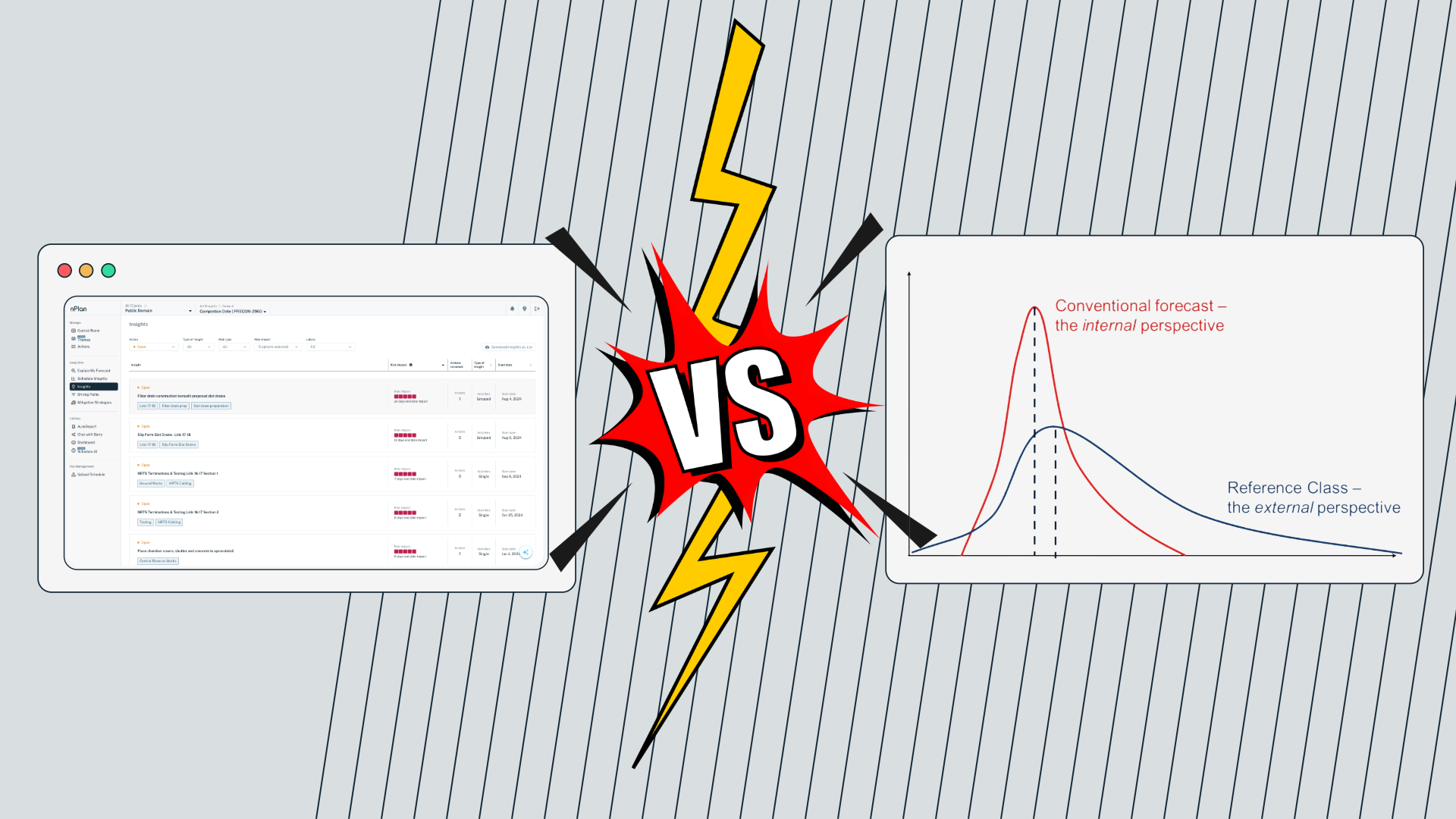
For decades, the go-to method for answering these questions has been reference class forecasting (RCF). RCF is based on large datasets of completed projects and provides a top-down view: “Projects like this tend to take X months and overrun by Y%.”
But what if you could take a bottom-up view instead? What if you could understand the actual risk in every activity, given the whole context of your specific schedule, and understand the key drivers of delay before you break ground?
This post breaks down the difference between RCF and nPlan’s AI-driven Schedule Risk Analysis (SRA), and explores when each approach makes sense.
What Is RCF?
RCF was pioneered by Daniel Kahneman and Bent Flyvbjerg to counteract planning bias. It relies on comparing your project to a dataset of completed, similar projects (a reference class) and applying a statistical uplift to your cost and schedule forecasts.
The idea is simple: if 80% of projects like yours overrun by 25%, there’s a good chance yours will too. So rather than assume everything goes to plan, you forecast based on what actually happened in the past.
Big players:
- IPA (Independent Project Analysis) is the gold standard. Many operators treat an IPA benchmark as part of the standard stage-gate process, especially pre-FID. Their dataset spans tens of thousands of projects.
- Oxford Global Projects, led by Bent Flyvbjerg and Alex Budzier, provides RCF data and guidance across infrastructure, IT, mining, and more.
Typical use case: RCF is most commonly used early in the project lifecycle, to create a realistic baseline. It’s particularly helpful when you have limited information about the project’s execution path but still need to plan and justify budgets.
The value: RCF is meant to give decision-makers a reality check. It’s a great way to sanity check optimism bias and answer the question: “Are we being too ambitious?” (John Hollman is the authority on this).
What Is nPlan AI-SRA?
nPlan takes a very different approach. Rather than starting from high-level comparisons, it dives deep into the schedule itself.
Here’s how it works:
- You upload a schedule file (e.g. Primavera P6) with all activities, durations, logic, and constraints.
- nPlan uses AI trained on 750,000+ past schedules to forecast how each activity is likely to unfold.
- It considers over 160 contextual features for each task: lag types, float, resource density, calendar logic, and more.
- The result is a probabilistic forecast of the full schedule, from the ground up.
This isn’t just a one-time forecast. nPlan can be re-run every time the schedule is updated, from pre-FID to commissioning and close out. That means teams can continuously re-analyze and action risk as work progresses.
Typical use case: While nPlan can absolutely be used early in the lifecycle (e.g. to stress test a proposed baseline or compare options), its real strength shows up in delivery. That’s when reality deviates from the baseline and new risk emerges daily.
The value: nPlan delivers fast, detailed, data-driven schedule assurance based on actual activity logic. It helps teams respond to change before delays compound. And it does this by empowering real project teams with real data driven insights.
Top-Down vs Bottom-Up: Key Differences
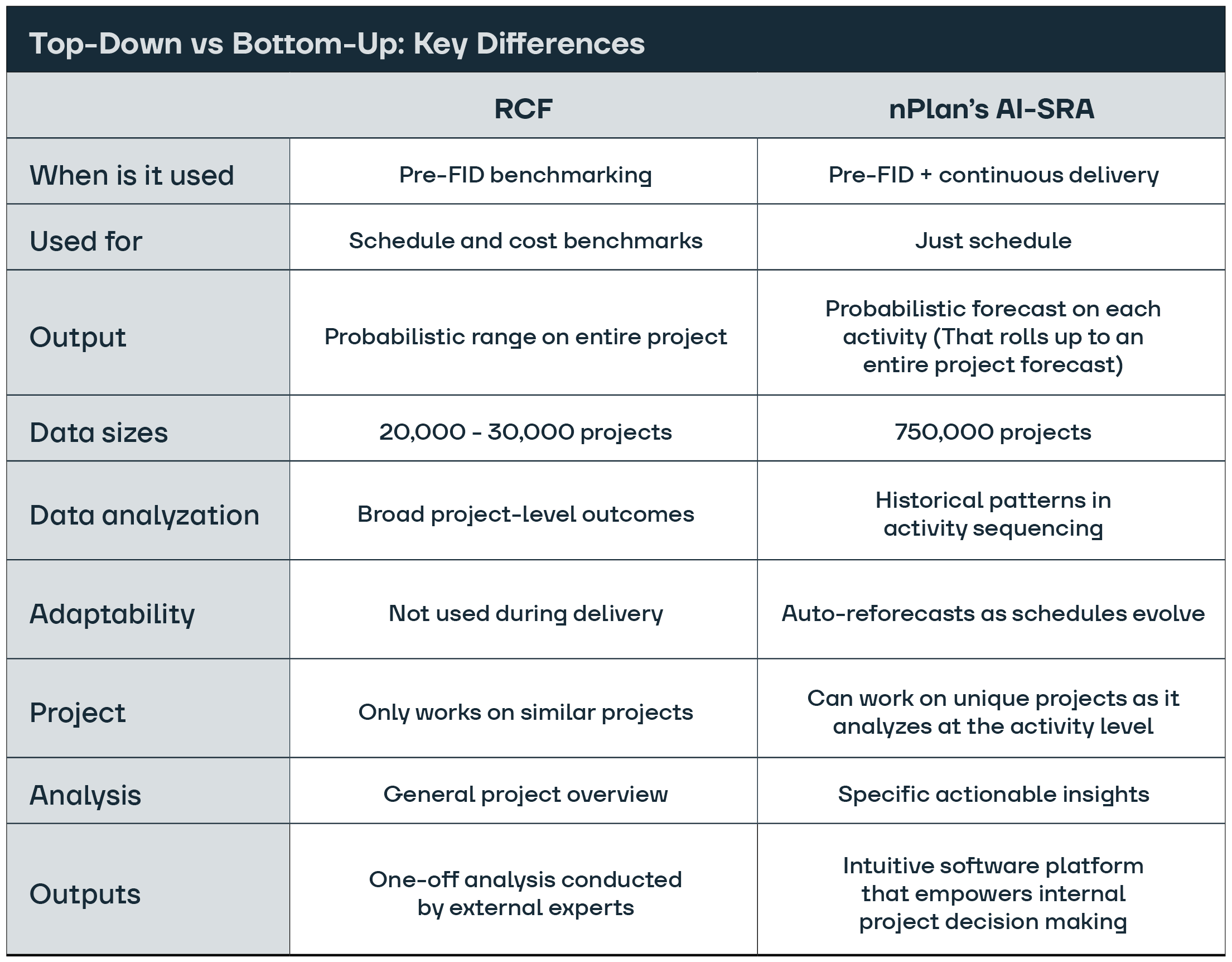
RCF answers: “How did other projects like this perform?”
nPlan answers: “Given the actual logic and context of this schedule, how is this project likely to unfold?”
When Should You Use Each?
Use RCF when:
- You’re early in the planning process and need a reality check.
- You don’t have a detailed schedule yet.
Use nPlan when:
- You have a L2 schedule at pre-FID and need more accurate assurance.
- You want to pinpoint and understand what will likely cause the delay on your project.
- Your contractor constantly changes the schedule and you need to challenge them quickly.
You don’t have to wait to use nPlan. Too often, teams delay deep schedule assurance until things go wrong. They treat RCF as a checkbox, then hope for the best. Then they get in touch 20% into delivery and there are signs of slippage already.
Why Start Sooner?
We get it, benchmarks are comfortable. They’re broad, they’re familiar, and they look official in a slide deck.
But they don’t tell you much about your schedule.
The earlier you use nPlan, the more confidence you gain in the logic, risk, and realism of your plan. You can:
- Catch weak sequences or overly optimistic durations.
- See which activities are driving delivery risk.
- Stress test alternative schedules before committing.
Additionally, nPlan is an embedded capability within your team that stays with you throughout the lifecycle of the project. A recent IPA report found that resource constrained teams experienced poorer project outcomes when they experienced staff churn. With nPlan the resource constraints are lessened and the continuity of knowledge and capability within the team maintained.
Wrap-Up
RCF and benchmarking have an important role to play in early project assurance. They set the stage. They challenge optimism. And they’re part of the DNA of project controls in many sectors.
It’s time we stop treating forecasting as a one-and-done exercise. The best project teams are moving toward continuous assurance, and the ones who start early are the ones who stay ahead.
.jpg)