AI as a critical friend - which can't be held accountable: BCG's Sara Loureiro's AI Day highlights
A BCG partner who sees hundreds of projects a year on where AI is delivering real value, why 70% of the work has nothing to do with the technology, and why the best AI is a critical friend - not a decision maker.

Sara Roque Loureiro is a Partner at Boston Consulting Group and a member of its Operations, Industrial Goods and Climate & Sustainability Practices. She focuses on capital project management excellence across a range of industries, with extensive experience supporting capital projects here in the UK - which is to say she spends her days looking at exactly the kind of problems nPlan was built to solve.
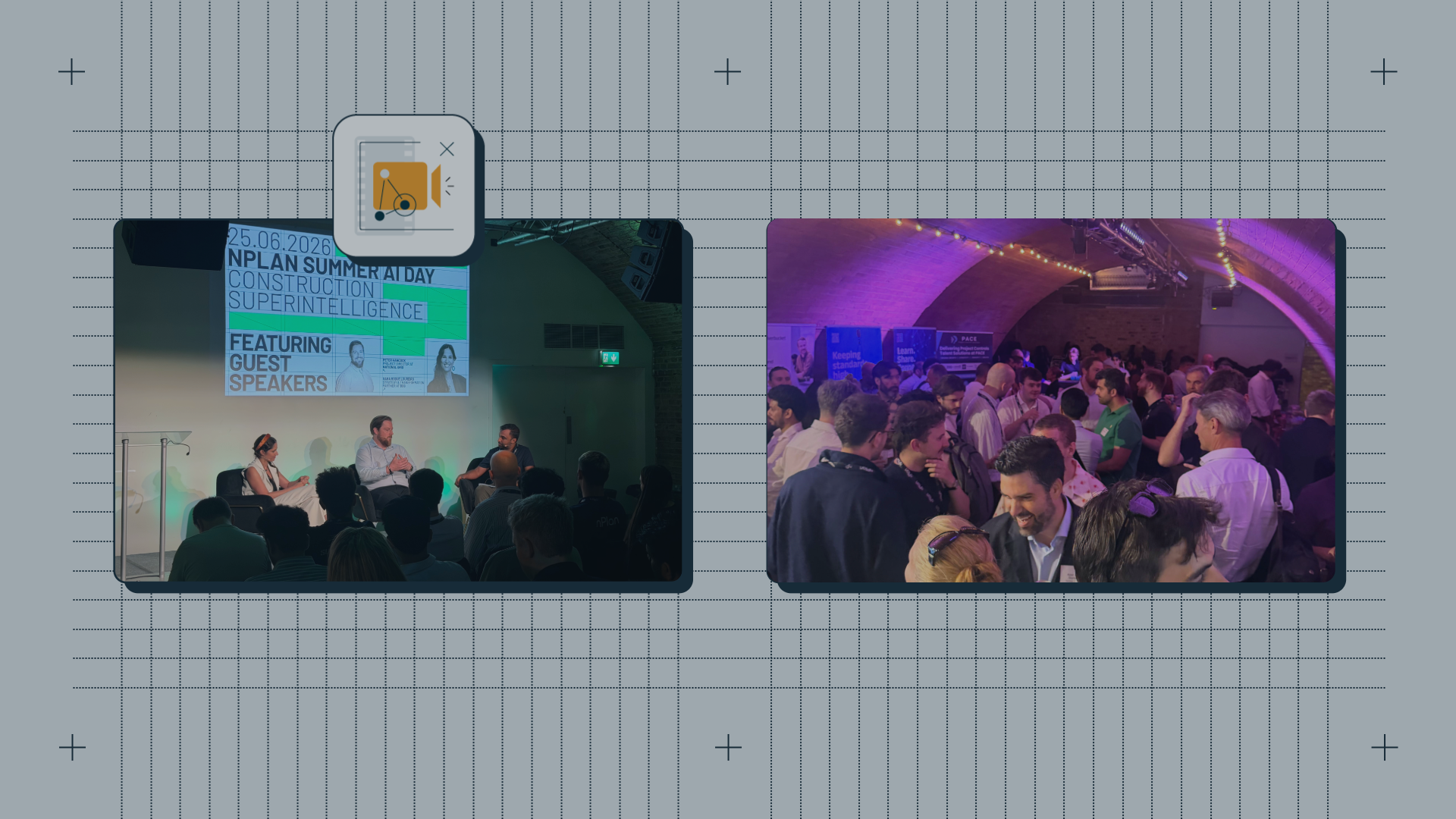
That bird's-eye view is why I was so keen to hear her speak at our Summer AI Day, which was streamed live from Kachette in London back in June. Sara spoke alongside Pete Hancock, Project Director at National Grid, during the fireside chat portion of the event; whereas Pete gave us the view from inside a single live megaproject (check out the highlights of his appearance here), Sara gave us a complementary viewpoint - the patterns she sees playing out across the whole industry. First off Dev asked her to 'lift us up a little bit' from the detail of single project delivery to the global picture...
The state of AI adoption in capital projects
Every year we do a study on AI adoption across industries, and what we see is from year to year it increases dramatically. Last year, 25% of the respondents said they were moving from pilots to scale...2026 was up to 40[%]… when we look at capital intensive industries energy, industrials, infrastructure, they were historically towards the bottom. But what we've been observing is that they are really catching up… around 50% of projects are over cost, over budget historically, and this is because of complexity, because of the huge amount of data and decision-making that's needed in a complex and fast environment.
There are a lot of datapoints floating around online regarding how well (or otherwise) large-scale projects are delivered - and so it was interesting to hear Sara benchmark the proportion of projects that overrun at 50%; nPlan's own data suggests that 6 out of every 7 large-scale projects are delivered late. It was also interesting to hear Sara talk about 'the huge amount of data and decision-making needed in a complex and fast-moving environment' as the root cause of execution failure as opposed to e.g. biases like optimism bias, recency bias, or strategic misrepresentation which we often talk about here. The good news? The problems she identifies are exactly those that AI solutions can help fix. Next, Dev followed up by asking Sara what use cases she was seeing get traction in the market 👇
The use cases delivering real value
One is typically across these projects we always know that there's a strong tendency to gold plating or, like, scope creep… looking at how can you see, like, design drawings specifications and understand where is kind of the contractor over scoping. Another classic and very strong one where we see is, again, everything that it's about transparency, control tower, schedule risk. In the sense that, you know, in the end, projects are very much cost, schedule, and quality… And I think the third big one is very much around actually efficiency of doing tasks as an organization across the the, across the full scope, right? So we're talking about procurement, supply chain.
There's a useful distinction hiding in Sara's three use cases. Spotting scope creep by reading design drawings, and driving efficiency by having AI produce reports or interrogate schedules (as nPlan's Barry is able to do), are both generative AI plays. Whereas using AI for forecasting and risk management (which nPlan enables via its Insights Pro product) is Predictive AI. For what it's worth, my guess is that the majority of AI deployments Sara is involved in right now are Generative rather than Predictive - the benefits of the former are easier to sell and perceive - and the time to value is shorter. In short: we still have a long way to go in terms of creating awareness and adoption of the benefits of AI-led project assurance.
Schedule complexity and 'firefighting'
There's the classic cost schedule trinity, right? But what I observe in a lot of my clients and a lot of projects I work with is in the end, schedule ends up being very key… every day of revenue foregone by a plant operator, it's huge… building a schedule is extremely complex. Millions of assumptions embedded in the schedule… it's extremely complex for kind of the human brain to put together all this information, plus the scenarios, plus know what matters. So I think in that sense, it's like a great and a perfect use case to have some layer of AI and intelligence… Because today there's very much the sense of firefighting. Everyone is firefighting, looking at the past, the problems… but not so much in the future.
This is about as neat an articulation of nPlan's founding thesis as you'll hear from someone who doesn't work here. Every day of delay is a day of revenue foregone - and yet the schedule is precisely the thing the human brain can't hold in its head, with its millions of embedded assumptions and its tangle of scenarios. Sara's word for how teams cope today is 'firefighting': heads down, staring at the past and the present, with almost no capacity to look ahead. Shifting a team from firefighting to foresight is, more or less, the whole point of what we do.
The 10/20/70 rule of AI adoption
There's a very kind of classic phrase that we, we use, which is like, in the end, all AI transformations are like 10, 20, 70. 10 are the algorithms. You need good algorithms. 20 is the reality is you need the, the right data, architectural foundations. But 70% is transformation, and it's people and processes. Because in the end, there's a big change management behind it… you need to explain people that now the process is different… This is a supporting tool for decision-making.
Again, what Sara says here matches our experience in the market. The successful adoption of AI tools often requires fundamental changes to project teams' ways of working. These changes are not especially onerous, positively change project professionals' experience of work, and eventually create value for the project owner - but they also create friction that slows down AI adoption. Consultants with Sara's experience rightly focus on reducing this friction as much as possible.
Critical thinking and accountability
The theme running through both of Sara's answers here is that AI, for all its power, elevates rather than displaces human work. The accountability stays with a person and so does the critical thinking, and rather than seeing that as a limitation, Sara frames it as the whole appeal: the technology takes on the heavy lifting so that people can do the more interesting, more human parts of the job better.
If you had someone you could talk to and give you ideas and help you spot things you didn't have to think and help you think faster, why would you not, right? So I, I do think that it's a great enabler. It's a great critical friend. And also, again, I, I do have a big angle that it's making work actually more enjoyable.
Where to start: just do it
I think two things. One is understand in your case kind of what is your big pain point, what are the workflows that are not working, what are you most struggling with, and what are kind of the use case you wanna start and pilot, and then literally, I mean, just do it, right?
My read-between-the-lines of Sara's advice? The companies diligently 'preparing' to implement AI and/or working out detailed standards by which to use it are often just procrastinating. In Sara's words: just do it. You'll figure out far more from a scrappy first experiment than from another month spent deliberating over the perfect setup.
Watch the full fireside chat
Those are Sara's highlights, but the full fireside chat - with Peter Hancock's viewpoint as a Project Director tasked with delivering the UK's biggest substation woven in - is the better watch for seeing how the two perspectives play off each other. You can find the whole conversation (along with the full AI Day keynote) over on our webinar site.
AI Day returns in 2027. Watch this space.