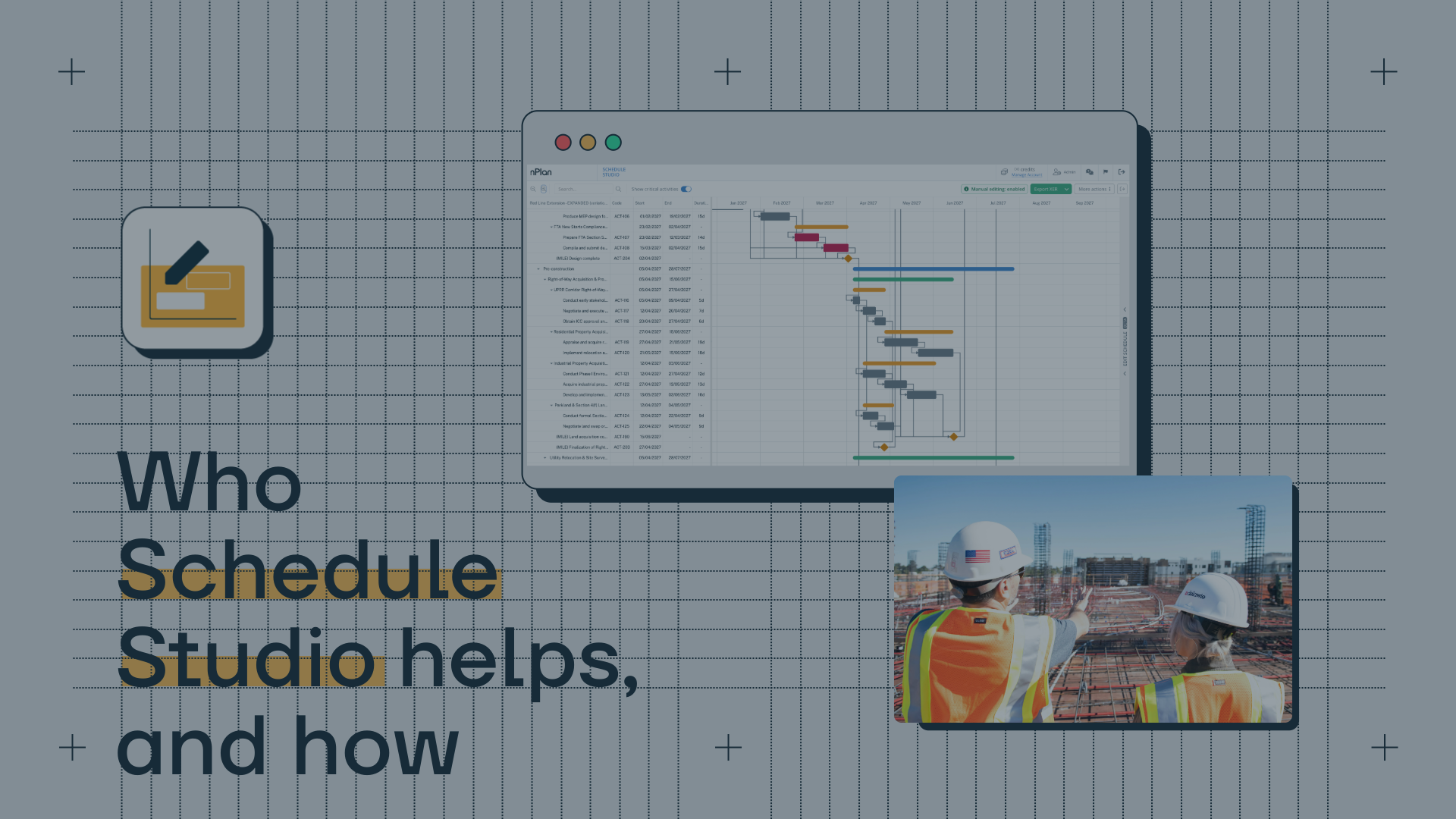
Who Schedule Studio helps, and how
More bids, faster decisions, new sectors. Here's how Schedule Studio helps the people who build construction schedules - and what changes for each of them.

The short version
More bids. Faster decisions. Entering new sectors. Whatever you need a schedule for, Schedule Studio gets you 80% of the way there, in a fraction of the time.
Key takeaways
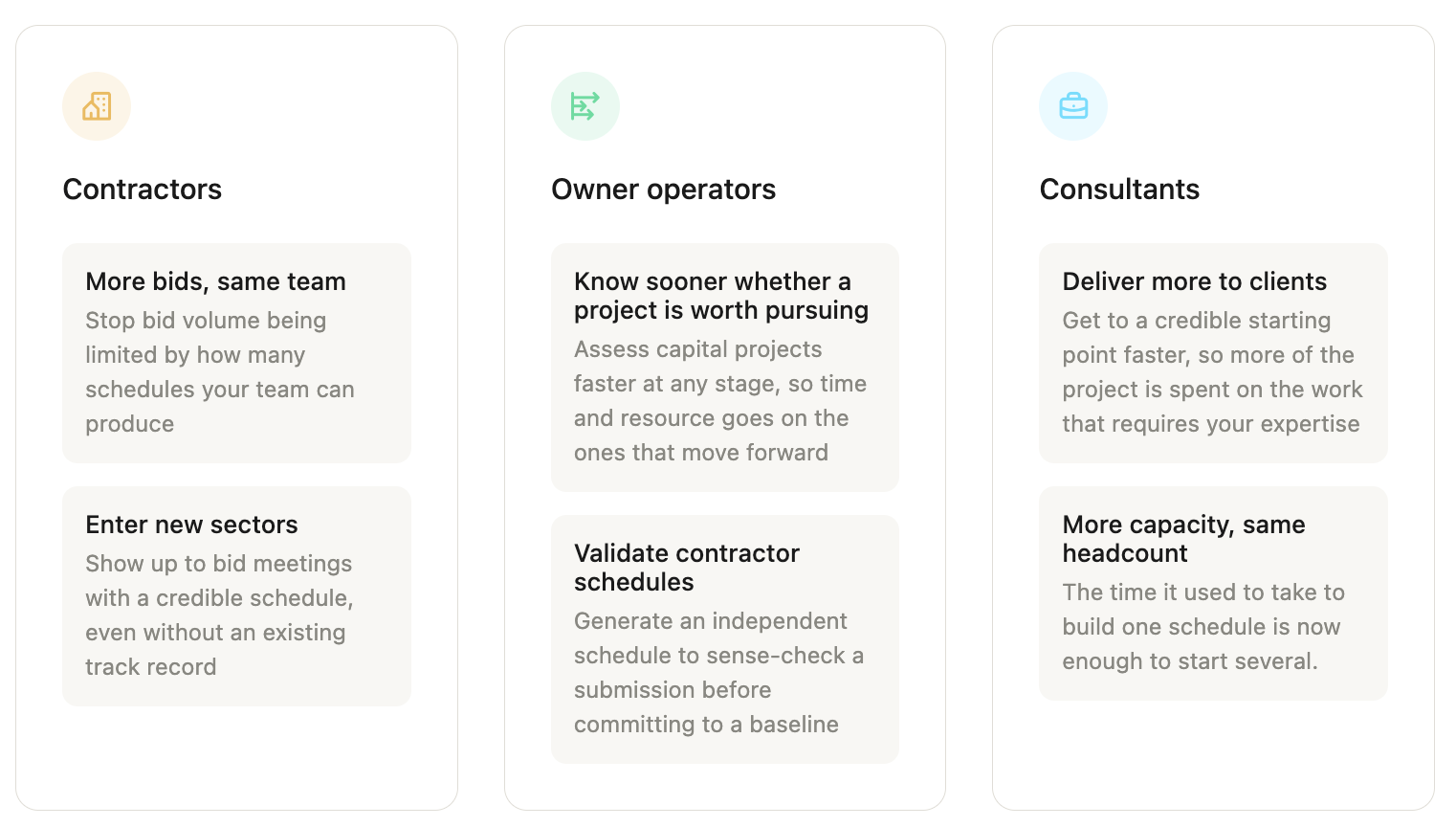
- For contractors: submit more bid schedules without increasing head count, and enter new sectors without needing an existing track record in that project type
- For owner operators: make faster go/no-go decisions on capital projects, and generate an independent schedule to sense-check a contractor’s submission before accepting it
- For consultants: get to a credible starting point faster, and spend more time on the work that requires your expertise
- In every situation: less time getting to a schedule, more time strengthening it
Schedule Studio produces a credible, construction-grade schedule in under 60 minutes. But what that actually means depends entirely on who you are, and what you’re trying to do with it.
Contractors
Bidding for work: more bids, without hiring a bigger team
Most bids require a schedule. Not the fully detailed, final version you’d build if you won the project, but the rolled-up, milestone-led schedule that shows you understand the work and have a credible plan to deliver it.
Building that schedule manually takes time. A planner might spend a full day or two on a single bid - working through the scope, the structuring, checking the logic. And a team can only submit as many bids as it can produce schedules. If you want to pursue more work without growing your headcount, it stands to reason that something has to change.
What we do know is that most planning teams aren’t short of ambition, they’re short of time. If you’ve got fifteen bid schedules due by the end of the month, a small team, and a day or two (at least) of manual work per schedule, the math doesn’t work, and you’re left submitting fewer bids, and winning less work, than you could.
Schedule Studio changes that equation. Upload the scope documents, write a prompt, edit the milestones, and you’ll have a structured first draft schedule in under 60 minutes. Now, your planner’s time can be spent on the parts that actually need their expertise - refining the logic, checking the sequencing, making sure it reflects how the project will actually be delivered.
The business case is pretty straightforward: more bids submitted with the same team, without cutting corners on quality.
Entering new sectors, and showing up with something credible
If you’ve spent years building in one sector and now you’re bidding on work in another, the challenge isn’t just technical. You don’t have established templates for how these projects flow, you don’t have the institutional knowledge of a team that’s delivered ten of them. And, if you show up to a bid meeting without a credible schedule, you’re signalling to the owner that you’re figuring it out as you go.
The alternative? Bring in an external specialist to produce the schedule. The downside - it’s expensive and slow. Paying tens of thousands for a single schedule created by an external provider isn’t utilising technology, it’s just hiring an outside person to do it manually, and paying a premium for it.
Thankfully, there’s another option. Schedule Studio is grounded in 750,000+ real project schedules - the largest construction schedule dataset in the world. With it, you can generate a logically structured starting point for project types outside your portfolio. You produce the schedule in-house, in under 60 minutes. You retain the output, and over time your team builds familiarity with how these projects are structured, which makes the next bid faster, and the next one? You guessed it - even faster.
It’s more than just time-saving and cost-saving, it’s a learning opportunity. Outsourcing means the knowledge stays outside the organisation, Schedule Studio keeps it in.
Owner Operators
Evaluate capital projects, and know sooner whether they're worth pursuing
Owner Operators have more than one project to think about. You’ll have a pipeline of projects at different stages of evaluation, and each will require dedicated time and resources before a decision can be made.
The Front End Loading (FEL) process is where most of that evaluation happens. At FEL 1, the question is whether a project is even worth exploring. At FEL 2, whether it’s feasible to execute, and at FEL 3, whether you’re committing to proceed. At every one of these stages, you need a schedule - to understand the timeline, estimate the resource requirements, and make the call.
If you’re evaluating ten projects and only one moves forward, the time spent on the nine that don’t is a cost with no return. In this game, speed matters - the faster you can assess feasibility, the sooner you know whether to invest further or walk away.
Schedule Studio gets you to a rough order of magnitude on timeline and resource in under 30 minutes. That’s enough to make a go or no-go call at FEL 1. It’s fast enough that evaluating four delivery scenarios takes the same time it used to take to evaluate one. And, it reduces the cost of the projects that don’t proceed, because you found out earlier.
Independently validate contractor schedules before you accept them
When a contractor submits a schedule, most client-side teams have limited time to scrutinise it properly. The schedule might look complete on paper, but logic errors, inconsistencies, and activities that don’t belong are easy to miss - especially on large, complex projects where manually checking every dependency isn’t realistic.
Rather than taking a contractor’s submitted schedule at face value, owner operators can use Schedule Studio to generate their own independent schedule from the same project scope documents. Where the two differ significantly - in sequencing, duration, or critical path - you have a basis for a targeted conversation before committing to a baseline.
That means you get an informed, independent point of comparison that most client-side teams currently don’t have.
Consultants
Delivering more to clients, without increasing headcount
Planning consultants face a version of the same time pressure as contractors, but the stakes are different. When you’re brought in to support a client through a complex project, the first thing you need is a credible schedule to work from. Building that manually before you can do anything else is time that comes out of the engagement, before any real value has been added.
A senior planner at an infrastructure consultancy described the difference:
It would probably take me a week to generate a 2,000 line schedule - and 100% of my time. With Schedule Studio, it takes about 10 minutes.
Their words, not ours - and that compression matters: the sooner you have a credible starting point, the sooner you can spend your time on the work that actually requires your expertise.
Stop building schedules the hard way
With Schedule Studio, you can stop building the V1 of every schedule from scratch. Get a logic-linked, construction grade schedule in a fraction of the time, export to Primavera P6 or Microsoft Project, and use the time you get back on the work that actually needs your expertise.
Schedule Studio is available now. Try it for free here, or get in touch with our team to find out more.
.avif)

.png)


