How AI-driven schedule generation will change what construction planning means
CPM changed how planners work, then P6 changed it again. AI-driven schedule generation is the next shift - and like the ones before it, it's not a threat to the profession, it's a change in what the profession does.

The short version
AI will not replace construction project planners or schedulers, but it will change what planning means - shifting the role from schedule creation towards schedule judgement. The planners who adapt earliest will be the most valuable ones in the room.
Key takeaways
- The creation phase of schedule production has historically consumed the majority of a planner’s time. AI removes that phase almost entirely
- What remains - and what becomes more important - is the judgement that only an experienced planner can apply: interpreting the project, challenging the logic, and making decisions that no model can
- This is not a threat to the profession, it’s a change in what the profession does
- Organisations that adopt AI-assisted schedule generation will be able to evaluate more projects, submit more bids, and make faster decisions with the same headcount
- The planners who understand how to work with AI tools will be more productive and more valuable than those who don’t
The introduction of CPM (Critical Path Method) in the late 1950s did not replace the engineers who understood project logic. It gave them a tool to work faster and with more rigour. The adoption of software like Primavera P6 didn’t make planners redundant, it changed what a planner spends their time on - less manual calculation, more programme management.
AI-driven schedule generation is the next shift in that sequence and, like the ones before it, it’ll change what construction project planning means - without making planners or schedulers unnecessary.
What changes for construction planning
The part of the job that changes is the creation phase.
Building a schedule from a scope document has historically been time-intensive, expertise-dependent work. A planner reads hundreds of pages, interprets the project, structures the WBS, sequences the activities, and produces a programme that reflects how the work will actually be delivered. On a complex project, that can take days or weeks before any real planning judgement has been applied.
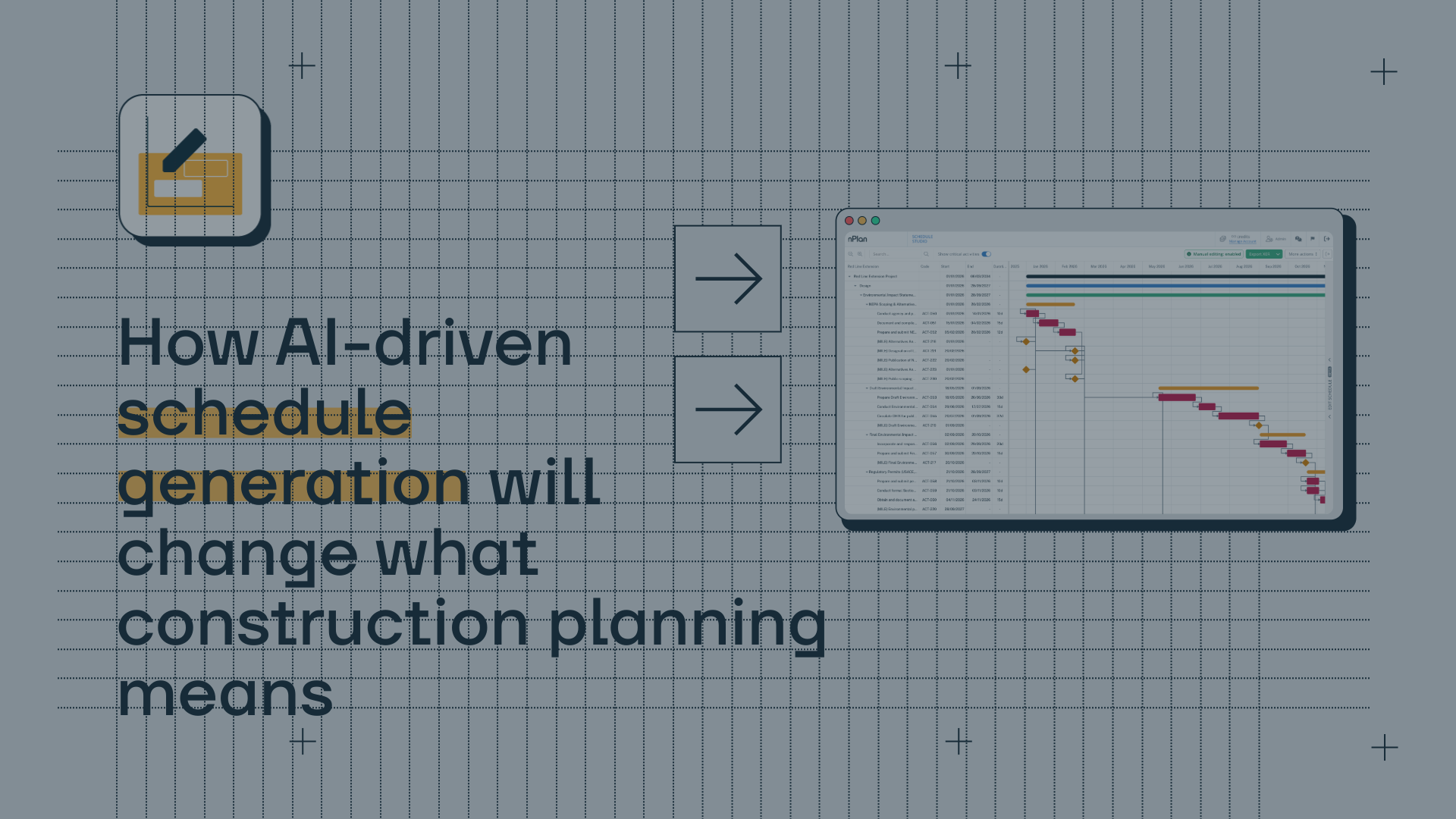
AI removes that phase almost entirely. A scope document goes in, a logically linked schedule comes out. The structure is there; the sequencing reflects construction logic, the WBS is built from a dataset of 750,000+ real construction schedules (or is based on your own).
What that creates is not a perfect, finished schedule. It creates a V1 that a planner can actually work with, rather than build from nothing.
What stays the same, and what becomes more important
If Schedule Studio gets you 80% of the way there, there’s still 20% to go - and that’s the part that matters most.
Interpreting whether the generated logic actually reflects how this specific project will be delivered. Knowing which dependencies are real constraints and which are assumptions that need to be challenged. Understanding how scope in one area creates risk in another. Recognising when a schedule looks credible on paper but does not reflect the reality of the site, the contractor, or the project.
Those are all jobs that require the kind of contextual understanding, professional experience and project-specific knowledge that only an experienced planner has. And, because the creation phase no longer consumes the week before that judgement can be applied, the judgement gets more time, and that means more iterations and more scenarios explored.
The planners who will be most valuable in this environment are not the ones who are fastest at building schedules from scratch, they’re the ones who are best at understanding schedules, challenging logic, and making decisions under uncertainty. AI accelerates the production of a starting point, it doesn’t replace the expertise that makes it good.
What this means for organisations
For the organisations as a whole, the shift is equally significant.
A planning team that could previously evaluate one capital project at FEL 1 in a week can evaluate four in the same time. A contractor that could submit eight bid schedules a month can submit thirty. An owner operator who spent two days validating a contractor’s schedule can do it in an afternoon.
That’s not a headcount reduction argument, it’s a capacity argument. The same team can pursue more work, make faster decisions, and spend more of their collective expertise on the projects that actually move forward.
The organisations that figure this out first will have a structural advantage over those that don’t: not because they have better planners, but because their planners are spending their time differently.
What this means for planners and schedulers
For individual planners and schedulers, the most useful thing to understand right now is that AI schedule generation, like Schedule Studio, is a tool, not a replacement - the same way P6 is a tool.
The planners who will get the most out of it are the ones who learn how to work with it: how to write a prompt that produces a useful output, how to interpret and challenge what the model generates, and how to use the time it creates to do better work rather than just faster work.
That is a skillset that is worth developing early, because the window in which AI-assisted schedule generation is a competitive differentiator is probably not as long as you think - within a few years, it’s likely to be a baseline expectation, the way P6 fluency is today.
The planners who are already comfortable with it when that happens will be the most valuable ones in the room.
Schedule Studio is available now. Try it for free here, or get in touch with our team to find out more.