How can an owner assess whether a contractor's completion date is realistic?
A three-step owner review of a contractor's baseline schedule: check it can calculate a date, test its assumptions, then ask how likely the date is.

Key takeaways: For owner-side project controls leads reviewing a contractor's baseline: check the schedule can calculate a date, ask what supports its durations and milestone assumptions, then find out how likely the date is with a probabilistic forecast before you accept or return it.
The contractor's baseline arrives, usually as a P6 file, the acceptance clock starts, and the finish milestone sits exactly on the contract completion date with no float to spare. Your controls lead now has days to decide whether that date will hold and to put the reasons in writing.
Before accepting it, ask the contractor where its key numbers came from and get a measure of how likely the date is. Those findings give you specific reasons to accept the programme, attach conditions or return it for revision.
Insights Pro · Driving Paths
See which paths in a contractor's baseline are most likely to move the completion milestone before you write your acceptance response.
See how Insights Pro worksHow can an owner tell whether a contractor's completion date is realistic?
An owner can tell whether a contractor's completion date is realistic by separating two questions the schedule answers together: could the work finish by that date, and how likely is it to? The critical path method answers the first by calculating the finish as if every activity takes exactly its planned duration. Only a probabilistic forecast answers the second, and acceptance needs both answers.
The US Government Accountability Office shows how far apart the two answers can be. In a worked example in its Schedule Assessment Guide (GAO-16-89G, December 2015), a schedule that calculates a 10 February finish has about a 7 percent chance of finishing on or before that date once realistic duration ranges are applied. A contractor planning for 70 percent certainty would promise 2 March instead.
The gap widens wherever paths converge. GAO calls this merge bias: if two parallel start-up and testing paths each have a 60 percent chance of finishing on time, the milestone they both feed has only a 36 percent chance (0.6 × 0.6), assuming the two paths are independent. Any commissioning or handover milestone fed by several paths behaves the same way, so a finish date can look comfortable on the critical path while depending on many things going right at once.

How should an owner review a contractor's baseline schedule before accepting it?
An owner should review the baseline in three steps, each depending on the one before: a forecast can only be as good as the logic it reads, and well-evidenced durations still need combining to show what they mean for the finish.
- Check the schedule can calculate a date. Confirm it covers the full scope, every activity is linked by logic, calendars match the real working pattern, and any date constraints are few and justified.
- Ask what supports the durations and milestone assumptions. Request the basis document and duration rationale, and test the assumptions behind key milestones, including third-party and owner-side interfaces.
- Ask how likely the date is. Obtain a probabilistic forecast of the completion milestone, compare the contract date with the confidence level you need, and focus discussion on the activities with the greatest delay-causing potential.
Step 1: can the schedule calculate a date?
The schedule can only calculate a meaningful date when its scope, logic, calendars and constraints are sound, so check those before discussing the finish. GAO's guide describes a reliable schedule as comprehensive, well constructed, credible and controlled, and its ten best practices give owners a public checklist to work from.
- Scope: every work package in the contract scope, including owner-side activities such as approvals, free-issue equipment and access, appears in the schedule.
- Logic: activities have predecessors and successors, so a delay in one moves the dates of others. Open ends, long lags and leads deserve a written reason.
- Calendars: working days, shift patterns, holidays, possessions, outages or seasonal windows reflect how the work will actually run.
- Constraints: hard date constraints are rare and explained. GAO is direct on this point: "A customer-mandated date, including contractual obligations, does not constitute a legitimate reason to constrain an activity."
That last check matters most for the question you are answering. A finish milestone pinned to the contract date will always show the contract date, whatever the logic behind it says. Remove or relax the constraint in a copy of the file and look at where the logic alone puts the finish. Diagnostic counts of open ends or high float help prioritise, but GAO stresses that its measures have no pass-or-fail tripwires and that the severity of an error matters more than the count.
Step 2: what supports the durations and milestone assumptions?
Durations and milestone assumptions are supported when the contractor can show where each important number came from, and the owner can see which assumptions depend on someone else. GAO recommends that durations use the same rationale, historical data and assumptions as the cost estimate, and that every baseline comes with a basis document explaining ground rules, assumptions, constraints, lags and long durations.
Ask for that basis first, which spares both sides arguing durations one by one. Productivity rates, crew sizes, procurement lead times and commissioning durations should trace back to a tender estimate, supplier quotations or recorded performance on similar work. Then look hard at the interfaces behind each key milestone: utility connections, regulatory consents, rail possessions, plant outages, long-lead equipment and anything the owner itself has promised to supply. An owner can find that the riskiest assumptions in a contractor's baseline are the owner's own obligations, and that is a finding worth having before acceptance.
Step 3: how likely is the completion date?
The likelihood of the completion date comes from a probabilistic forecast, which turns duration uncertainty into a range of finish dates with a confidence level attached to each. GAO's guide notes that some programmes treat the 80th percentile as a conservative promise date and others use lower percentiles, and that schedule outcomes tend to skew late, so the owner should decide its tolerance before the numbers arrive.
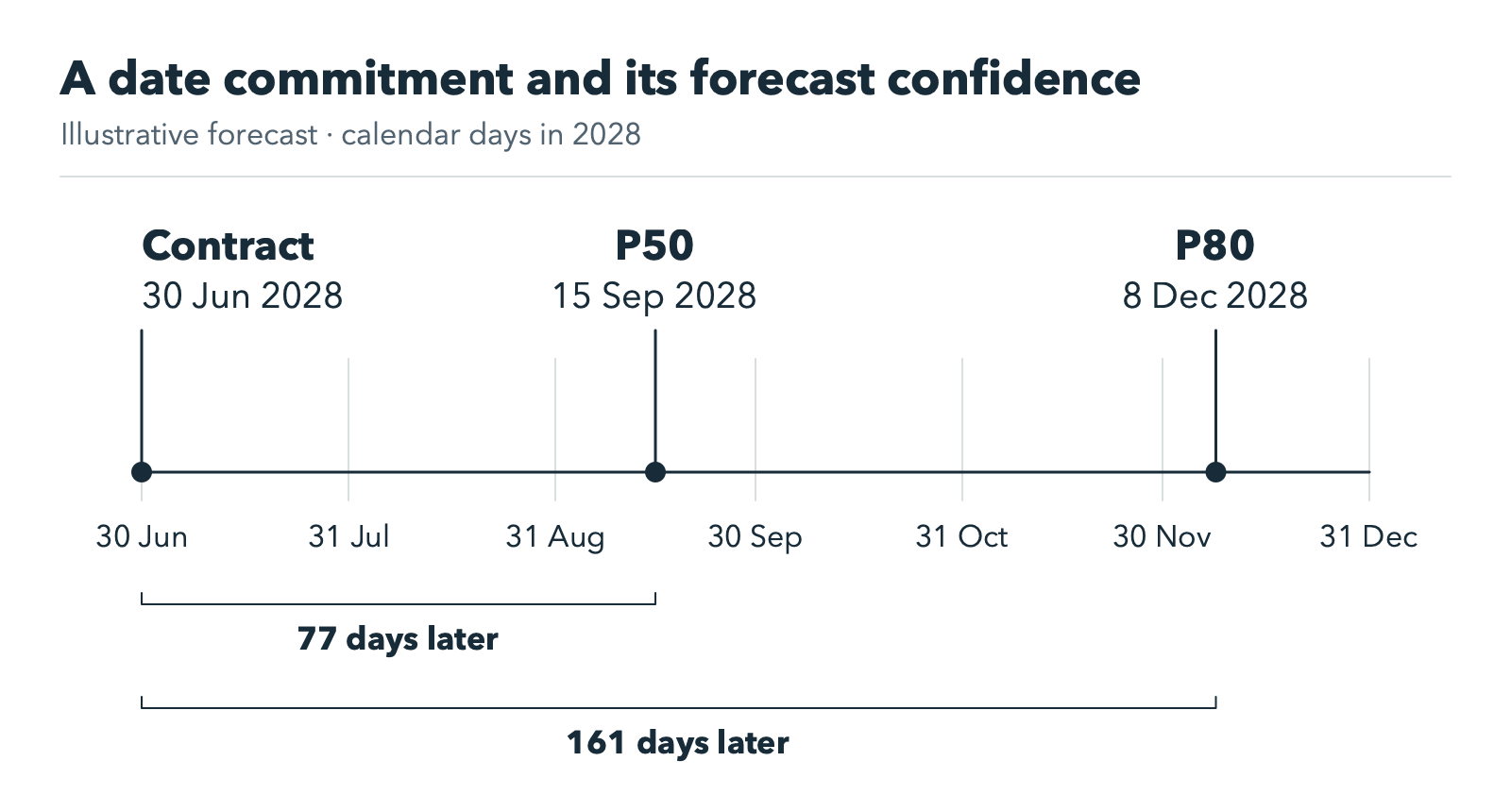
Illustrative scenario (assumptions labelled, not a real project). The contract completion date is 30 June 2028 and the submitted baseline also finishes on 30 June 2028 with zero total float. A probabilistic forecast of the same schedule puts the 50 percent confidence (P50) finish at 15 September 2028 and the 80 percent confidence (P80) finish at 8 December 2028.
The P50 finish is 77 days after the contract date and the P80 finish is 161 days after it. Because the contract date is earlier than P50, its forecast confidence is below 50 percent; the full forecast is needed to read its exact probability. That gap gives the owner a concrete question for the contractor: which risks can you mitigate, and what confidence would those changes give us in the committed date?
In a traditional quantitative schedule risk analysis (QSRA), the project team uses workshops to agree duration ranges and key risks, then runs a Monte Carlo simulation. AI-led schedule risk analysis (AI-SRA) offers an alternative: the forecast and ranked risk drivers are available before the workshop, so the team can spend its time validating the findings and deciding how to respond.
With nPlan Insights Pro, we forecast every activity in the submitted schedule using what our models have learnt from how past projects actually performed, map the driving paths most likely to affect the completion milestone, and highlight the activities and themes with the greatest delay-causing potential. Those findings turn a general worry about optimism into a short agenda for the contractor: these paths, these activities, and the evidence that would make us comfortable with them. Mitigation scenarios can then show how much a proposed resequence or earlier procurement would move the forecast. Our article on traditional risk software and nPlan explains the differences between the two approaches.
On the Transpennine Route Upgrade in northern England, the project team built our outputs into its T-minus reviews at 12, 8 and 4 weeks before major track possessions, alongside its traditional methods. After one Driving Paths review, the TRU East team raised risks to key possession dates with senior stakeholders. At acceptance, those outputs give your team an independent view to test. Your team still validates scope, site conditions and delivery assumptions, reconciles the findings with the risk register, and decides whether the evidence supports acceptance or a revised submission.
When is a different check the better call?
The right first check depends on the maturity of the submission. A summary schedule with missing logic needs structural repair under step 1 before an activity-level forecast can give you a useful answer. If there is no detailed schedule yet, a top-down comparison with similar completed projects is more useful, as our piece on reference class forecasting explains. And if you want a fully independent comparator built from the same scope documents, Schedule Studio can draft one for your planners to review. Where the contract prescribes a particular risk analysis, follow it and use other views as a challenge to its results.
What does the contract let an owner do?
The contract decides how much leverage an owner has over a baseline it doubts, so read its scheduling clauses before writing comments.
What can an owner do under NEC4 in Great Britain?
Under NEC4, the Project Manager either accepts the programme or gives reasons for not accepting it, and one permitted reason in clause 31.3 is that the programme "does not represent the Contractor's plans realistically". The other listed reasons are impracticable plans, missing required information and non-compliance with the Scope, as Brodies explains. NEC's own guidance adds that reasons must be given, and that withholding acceptance for a reason not in the contract is a compensation event.
Timing matters as much as the reasons. The CECA NEC4 bulletin (June 2021) notes that after two weeks of silence the Contractor can notify the Project Manager, and after a further week the programme is treated as accepted.
What can an owner do on US federal construction contracts?
On US federal construction contracts, FAR 52.236-15 requires the contractor to submit a schedule for approval within five days after work begins, or another period the Contracting Officer sets, and lets the Contracting Officer withhold progress payments until it arrives. GAO uses its guide to assess federal programme schedules, and AACE International's recommended practice 78R-13 covers original baseline schedule review for the people deciding whether a baseline is acceptable to the owner.
On private US work, the contract's own scheduling specification governs. Read it first, then give specific reasons tied to evidence inside the review window.
What evidence should an owner request before accepting the baseline?
An owner should request the evidence that would close each specific concern, name who supplies it, and agree the review action before acceptance. GAO's guide lists similar items for auditors, including the native schedule file rather than a PDF, the basis document, the duration rationale, the risk analysis and the current risk register.
| Concern | Evidence to request | Supplied by |
|---|---|---|
| Incomplete scope | Native schedule file mapped to the contract scope and work breakdown | Contractor planner |
| Weak logic | Basis document explaining open ends, lags, leads and long durations | Contractor planner |
| Wrong calendars | Calendar definitions for shifts, holidays, possessions, outages and seasonal windows | Contractor planner |
| Pinned finish | Every hard constraint with its written justification | Contractor planner |
| Short durations | Basis of estimate: rates, crew sizes, lead times and past performance | Contractor estimator |
| Interface risk | Interface register covering consents, connections, possessions and owner-supplied items | Contractor and owner interface managers |
| No likelihood | P50 and P80 finish with method and assumptions, or an independent forecast | Contractor risk manager |
| Register mismatch | Risk register cross-referenced to schedule activities | Contractor and owner risk managers |
| Unscheduled mitigation | Mitigation shown as activities with owners, dates and forecast effect | Contractor project manager |
For each concern, the owner-side reviewer needs a specific action before the acceptance window closes.
| Concern | Owner's review action before acceptance |
|---|---|
| Incomplete scope | Trace each scope item to activities; list gaps as reasons |
| Weak logic | Re-run with unexplained items corrected; record any change to the finish |
| Wrong calendars | Check calendars against agreed access and operating windows |
| Pinned finish | Relax unjustified constraints in a copy; compare the logic-driven finish |
| Short durations | Test the riskiest durations against the evidence and a forecast |
| Interface risk | Confirm third-party dates; add owner obligations to your own register |
| No likelihood | Compare the contract date with your agreed confidence level |
| Register mismatch | Reconcile forecast hotspots with register entries; add missing risks |
| Unscheduled mitigation | Accept only mitigation that appears in the schedule and register |
Once each row is closed or carried as a recorded condition, the decision becomes straightforward to write down: accept, accept with conditions the contractor has agreed, or return the programme with reasons tied to specific rows. Both parties then have a shared view of how likely the date is and what would move it.
Insights Pro · Mitigation Strategies
Test the contractor's proposed mitigations against the forecast, so any conditions you attach to acceptance rest on evidence.
Book a call with our teamFrequently asked questions
What if the contractor will not remove a date constraint on the finish?
Ask for the written justification GAO expects for every hard constraint, and review a copy of the file with the constraint relaxed so both parties can see where the logic alone puts the finish. If the constraint stays without a justification, record it as a reason or a condition in your response.
How often should the owner repeat this check after accepting the baseline?
Repeat it whenever a revised programme arrives, and run the forecast again on each update to see whether the likelihood of the completion date is improving or slipping. Under NEC4 the interval is set in the Contract Data, commonly every four weeks. On US federal work, GAO expects each update to use actual progress and come with a narrative of what changed.
What is the difference between a P50 and a P80 completion date?
A P50 completion date is the date the project has a 50 percent chance of finishing on or before, and a P80 date has an 80 percent chance. GAO's Schedule Assessment Guide notes that some programmes treat the 80th percentile as a conservative promise date while others use lower percentiles. The owner should agree which confidence level it needs before the forecast arrives.
Does an AI forecast replace a schedule risk workshop or QSRA?
AI-SRA can be an alternative to traditional QSRA. It provides activity-level uncertainty forecasts, a whole-project forecast and ranked risk drivers before the workshop. The project team then validates those outputs, agrees mitigations and decides which risks to tolerate, transfer, treat or terminate. The team remains responsible for the acceptance decision and any method the contract requires.
Sources
- GAO Schedule Assessment Guide: Best Practices for Project Schedules (GAO-16-89G), December 2015
- Brodies LLP, On what grounds can a Project Manager reject a programme submitted for acceptance by a Contractor?, May 2021
- NEC Contracts, FAQ: categorising reasons for non-acceptance
- CECA NEC4 Bulletin No. 6: Importance of an accepted programme every month/period, June 2021
- FAR 52.236-15 Schedules for Construction Contracts
- AACE International Recommended Practice 78R-13: Original Baseline Schedule Review, As Applied in Engineering, Procurement, and Construction
- nPlan, Using AI to de-risk delivery during the Transpennine Route Upgrade project (published case study, October 2024)
- nPlan, From QSRA to AI-SRA (white paper)
- nPlan Insights Pro
- nPlan, Traditional risk software vs nPlan
- nPlan, Reference Class Forecasting (RCF) vs nPlan
- nPlan, Who Schedule Studio helps, and how
- nPlan, Why we built Driving Paths