How can a rail owner assess delay risk between civil works, signalling and testing?
Rail owners can assess possession delay risk at each hand-off: trace dependencies, forecast which hand-offs risk not being ready, record what closes each.
Written by
Stacey Gray
Believes the world's biggest projects deserve better than guesswork. Powered by customer stories, products that solve real problems, and the occasional gelato.
Updated 10 November 2026
Key takeaways: For rail owners and programme directors preparing a constrained possession, assess delay risk at the hand-offs between civil works, signalling and testing. Trace each dependency in the schedule, forecast which hand-offs risk not being ready before the possession starts, and keep one record of the evidence, deadline and owner that closes each before the window opens.
The owner of a constrained possession needs a one-page interface closure record. For each hand-off between civil works, signalling and testing, it names the evidence that the hand-off is ready, the forecast risk that it will not be ready, the date by which someone must decide, and the person who owns that decision.
Delay risk on a possession can sit in those hand-offs, and the record is how an owner sees it. A risk register organised by activity will show that the civil works, the signalling installation and the test programme each look manageable on their own, while the possession is lost in the gaps between them.
Insights Pro · Driving Paths
See which hand-offs between civil, signalling and testing risk not being ready for your possession, weeks before the window opens.
What tools can assess delay risk between civil works, signalling and testing?
The tools that assess this risk combine a dependency trace of the works schedule leading up to the possession with a forecast of which hand-offs risk being late before the window opens, and they feed an owner's interface closure record. The trace shows where civil completion, signalling readiness and testing depend on one another. The forecast ranks the paths that put readiness for the possession at risk, weeks in advance.
A planner can trace the dependencies with the scheduling tool the works schedule already lives in, whether Primavera P6, Asta Powerproject or Microsoft Project. A schedule risk analysis, whether a traditional quantitative schedule risk analysis (QSRA) or AI-led schedule risk analysis (AI-SRA), estimates which paths are most likely to slip. Neither, on its own, tells the programme director who must close which gap by when, which is the job of the record.
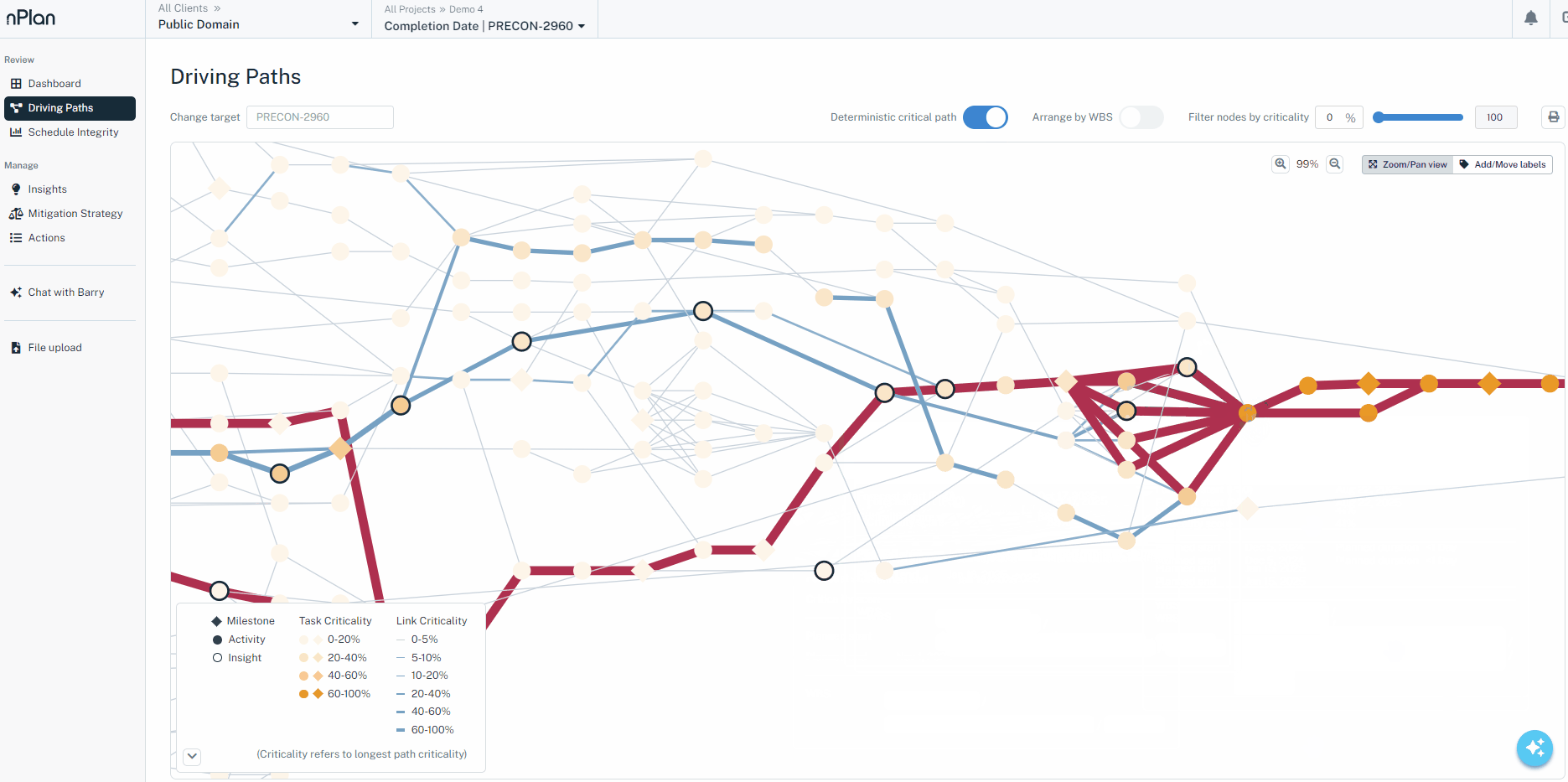
Insights Pro's Driving Paths on nPlan's demonstration data: the critical path in red and sub-critical paths in blue, with nodes shaded by criticality.
The US Government Accountability Office makes the underlying point in its Schedule Assessment Guide (GAO-16-89G): once dependencies are logged, "major handoffs between groups should be discussed and agreed on to ensure that the schedule correctly models what they expect to happen." A possession is a short, fixed window in which several groups hand work to one another, so each hand-off is a point where the groups' expectations of the schedule have to match.
Where can a possession lose time between civil works, signalling and testing?
A possession can lose time at a hand-off when each discipline plans to its own definition of done and the window is fixed. Civil works can be complete by the civil team's measure while a cable route, a location case base or a piece of track geometry is still unfit for the signalling team to start. Signalling can be installed while the data, the test plan or the tester in charge is not yet ready for testing to begin.
In an illustrative case, the civil team reports complete, the signalling team reports ready, and the first test run still cannot start, because no one owned the gap between what civil delivered and what signalling needed. The window is already booked and the train operators have planned around it, so the hours lost at that hand-off come straight out of the time left for testing and handback.
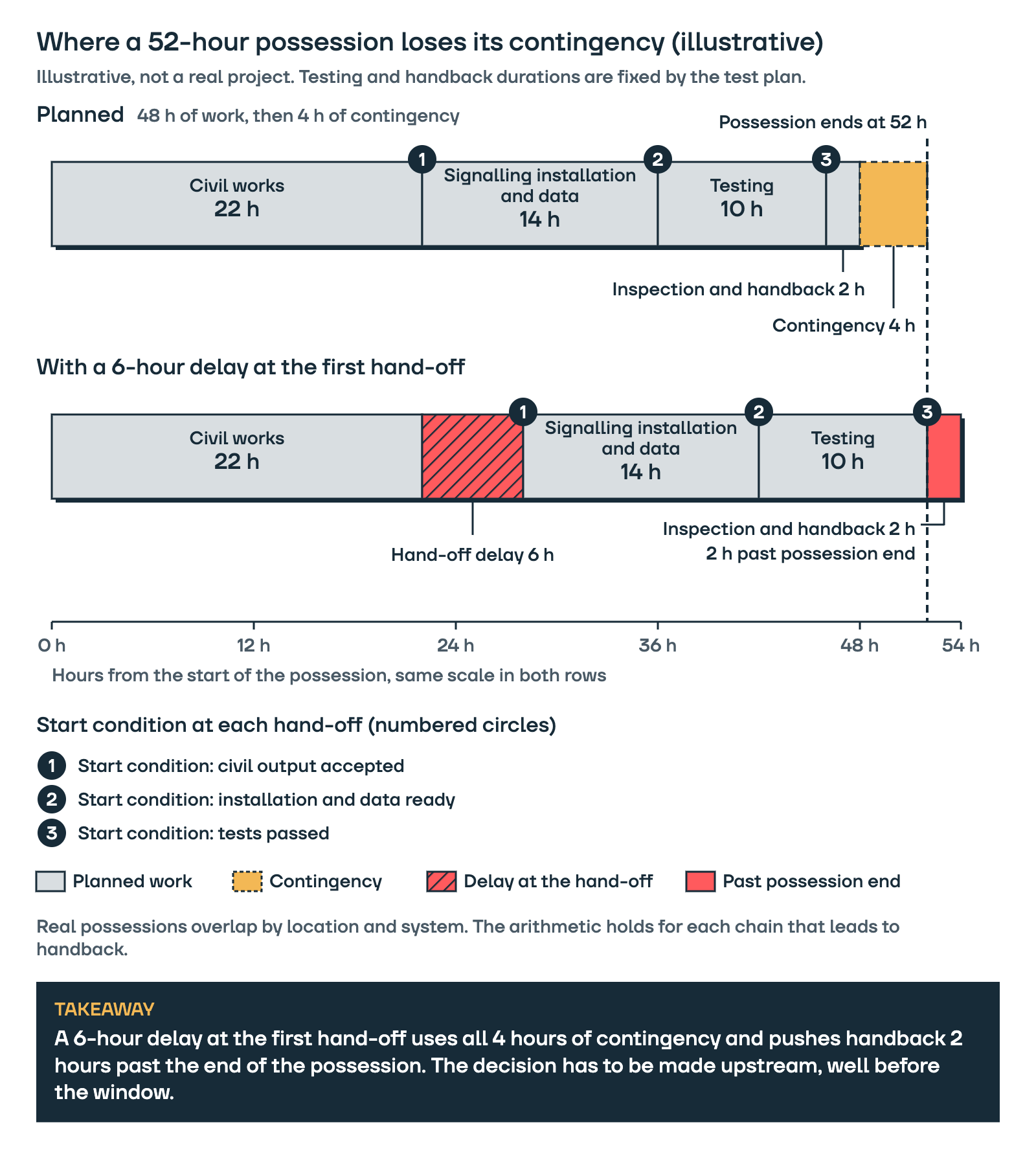
In this illustrative planning example, not forecast output, a 52-hour possession with a 6-hour delay at the first hand-off uses all 4 hours of contingency and pushes handback 2 hours past the end of the possession, so the decision has to be made upstream, well before the window.
Work on a real possession overlaps by location and by system, and several hand-offs can happen in parallel along a route.
How do you build an interface closure record?
Trace each dependency in the schedule: Follow the logic from civil completion through signalling installation and testing to handback, and list every point where one discipline's output is another's start condition. Check scope separately from sequence: a scope trace confirms that every piece of work the possession needs appears in the schedule, while a link and sequencing check confirms that the logic between those pieces is real and complete.
Forecast readiness before the possession: Run a forecast of the works schedule leading up to the window and note which hand-offs risk not being ready when the possession starts. Review those findings weeks in advance, so the team can act before the window opens.
Record what closes each hand-off: For each one, write down the evidence that proves readiness, the mitigation if the forecast is poor, the date by which a decision is needed and the named owner.
The forecast is where the trace becomes a ranking. With nPlan Insights Pro, we forecast every activity and milestone in the schedule using what our models have learnt from more than 780,000 past project schedules, and Driving Paths shows the critical path alongside the sub-critical paths most likely to become critical. For a possession, those sub-critical paths can run through work needed to make a hand-off ready before the window opens, which is exactly the row the record needs.
The completed record fits on one page, with the evidence and the deadline kept together, because evidence that arrives after the decision date does not help.
Interface closure record for one possession (example rows)
Interface
Evidence and decision deadline
Owner
Civil to signalling
Cable routes and bases signed off as fit to install; due T-4 weeks
Owner's interface manager
Signalling to testing
Data, test plan and tester in charge confirmed; due T-2 weeks
Signalling lead
Testing to handback
Test records and inspection plan agreed; due before the window
Test lead (possession planner contributes)
Worked row: civil to signalling (illustrative example; hour figures are planning, not forecast output)
Field
Entry
Evidence
Walked and signed-off cable route; base inspection records
Readiness risk
Forecast shows the hand-off at risk of not being ready before the possession; if it slips 6 hours, handback runs 2 hours past the window
Mitigation
Finish ducting in an earlier shift; move one route's tests
Decision deadline
T-4 weeks review
Named owner
Owner's interface manager, reporting to the programme director
What happens when a handover is incomplete?
When a handover is incomplete, the civil, signalling and test leads resolve what they can between them, and anything they cannot close goes to the programme director as a clear choice to resequence or reduce scope, with the forecast effect of each option attached.
Take the worked row into a T-4 weeks review. The civil lead reports the ducting complete on all but one route, where a drainage clash has held up the final section. The signalling lead confirms installation cannot start on that route until the section is proven, and the test lead points out that the route's tests sit in the middle of the test sequence, so a late start there delays everything after it. Up to this point, each lead's own report has been accurate.
The record puts the three reports in one row. Insights Pro Mitigation Strategies lets the team test the options they propose against the forecast: finishing the ducting in an earlier shift, reordering the test sequence so the affected route is tested last, or taking that route out of this possession and into the next one. The team compares how each option changes the forecast readiness for the possession, then checks the detailed possession plan with the authorised leads.
Who decides how to close the hand-off?
The leads can agree the first two options among themselves, provided the test lead confirms the reorder is acceptable under the test plan. Moving scope into a later possession is a programme decision, which the programme director makes by the deadline in the record, weighing the consequences for the next possession. The record then shows that the row is closed, how it was closed and who decided.
On the Transpennine Route Upgrade, where the team used Insights Pro, it reviewed our findings at T-minus reviews 12, 8 and 4 weeks before major possessions, alongside its traditional methods, and a Driving Paths review highlighted risks to key possession dates. In our webinar with Richard Palczynski and Mike Ellis, TRU said it asks its supply chain to provide an AI-SRA that assesses the confidence of starting any major blockage on time. The interface closure record is our proposed way to organise the same cadence around hand-offs.
How does this work for possessions in Great Britain?
In Great Britain, the record works inside Network Rail's possession arrangements and each project's own acceptance process. The Office of Rail and Road explains that the arrangements for restrictions of use, including engineering possessions, are set out in Part D of the Network Code, and that the Schedule 4 possessions regime exists to compensate operators for planned disruption and to incentivise safe, early, efficient planning of engineering work.
Who confirms the line is safe to hand back?
The railway's authorised people confirm it. Possession of a running line for engineering work is governed by Rule Book module GERT8000-T3, and the person in charge of the possession (PICOP) works to handbook GERT8000-HB11. Network Rail's standard NR/L2/OHS/019 (Issue 12, clause 5.1.6) makes the Person in Charge responsible for checking and confirming that the line is clear and safe for the passage of trains, as the ORR recorded in a February 2025 letter to the Rail Accident Investigation Branch. The record shows when those confirmations are planned and who gives them; it does not replace them.
Does signalling work need regulatory authorisation before use?
Some does. Under the ORR's policy on authorisations under the Railways (Interoperability) Regulations 2011, a new structural subsystem within the regulations' scope needs authorisation for placing in service before use, and an upgraded or renewed one may need it if the ORR so decides. The ORR grants it and the owner secures it, so those submissions belong in the record as rows with their own deadlines.
How does this work for rail and transit access windows in the United States?
In the United States, the same record fits FTA-funded transit projects and their operators' access arrangements, with each agency's own rules deciding how track access and acceptance work. The Federal Transit Administration's Project and Construction Management Guidelines (January 2025 update) ask sponsors to "clearly enforce responsibility, authority, and accountability at each interface" and to assign an integration manager to develop an integrated test plan, noting that some owner-furnished equipment and interfaces may not be the contractor's responsibility at all.
For major capital projects under FTA oversight, the Oversight Procedure 54 on readiness for service describes how the project management oversight contractor reviews the sponsor's system integration testing. It expects that testing to sit in the master schedule with the interdependencies shown, and it sets a sequence in which design affecting the equipment is approved, equipment is inspected, and the test plans, procedures and reports for one phase are complete before the next phase begins. Each of those conditions is a hand-off that belongs in the record.
Access windows on US systems are governed locally. Rail transit agencies covered by FTA's rule on rail transit roadway worker protection (49 CFR Part 671) must keep a track access guide as part of their on-track safety programme, while railroads under Federal Railroad Administration oversight work to the roadway worker protection rules in 49 CFR Part 214. For a US owner, the record follows the agency's own outage and access process and its safety certification, and the agency's authorised staff make the access and acceptance decisions.
Where does the record stop and the railway's authority begin?
The record tracks the evidence and deadlines for safety-critical hand-offs. The railway's authorised staff make the sign-offs and follow the railway's own acceptance sequence. A forecast can show that a test is likely to start late; it cannot decide that a test can be shortened, reordered against the test plan or skipped, and it cannot authorise a line to be handed back.
Within that boundary, the record does its most useful work weeks before the window, and it is the practical piece to bring to your next pre-possession review. Owners, contractors and delivery authorities build trust in forecasts like these over time.
Insights Pro · Mitigation Strategies
Test resequencing and scope options against the forecast before your programme director decides, so every closed interface rests on evidence.
How far ahead of a possession should the interface closure record be started?
Start it as soon as the possession is booked and the works schedule exists, and review it at fixed points before the window, for example at set numbers of weeks before it opens. Each review should close rows or move them to a named decision, and the last review should leave nothing open that the programme director has not already decided on.
Is the interface closure record the same as an interface register?
No. An interface register lists every interface on the programme and who manages it. The closure record covers the hand-offs needed for one possession, including readiness before it starts, and adds the forecast readiness risk, the evidence that closes each one, the date by which a decision is due and the person who owns it. It draws on the register and is far shorter.
Who should own an interface between two contractors?
Name one person, on the owner side or in the alliance, who is accountable for the hand-off closing on time, even when two contractors do the work on either side of it. FTA's Project and Construction Management Guidelines ask sponsors to enforce responsibility, authority and accountability at each interface. Shared ownership leaves the gap the record exists to close.
Can a forecast decide whether a possession goes ahead?
No. A forecast shows which hand-offs risk not being ready before the possession starts and how proposed mitigations change that risk. The decision to proceed, resequence or reduce scope belongs to the programme director, and safety, access, testing and handback decisions stay with the railway's authorised personnel and its own acceptance process.
By clicking “Accept all”, you agree to the storing of cookies on your device to enhance site navigation, analyse site usage, and assist in our marketing efforts. Find more information on our use of cookies here.