What schedule evidence should an energy owner review before final investment approval?
Before final investment approval, an energy owner's schedule pack should show what supports each date, what is still open and an independent forecast.
Written by
Stacey Gray
Believes the world's biggest projects deserve better than guesswork. Powered by customer stories, products that solve real problems, and the occasional gelato.
Updated 10 November 2026
Key takeaways: For energy owners, sponsors and investment committee preparers: before final investment approval, the schedule evidence pack should show what supports each proposed date and what is still open, built around an independent forecast from the current schedule, with a named owner answering every open finding.
An investment committee paper can carry one completion date on its cover and, behind it, a schedule, usually a Primavera P6 file, that nobody outside the project team has independently read. The committee is about to commit capital against that date, so the owner's real question is what supports it, and what is still unresolved.
A schedule can pass every format check and still lack the evidence to commit capital on its dates. The pack that serves the committee shows open items as clearly as confirmed ones and names the person who will close each.
INSIGHTS PRO · INDEPENDENT FORECAST
Upload your current schedule (Primavera P6, Asta Powerproject or Microsoft Project) and see an independent milestone forecast, with the activities and paths driving delay risk, before your dates go to the investment committee.
What schedule evidence should an energy owner review before final investment approval?
Before final investment approval, an energy owner should review how mature the schedule is and what scope it covers, whether contractor interfaces and milestone definitions hold together, an independent forecast built from the current schedule, and the mitigation options tested against that forecast. One record then ties each finding to its support, its open question, an accountable owner and the next decision. The committee approves a commitment of capital against dates, so every item in the pack should answer one question: what supports this date?
No single tool checks all of that. Schedule quality checks in the scheduling software test how the network is built. A reference-class benchmark tests whether the overall duration is plausible against similar completed projects. A schedule-level forecast, whether from a traditional quantitative schedule risk analysis (QSRA) or from AI-led schedule risk analysis (AI-SRA) in Insights Pro, tests the dates your own activities and logic imply. The forecast is the step that reads the schedule the committee is being asked to rely on, which is why the pack needs one before the committee meets, and why the maturity and scope checks have to come first.
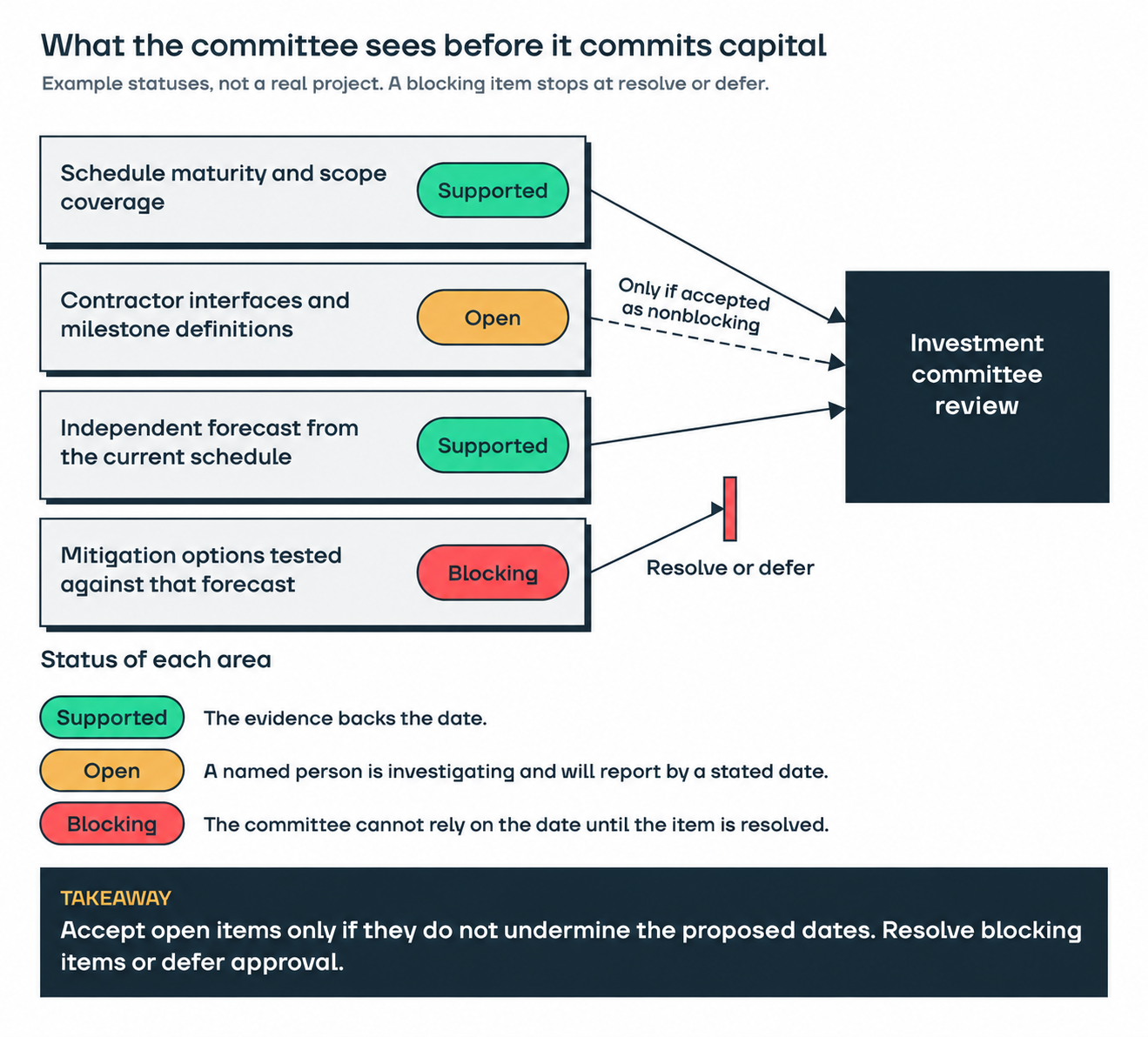
A complete pack shows the committee the status of every finding, including any that would block the decision.
How mature is the schedule, and what scope does it cover?
Schedule maturity is the first evidence because it tells the committee how much project definition sits behind each date. AACE International's Recommended Practice 27R-03, Schedule Classification System sorts schedules into five classes by degree of project definition. It lists budget, authorisation or control as the end use of a Class 3 schedule, prepared at roughly 10% to 40% of complete definition with semi-detailed planning, while detailed bottom-up planning belongs to Classes 2 and 1.
The same practice separates a schedule's class from its level. Class describes how complete the underlying definition is; level describes how much detail is shown for reporting. A network broken down to thousands of activities can therefore still rest on immature engineering, and the activity count tells the committee nothing about which. AACE's companion cost estimate classification for the process industries, 18R-97, makes the point directly: "it is the maturity of the defining deliverables that is the determinant, not the percent." Ask for the deliverables, then judge the class. For large industrial projects, the Construction Industry Institute's Project Definition Rating Index (PDRI), version 5.0 gives the front-end team a structured way to measure scope development before the schedule is classified.
Report scope coverage and logic quality as separate checks:
Scope trace: Every element of the scope in the investment estimate appears in the schedule, including the work the owner performs: consents, land, grid or pipeline connection agreements and owner-furnished equipment. The US Government Accountability Office's Schedule Assessment Guide asks for "activities both the owner and contractors are to perform."
Logic and sequencing: Activities are linked, with no unexplained constraints, open ends or long durations, so a delay anywhere flows through to the milestones it should move.
Basis of the schedule: A written basis document explains the approach, ground rules and assumptions behind the durations, which GAO pairs with the baseline schedule.
A schedule can score well on logic and still leave out a whole package of owner scope, which is exactly the gap a format check will not find.
Do contractor interfaces and milestone definitions mean the same thing to everyone?
Interfaces and milestone definitions decide whether dates in separate schedules describe the same event. An energy project at investment stage can combine an EPC contractor's schedule with others for long-lead equipment, a pipeline or grid connection, and the owner's own consents, and those schedules only support one completion date if their hand-offs match. GAO's guide calls these hand-offs "giver/receiver" milestones and says they "must be clearly identified and logically linked between schedules."
Definitions matter just as much, because mechanical completion, ready for start-up and commercial operation carry the meaning each contract gives them, and two packages can use the same words for different conditions. Temporary construction power and permanent energisation of the grid connection are also different milestones with different owners, and a schedule that blurs them can show an early date the permanent connection will not support. Check for:
A giver milestone and a receiver milestone for every interface, carrying the same date and definition in both schedules.
One written definition for each key milestone, referenced to the contract clause that sets it.
Owner-furnished items, such as site access, consents and free-issue equipment, linked into the contractor logic they enable.
External dependencies, such as a grid connection date or a pipeline tie-in, held as dated activities with a named owner.
This check stops at the interfaces that support the investment dates. Detailed commissioning and start-up sequencing comes later, once the systems and their turnover plans are defined.
How is an early benchmark different from a forecast built on the schedule?
A forecast built on the schedule itself works from the inside. With Insights Pro, the team uploads its existing schedule and we forecast every activity using what our AI has learned from more than 780,000 past project schedules, then roll those forecasts up to the milestones the committee cares about. Driving Paths shows the critical path and the sub-critical paths that may be sources of unforeseen risk to a milestone, and Insights Pro identifies which themes and activities influence the outcome most. AI-SRA can serve as an alternative to a traditional QSRA, with the forecast and ranked drivers arriving before the team meets, as our white paper From QSRA to AI-SRA and our comparison of traditional risk software and nPlan explain. The project team still validates the results, considers mitigation and makes the acceptance decision.
Reading the forecast's assumptions is the owner's part of the work. Look at which activities are forecast to take longer than planned, which sub-critical paths come close to driving the milestone, and whether those findings point back to scope or interface gaps from the earlier checks. The forecast can only read the schedule it is given, so scope that is missing from the schedule is missing from the forecast too.
What if the forecast misses a deadline?
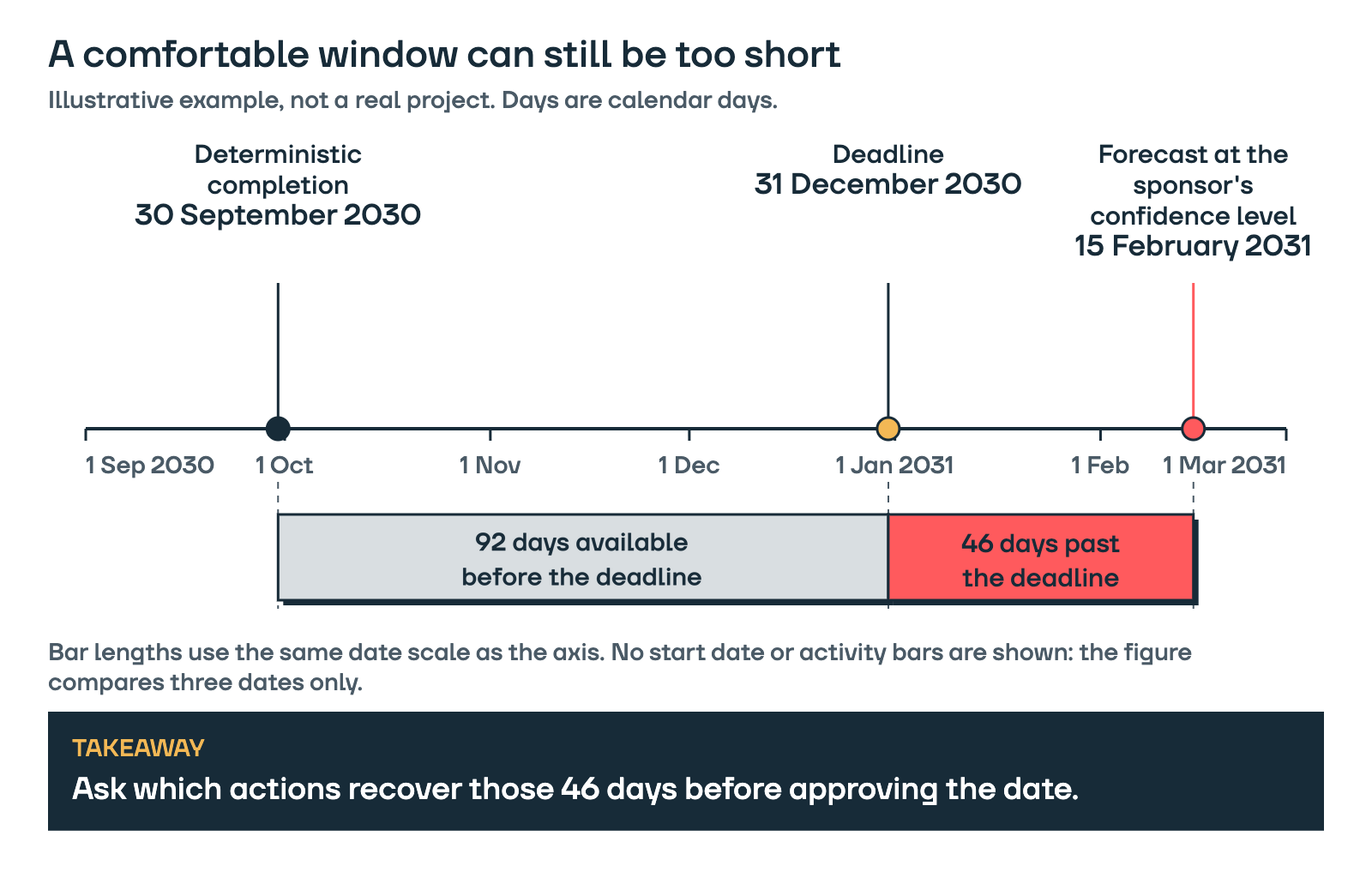
In an invented example that describes no real project, the schedule's deterministic completion is 30 September 2030 and a contractual or regulatory deadline falls on 31 December 2030. If the forecast at the confidence level the sponsor uses lands on 15 February 2031, that forecast date falls 46 days after the deadline, and the committee's question becomes which actions recover those days and what they cost.
Illustrative only: a comfortable window before the deadline can still be too short once the forecast lands 46 days past it.
Mitigation Strategies, the scenario tester in Insights Pro, lets the team test proposed actions against the same forecast, and Schedule Optimisation, part of Insights Pro, sets out practical options such as rephasing, fast-tracking, acceleration and scope deferral, each with the days it recovers and the reasoning behind it. These are modelled options for the committee to weigh; none has been achieved yet.
What goes in the schedule evidence review table?
Evidence and open questions by area
Area
What supports it
Open question to record
Maturity
Schedule class matched to defining deliverables
Which deliverables are still incomplete?
Scope
Trace from estimate scope to schedule activities
What owner scope has no activities?
Interfaces
Matching giver and receiver milestones
Which hand-off dates disagree?
Milestones
One written definition per key milestone
Which contracts define it differently?
Forecast
Milestone forecast and driving paths from the current schedule
Which assumptions drive the gap to plan?
Mitigation
Options tested against the same forecast
Which option is feasible, and at what cost?
Worked example: status, owner and next decision
Area
Accountable owner
Status and next decision
Maturity
Engineering lead
Supported. Accept the schedule class.
Scope
Lead planner
Supported. Confirm that all owner work is in the schedule.
Interfaces
Interface manager
Open. Report by 8 June 2029 on hand-offs outside the proposed approval scope.
Milestones
Contract manager
Supported. Use the agreed milestone definitions.
Forecast
Project controls lead
Supported. Present the dates supported by the current forecast.
Mitigation
Project director
Blocking. Test a feasible option and report its cost by 15 June 2029.
Mark every row supported, open or blocking: supported means the evidence backs the date, open means a named person is investigating a gap and will report by a stated date, and blocking means the committee cannot rely on the date until the item is resolved. The committee can accept an open item only if it does not block the decision and does not undermine a proposed date. If the missing evidence is needed to rely on a proposed date, resolve the finding or defer approval.
How do Great Britain and the United States frame the investment gate?
Investment approval belongs to each owner's own governance, so there is no universal chain of gates. Public sponsorship, contracts and regulatory authorisations still add criteria and dated obligations the pack should test, and they differ between the two markets.
What does the gate look for in Great Britain?
For projects that go through government assurance, the Gate 3 Review: Investment Decision workbook from the National Infrastructure and Service Transformation Authority (NISTA), updated 20 August 2026, examines the full business case "to confirm that the project is still required, affordable and achievable within the proposed time." Its questions include whether the project is "founded upon realistic timescales, taking account of statutory lead times, and showing critical dependencies (including external) such that any delays can be handled", and its evidence notes say a project may have undertaken a QSRA. That is close to the evidence pack described here: realistic timescales, consents and external dependencies in the logic, and a quantified view of schedule risk.
A generator holding a Contract for Difference also carries dated contract obligations. The Allocation Round 7 standard terms, finalised on 31 July 2025, require a Milestone Requirement to be met by the Milestone Delivery Date, through either the Project Commitments route or the 10% spend route, and set a Longstop Period. Those dates belong in the pack beside the forecast. Regulators grant consents and the counterparty administers the contract, while the owner secures each one, so every such obligation needs an accountable owner in the review table.
What does the gate look for in the United States?
For federal programmes, GAO's Schedule Assessment Guide (GAO-16-89G) sets the expectation directly: "Programs should include the results of the schedule risk analysis in constructing an executable baseline schedule." It is a detailed public US reference for what a reliable schedule contains, and its practices give a private energy owner a clear standard for what to ask of contractors' schedules.
Federal authorisations can also put a date on the project. The Federal Energy Regulatory Commission's 2019 order for the Rio Grande LNG terminal required it to complete construction and make the terminal available for service within seven years, by 22 November 2026. The Commission later extended that deadline to 22 November 2028, and in April 2026 the developers asked for a further extension to 22 November 2031, stating that the final train was scheduled to enter service in the second quarter of 2031. An earlier request in 2022 had linked the timing to reaching a final investment decision. For any US energy owner, an authorisation deadline is a dated constraint to read the investment-stage forecast against, and moving it is a separate request to the Commission.
Where does the evidence pack stop?
The pack informs the committee's judgement, and the decision stays with the committee. A forecast gives the committee the likelihood of each date and the drivers behind it; it is not financial approval and it does not guarantee a completion date. Planners and engineering leads still validate scope, interfaces and execution assumptions, and sponsors judge how much of the remaining uncertainty they can accept.
Sometimes only an early benchmark exists and there is no mature schedule yet. In that case, say plainly what the benchmark can support, such as a plausible duration envelope and a decision to fund further front-end work, and what it cannot, such as a committed contract date. The pack is then incomplete, and the review table shows which deliverables and which schedule work will complete it.
What should you resolve before the committee date?
Before the committee date, resolve every blocking row and make sure the dates on the cover of the paper match the forecast you are prepared to defend. If the forecast and the deadline leave no room, bring the tested mitigation options and their costs to the committee alongside the dates, so the decision covers the recovery plan as well as the commitment.
Can a schedule forecast approve a final investment decision?
No. A forecast shows how likely the milestone dates are and which activities and paths drive the risk, based on the schedule supplied. The sponsor and the investment committee decide whether the remaining uncertainty is acceptable, and financial approval stays with them.
What schedule maturity does AACE link to investment approval?
AACE International's schedule classification system lists budget and authorisation among the end uses of a Class 3 schedule, prepared at roughly 10% to 40% of complete project definition. Owners can define their own classes, so ask which class the defining deliverables actually support.
Does an independent forecast need a fully detailed schedule?
It needs a logic-linked schedule that represents the proposed work. Insights Pro forecasts from the schedule you upload, so missing scope or logic limits what the forecast can tell you. Before any such schedule exists, a reference-class benchmark is the better tool.
Who should own the schedule evidence review table?
The owner's sponsor or project director should hold the table and present it with the committee papers. Planners, engineering leads, contract managers and consents leads each own the findings in their area and the response due before the committee date.
By clicking “Accept all”, you agree to the storing of cookies on your device to enhance site navigation, analyse site usage, and assist in our marketing efforts. Find more information on our use of cookies here.