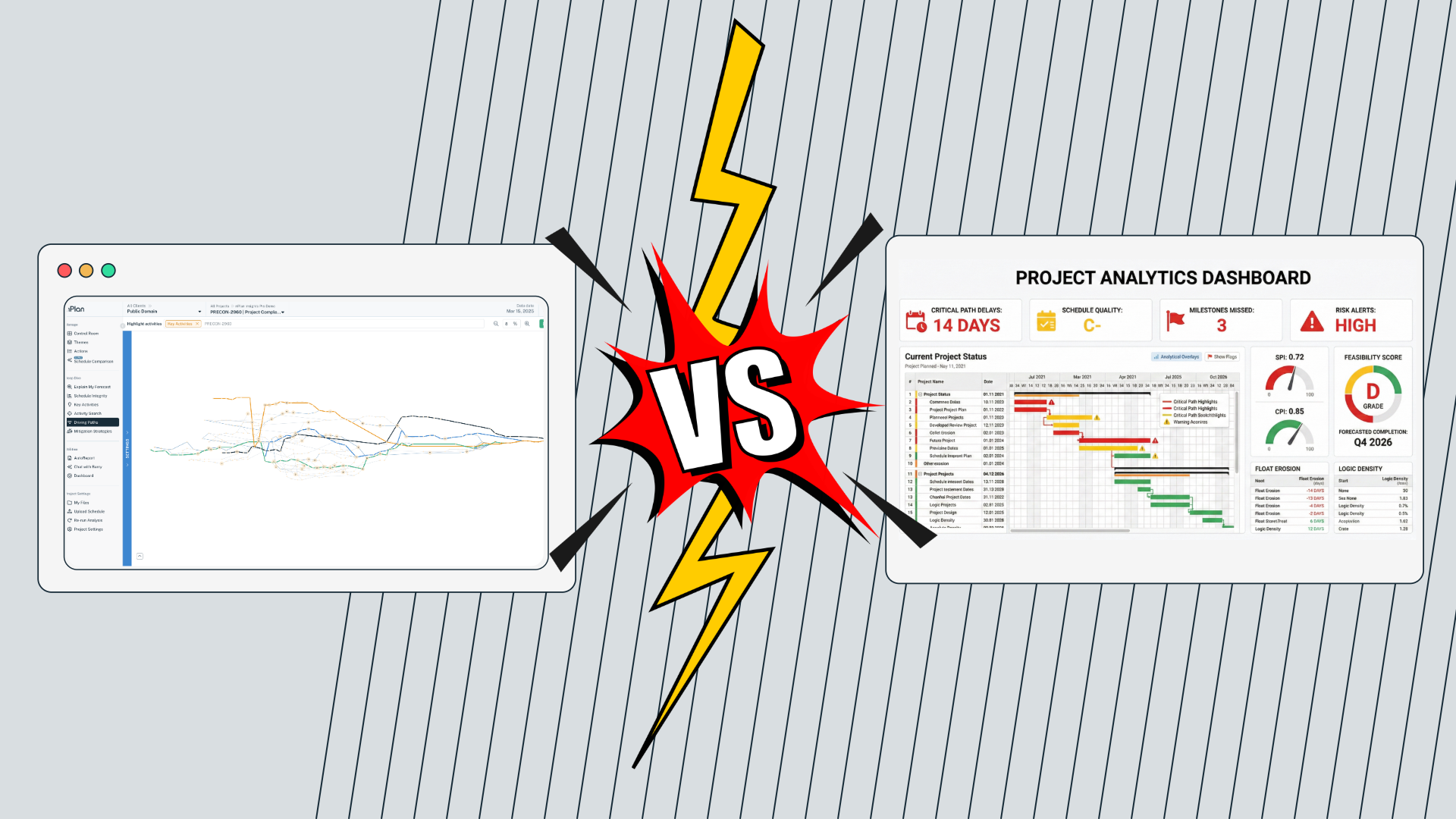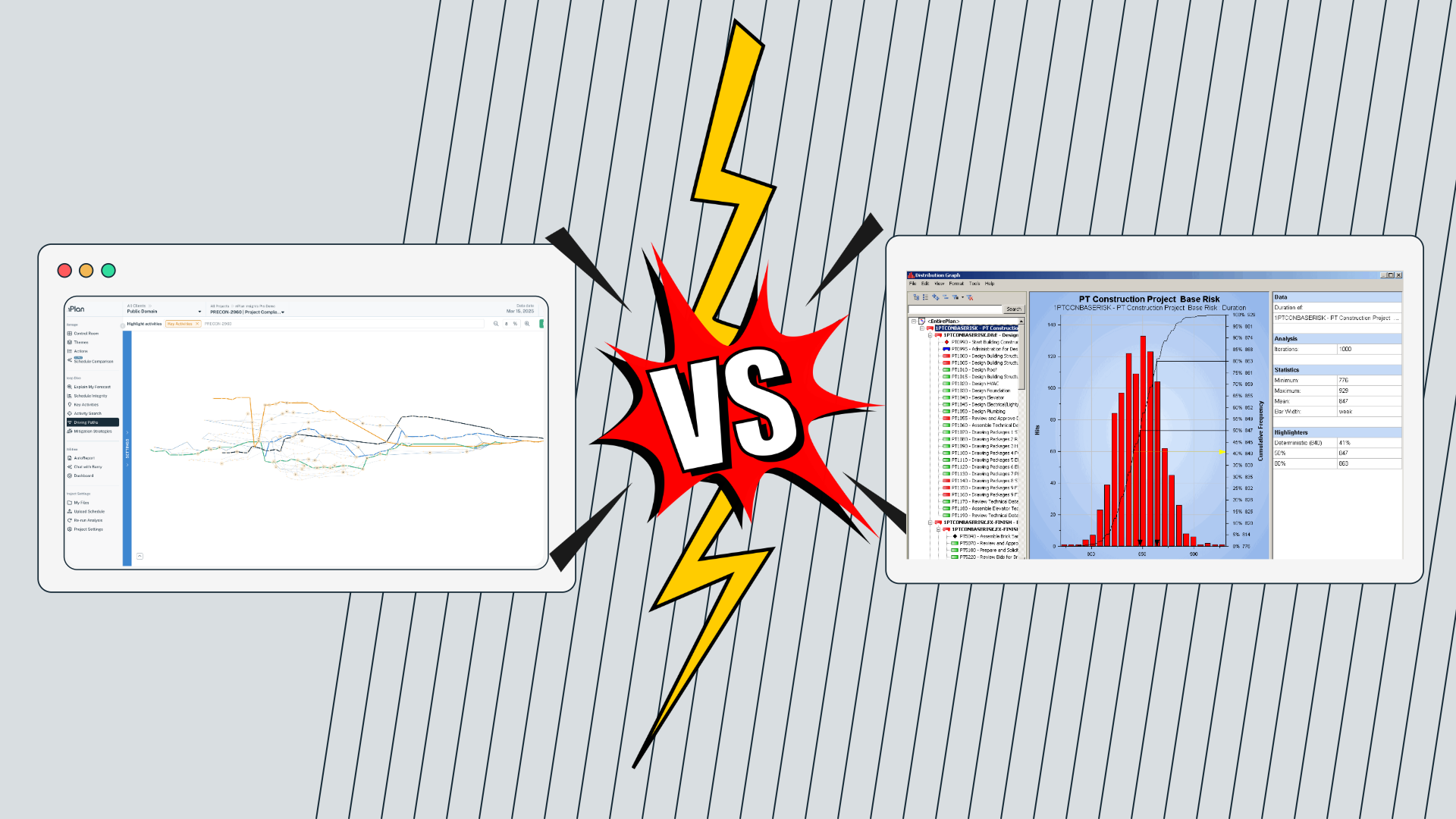
Traditional risk software vs nPlan
Traditional QSRA tools simulate ranges your team estimates; nPlan's AI-SRA forecasts every activity from 780,000+ past project schedules on each update.

Updated 27 October 2026
TLDR: For project controls and risk leads who run QSRA in tools such as Safran Risk, Deltek Acumen Risk or Oracle Primavera Risk Analysis: traditional risk software simulates duration ranges your team estimates in workshops, while nPlan's AI-SRA forecasts every activity from more than 780,000 past project schedules on each update. The two work well side by side.
If you're delivering a large capital project, you already know the questions that matter:
- When will we most likely finish?
- Where is the schedule risk coming from?
- How confident should we be in the plan we're presenting?
Our view is that the choice between traditional risk software and nPlan is rarely one or the other. QSRA remains the right tool for formal, governed analysis at key decision points, and AI-SRA keeps an evidence-based forecast current on every schedule update in between, so those three questions have a fresh answer each time the schedule changes.
Insights Pro · Driving Paths
Forecast every activity on your next schedule update and see which paths carry the most delay-causing potential, alongside the QSRA you already run.
See how Insights Pro worksWhat is the difference between traditional risk software and nPlan?
Traditional risk software runs a quantitative schedule risk analysis (QSRA): the project team estimates duration ranges and risk events, and a Monte Carlo simulation turns them into a range of possible finish dates. nPlan runs an AI-led schedule risk analysis (AI-SRA): machine-learning models trained on how past projects actually performed forecast every activity in the schedule, and those forecasts roll up into the same kind of probabilistic view. The difference lies in where the uncertainty comes from and how often it can be refreshed.
For decades, the industry's answer to these questions has been Quantitative Schedule Risk Analysis (QSRA), supported by tools like Safran Risk, Deltek Acumen Risk, and Oracle Primavera Risk Analysis. These tools formalised probabilistic thinking in project controls and became embedded as best practice across major programmes.
Now a different approach has emerged: AI-led Schedule Risk Analysis (AI-SRA). Not as a replacement for probabilistic thinking, but as a response to a constraint that has existed until now: the dependence on limited, biased opinion for the quantification of risk and the inability to analyse complex schedules to gain insights from them. If you want a detailed explanation about nPlan vs traditional risk software, download our whitepaper, From QSRA to AI-SRA.
At a high level, the difference can be summarised simply:
- Traditional QSRA asks: "What outcomes are plausible, given what we think we know?"
- AI-SRA asks: "What outcomes are likely, based on the data and augmented by our experience?"
QSRA evolved to cope with limited data and computational power. AI-SRA exists because those constraints no longer apply.
How does traditional QSRA software work?
QSRA software takes a critical path schedule, attaches uncertainty to its activities and runs many simulated versions of the project to show how likely each finish date is. The US Government Accountability Office's Schedule Assessment Guide (GAO-16-89G, December 2015) sets out the purpose: a schedule risk analysis predicts the level of confidence in meeting a completion date, the contingency of time needed for that confidence, and the high-priority risks.
The uncertainty in a QSRA comes from the people who know the project. GAO describes two ways to collect it: three-point duration estimates (optimistic, most likely and pessimistic) and a risk driver approach that models identified risk events with their probabilities and effects. Both start from the project's risk register and rely on interviews and workshops with the subject matter experts closest to the work. AACE International's recommended practice 57R-09 describes the risk driver method for integrated cost and schedule risk analysis using Monte Carlo simulation of a critical path model.
The established tools are built for this job. Safran describes Safran Risk as combining schedule risk with cost risk analysis on a single platform, including joint confidence levels, and Deltek describes Acumen as quantifying cost and schedule uncertainty with Monte Carlo simulation, running thousands of simulations in seconds.
The simulation is rarely the slow part. The elapsed time sits in the inputs: preparing a schedule the analysis can handle, arranging workshops and interviews, and agreeing ranges. GAO is open about the human side of that process, noting that risk workshops "may exhibit social and institutional pressures to conform" and advising that experts are interviewed without an authoritative figure in the room. Because of that collective effort, a full QSRA is usually refreshed at set points in a project rather than on every update.
How does nPlan's AI-SRA work?
AI-SRA takes its duration uncertainty from how past projects actually performed: our models forecast each activity in the schedule, and those forecasts roll up into the probabilistic output project controls teams already use.
Because the forecast works at activity level, it does not need a near-identical past project in the dataset. Our models learn how different types of work actually perform and apply that to each activity in the context of your schedule. We work with the schedules teams already have, uploaded from Primavera P6, Asta Powerproject or Microsoft Project, and we analyse the full native logic of the schedule.
That matters most where a slipped milestone carries a direct cost. A delayed grid connection holds up the generators waiting to connect, a rail possession that overruns disrupts services and pushes the remaining work to the next available slot, and every day of delay on an oil, gas or LNG start-up is a day of lost production. Our dataset also spans data centres, highways and heavy infrastructure.
In nPlan Insights Pro, the forecast feeds Driving Paths, which shows the paths most likely to move a key milestone, and Mitigation Strategies, which lets the team test and communicate mitigation options against the forecast. Schedule Optimisation is included in Insights Pro and finds practical ways to bring a key milestone forward, such as rephasing, fast-tracking, acceleration or scope deferral, showing the days each option recovers and the reasoning behind it. Planning teams without a dedicated risk function can start with Insights Core, which gives a forecast on every schedule upload, driving paths and a comparison between schedule updates.
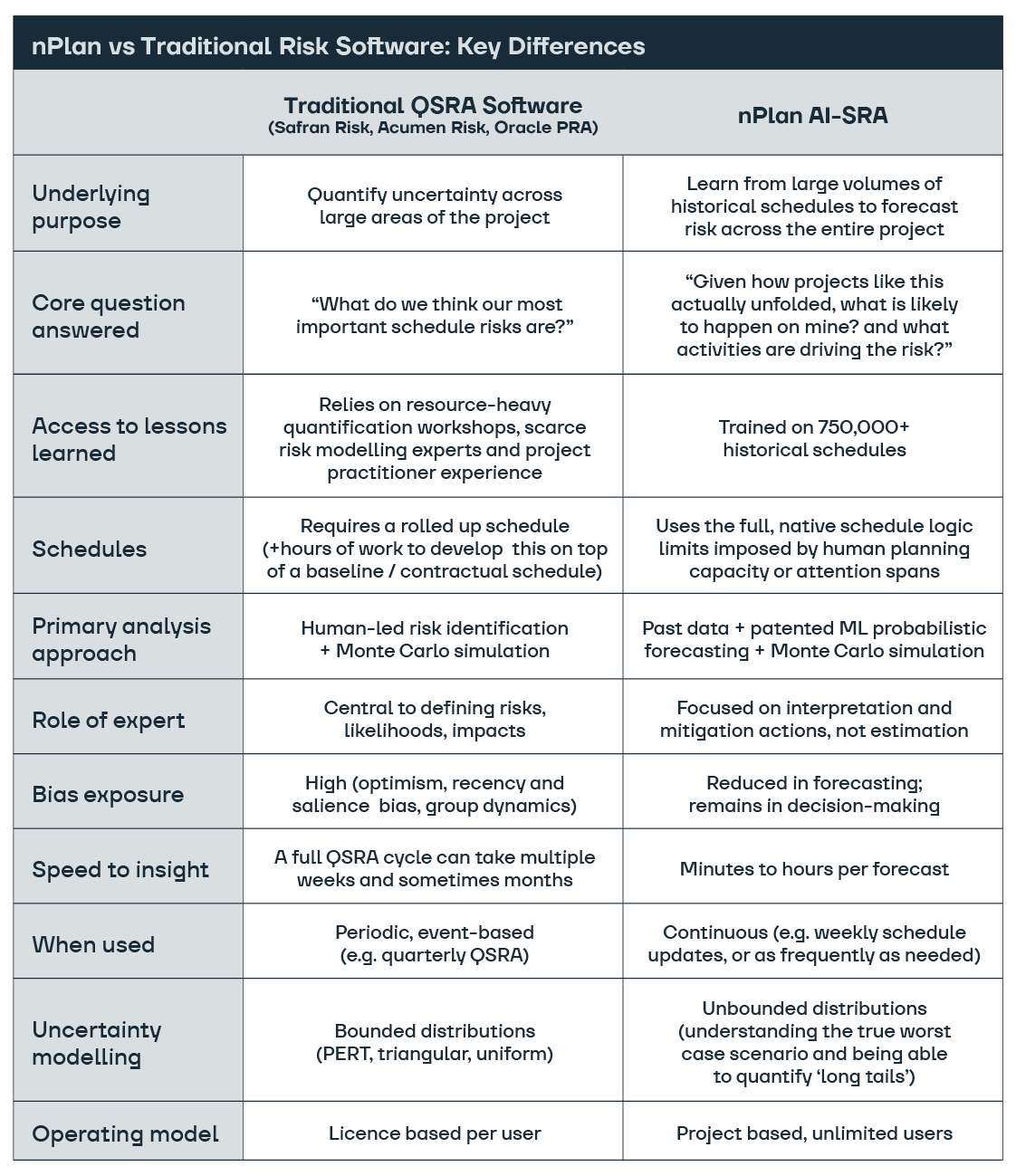
nPlan vs traditional risk software: key differences
Side by side, the two approaches produce the same kind of probabilistic answer from different inputs, on a different rhythm.
The main differences:
| Dimension | Traditional QSRA software | nPlan AI-SRA |
|---|---|---|
| Purpose | Quantify uncertainty across large areas of the project | Forecast risk across the whole project from past schedules |
| Lessons learned | Workshops, risk modelling experts and practitioner experience | More than 780,000 past project schedules |
| Schedule used | Usually a rolled-up schedule built for the analysis | The full native schedule and its logic |
| Method | Human-led risk identification plus Monte Carlo simulation | Patented machine-learning forecasts plus Monte Carlo simulation |
| Expert's role | Defines risks, likelihoods and impacts | Interprets forecasts and chooses mitigation actions |
| Bias exposure | Optimism, recency and salience bias, plus group dynamics | Reduced in forecasting; remains in decision-making |
| When used | Periodic or event-based, for example a quarterly QSRA | Every schedule update, or as often as needed |
| Uncertainty model | Bounded distributions such as PERT, triangular or uniform | Unbounded distributions that can quantify long tails |
nPlan's models are trained on more than 780,000 past project schedules, learning patterns in activity sequencing, duration growth, logic structure, and delivery outcomes. When a new schedule is uploaded, every activity is analysed in context, not in isolation.
The output is a probabilistic forecast for each activity, which then rolls up into a project-level view of schedule risk.
Crucially, this forecast can be regenerated every time the schedule changes, without repeating workshops or rebuilding models from scratch.
Why this matters for teams already using QSRA tools
For teams already using Safran Risk, Acumen Risk, or Oracle PRA, the question is rarely "Should we abandon QSRA altogether?"
More often, it is:
- Why do our QSRAs feel disconnected from day-to-day delivery?
- Why do we only revisit schedule risk periodically?
- Why do the same issues keep surprising us during execution?
- How can we use our time managing risk rather than just quantifying it?
- Why don't I trust what my teams are telling me?
AI-SRA does not challenge the value of probabilistic thinking. It challenges the idea that uncertainty must be estimated manually and infrequently.
A simple count shows how infrequent that can be in practice.
Illustrative scenario (assumptions labelled, not a real project). A 36-month programme updates its schedule every month and runs a full QSRA every quarter. That gives 36 schedule updates and 12 QSRAs (36 ÷ 3). On 24 of the 36 updates, two in every three, the monthly report carries a risk view last refreshed one or two months earlier. Running an AI-SRA forecast on every update gives all 36 a current, activity-level view, and the quarterly QSRA keeps its role as the governed checkpoint.
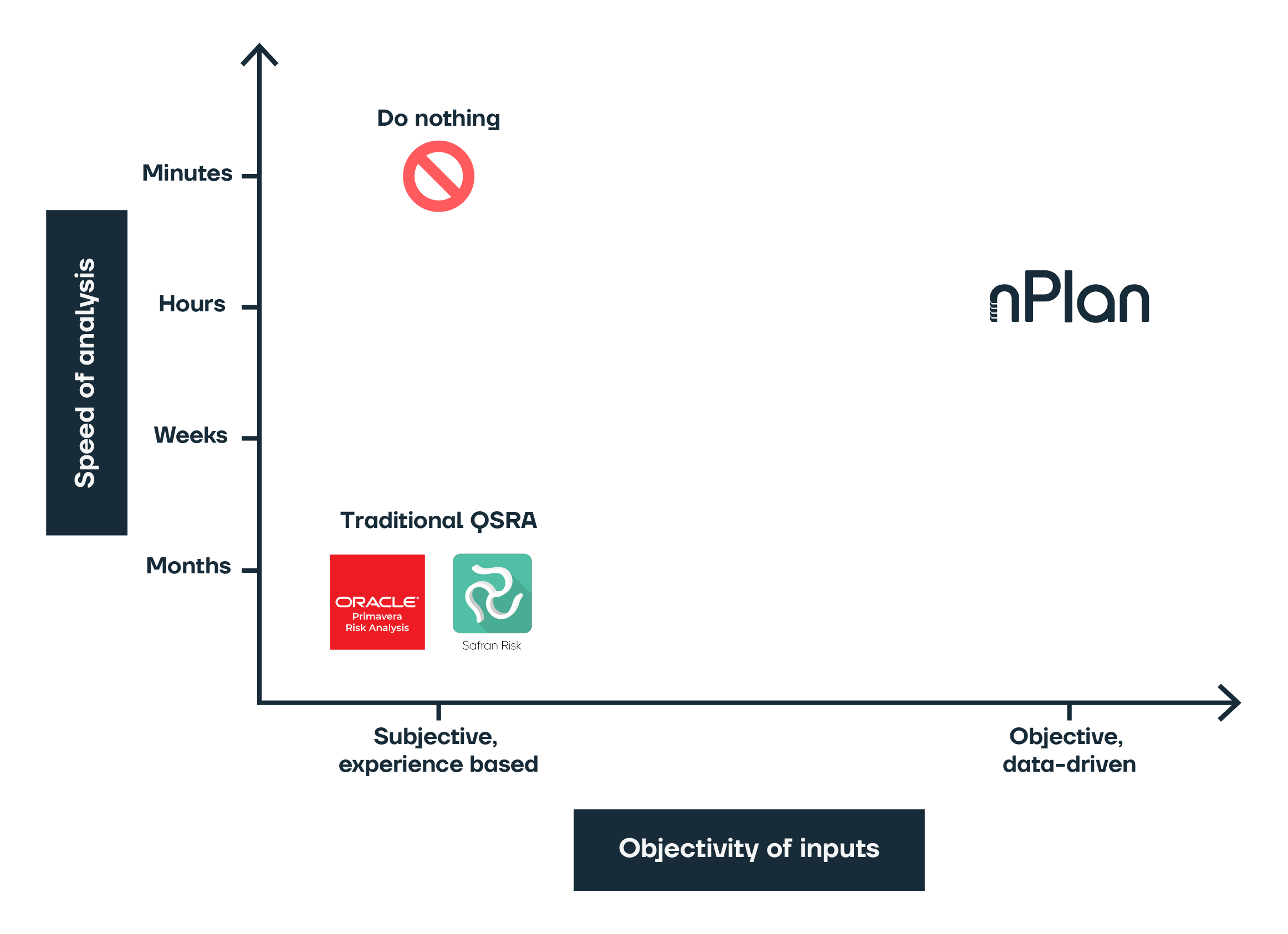
The chart below places traditional QSRA, nPlan and doing nothing by how objective their inputs are.
Our joint case study with the Transpennine Route Upgrade shows the same approach on a live railway: the 122 km line between Manchester and York is being electrified and re-signalled, with the most congested sections doubled from two tracks to four, and the project team uses nPlan forecasts on that programme. The full case study, available to download from that page, explains how the forecasts fit into the team's work.
When is traditional risk software the better call?
Traditional QSRA software is the better first choice in several situations, and AI-SRA is not always the right starting point.
- The contract or funder prescribes the method. Where a contract, lender or sponsor specifies a particular risk analysis, run it as required and use AI-SRA as an independent challenge to its results.
- You need a formal integrated cost and schedule risk model. When the brief is to size cost and time contingency from named risk events, as in AACE 57R-09, a dedicated QSRA tool is designed for exactly that work.
- The schedule cannot yet calculate a sound date. If logic is missing or the file is a summary, fix the structure first, because no forecast can be better than the network it reads.
- There is no detailed schedule yet. A top-down comparison with similar completed projects is more useful at that stage, as our piece on reference class forecasting explains, and Schedule Studio can turn scope documents into a logic-linked first draft for your planners to review and refine.
How do UK and US guidance treat schedule risk?
Both markets expect an evidence-based view of schedule uncertainty, through different guidance.
What does UK government guidance expect?
In the UK, HM Treasury asks appraisers to correct for optimism using evidence from past projects. Its Green Book supplementary guidance on optimism bias says adjustments should be "based on data from past projects or similar projects elsewhere", and gives upper-bound works duration uplifts of 4 percent for standard buildings, 25 percent for non-standard civil engineering and 54 percent for equipment and development projects. Those uplifts come from a 2002 Mott MacDonald study and should only be reduced when there is clear and tangible evidence that the causes of delay are being managed.
As an illustration, a non-standard civil engineering scheme with a 30-month works estimate would carry the 25 percent upper bound, an extra 7.5 months (30 × 0.25), until that evidence exists. A forecast drawn from how past projects actually performed gives the appraisal team project-specific evidence to set beside those generic uplifts, while the guidance itself still governs how any reduction is justified.
What does US federal guidance expect?
In the US, GAO's Schedule Assessment Guide makes schedule risk analysis its eighth best practice and says programmes should include its results when building an executable baseline. GAO expects a schedule risk analysis when the baseline is formed, preferably before key decision points, and again as needed, for example when schedule contingency is used up faster than expected. It also states that risk data "should not be based on arbitrary percentages or factors".
Some US agencies set an explicit confidence target. NASA's NPR 7120.5F requires single-project programmes to be planned and budgeted at Key Decision Point C on a 70 percent joint cost and schedule confidence level, or another level the Decision Authority approves with written justification. For teams working to a confidence target like that, a forecast refreshed on each update shows whether the plan is still holding the level it was baselined at.
Wrap up
Traditional QSRA has played an important role in improving how major projects think about risk. It introduced probabilistic language, formal governance, and discipline into schedule forecasting.
AI-SRA represents the next step in that evolution: continuous, data-driven schedule assurance grounded in how projects actually behave, not just how we think they might. While allowing project experts to utilise their time actually aiding project delivery.
As delivery environments become more complex and schedules change more frequently, the ability to re-forecast risk at the activity level is becoming less of a "nice to have" and more of a practical necessity.
Insights Pro · Schedule Optimisation
Once the forecast shows where the risk sits, Schedule Optimisation, included in Insights Pro, sets out practical options to bring a key milestone forward and the days each one recovers.
Book a call with our teamFrequently asked questions
What is AI-SRA?
AI-SRA, or AI-led schedule risk analysis, is our approach to schedule risk: models trained on more than 780,000 past project schedules forecast every activity in your schedule, and those forecasts roll up into a probabilistic view of key milestones and the finish. It keeps the probabilistic output of QSRA and changes where the uncertainty comes from.
Does nPlan replace Safran Risk, Acumen Risk or Primavera Risk Analysis?
Not necessarily. A team can keep its QSRA tool for governed analyses at key decision points and use nPlan for an independent, activity-level forecast on each schedule update. Where a contract prescribes a particular risk analysis, follow it and use AI-SRA as a challenge to its results.
Which schedule formats does nPlan work with?
We work with the schedules teams already have, uploaded from Primavera P6, Asta Powerproject or Microsoft Project. Portfolio forecasts can also feed into Power BI for teams reporting across many projects.
How often should a schedule risk analysis be updated?
GAO's guide expects a schedule risk analysis when the baseline is set, preferably before key decision points, and whenever schedule contingency is being used up faster than expected. An AI-SRA forecast can be run on every schedule update, so the risk view moves with the schedule between those formal points.
Can AI-SRA help before a detailed schedule exists?
A forecast needs a schedule to read, so the first step is a credible draft. Schedule Studio turns scope documents into a logic-linked first schedule with a work breakdown structure, durations and critical path for planners to review and refine, and it exports to P6. Schedule Studio is free to try, and once the schedule exists it can be forecast like any other.
Sources
- GAO Schedule Assessment Guide: Best Practices for Project Schedules (GAO-16-89G), December 2015
- AACE International Recommended Practice 57R-09: Integrated Cost and Schedule Risk Analysis Using Risk Drivers and Monte Carlo Simulation of a CPM Model
- HM Treasury, Green Book supplementary guidance: optimism bias
- NASA NPR 7120.5F, Space Flight Program and Project Management Requirements, Chapter 2
- Safran, Safran Risk product page
- Deltek, Acumen product page
- nPlan, From QSRA to AI-SRA (white paper)
- nPlan and Transpennine Route Upgrade, Using AI to de-risk delivery and build trust with passengers during the Transpennine Route Upgrade project (joint case study)
- nPlan Insights Pro
- nPlan Insights Core
- nPlan Schedule Studio
- nPlan, Why we built Driving Paths
- nPlan, Reference Class Forecasting (RCF) vs nPlan