What should you check before using an AI-generated tender programme?
For bid teams and owners: before an AI-generated programme goes into a tender, trace scope, record assumptions, test sequence and confirm each committed date.

TLDR: For bid teams and owner-operators, an AI-generated tender programme is ready to submit only when every tender requirement maps to an activity or a logged gap, its assumptions are written down, the people who will build the work have tested its sequence, and the bid lead has confirmed each date the business will commit to.
The draft arrives looking finished, with a work breakdown structure, logic links and durations your planners would otherwise have spent the first stretch of the tender window building. That polish is useful, but a tidy Gantt chart tells you nothing about whether the access restriction in appendix F made it into the logic.
Our view is that a generated programme is a well-organised first draft that your team has to accept, line by line, before it carries your name. The acceptance step turns missing work into a question with an owner before submission, instead of an assumption nobody checked.
Schedule Studio · Assumption review
Validate the AI's assumptions about your scope, phase by phase, before detailed schedule generation, so the draft you trace against the tender starts from your intent.
Try Schedule Studio freeWhat should you check before accepting the draft?
Check four things, in this order, because each depends on the one before it. The US Government Accountability Office puts the dependency plainly in its scheduling guide: "If activities are missing from the schedule, then other best practices will not be met" (GAO-16-89G Schedule Assessment Guide).
- Scope coverage: trace every tender requirement to an activity, or log it as a gap.
- Assumptions: record what the draft assumed where the documents were silent.
- Sequencing and interfaces: test the logic and the real constraints of this site and these parties.
- Commitments: reconcile milestones with the dates and qualifications the business will offer.
Does every tender requirement have an activity?
Work from the tender documents to the programme, never the other way round. Asking whether the draft looks complete only tests the work it already contains; reading the scope, specification, drawings register, phasing constraints and key dates line by line tests what the client asked for.
Include work your own team will not do. GAO's first best practice says the schedule should cover activities "both the owner and contractors are to perform", which in a tender means client design approvals, possessions or outages, utility diversions, consents and the supply of client-provided materials. These are the activities a generated draft is least likely to know about, because they often sit in correspondence and clarifications rather than in the scope document you uploaded.
Which assumptions did the draft make for you?
Every draft fills silence in the documents with assumptions, and a generated draft makes them less visibly than a planner working by hand would. Working calendars, shift patterns, typical durations, the shape of the work breakdown structure and anything treated as out of scope all need writing down where the bid team can see them.
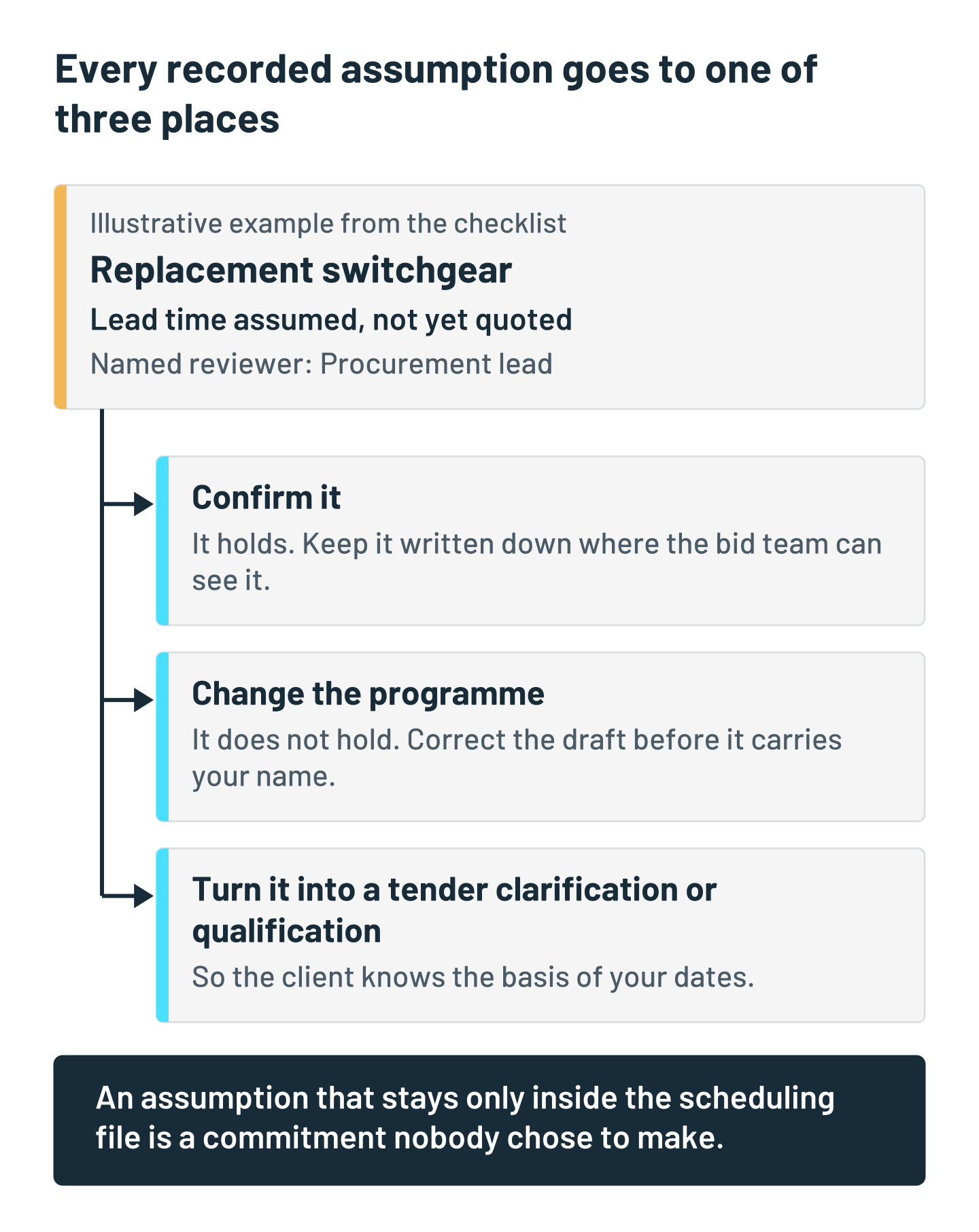
Once recorded, each assumption has one of three destinations: confirm it, change the programme, or turn it into a tender clarification or qualification so the client knows the basis of your dates. An assumption that stays only inside the scheduling file is a commitment nobody chose to make.
Does the sequence work on this site, with these interfaces?
Start with the mechanical checks: open ends, activities without a predecessor or successor, hard date constraints and long lags that hold the logic together artificially. Then hand the draft to the people who will build the work, because logic can be perfectly valid and still describe a job that cannot be done that way.
The planning team owns the questions only they can answer. Can the chosen method actually be used here? Does the sequence respect access routes, possession or outage windows and working-hour limits? Are supplier lead times quoted or guessed? Do design release and consents arrive before the work that depends on them? On a UK NEC4 contract, clause 31.2 also asks for the dates when the contractor needs access, acceptances and information from others, so a programme that omits them is incomplete as well as optimistic (GMH Planning, ECC clause 31.2).
Can the business commit to these dates?
Compare every key milestone in the draft with the dates the tender requires. Where the draft finishes later than a required date, someone has to decide whether to resequence, add resource, price the risk or qualify the bid.
On a UK NEC4 contract, those dates are the Completion Date, any Key Dates and any sectional completion. NEC4 also asks for float and time risk allowance to be shown, so make both visible rather than buried in durations.
On a US contract, the dates to test are Substantial Completion and the interim milestones in the bid documents, along with the start and completion dates FAR 52.236-15 asks for on federal work.
That decision belongs to the bid lead, who confirms which dates and qualifications the business can stand behind, because the business that signs the contract carries the delay damages attached to them.
What does a tender programme acceptance checklist look like?
An acceptance checklist is one row per tender requirement, showing where the requirement comes from, which activity delivers it, what is still unresolved and who must close it. The rows below are illustrative, for a hypothetical UK water pumping station refurbishment under NEC4. The first table traces each requirement to its source and activity.
| Requirement | Supporting document | Corresponding activity |
|---|---|---|
| Keep station running | Scope, operational constraints | Temporary over-pumping: install, commission, remove |
| Client design review | Scope, submittals procedure | Client review after each design package |
| Replacement switchgear | Specification, electrical section | Procurement, delivery, installation, testing |
| Ecology survey | Consents schedule | None in the draft |
| Inlet works by Key Date 1 | Contract Data part one | Inlet works completion milestone |
The second records what is still open and who must close it.
| Requirement | Unresolved gap | Named reviewer |
|---|---|---|
| Keep station running | Permitted shutdown length not stated | Planning lead, by tender clarification |
| Client design review | None: period matches the procedure | Planner |
| Replacement switchgear | Lead time assumed, not yet quoted | Procurement lead |
| Ecology survey | Add the survey and confirm its seasonal window | Environmental lead |
| Inlet works by Key Date 1 | Draft finishes after Key Date 1 | Bid lead |
Two rules keep the checklist reliable. No requirement may have an empty activity cell without an entry in the gap column, and no gap may leave the bid meeting without a reviewer and one of four decisions: add the activity, raise a clarification, price it as a risk, or qualify the tender. The ecology row is the one that matters most, because it is the kind of omission a polished draft hides best.

The same structure works for owners scoring tenders, and our own tender work shows why a forecast alone is not enough. In a 2023 tender evaluation for a government agency overseeing two highway projects, we analysed four bid schedules for its tender review. Of the two bids the case study compares in detail, the one forecast more likely to finish on time was the less developed plan: that contractor "was found to not have properly linked many of the preliminary and design activities". An owner who asks each bidder for the requirement trace alongside the programme sees that gap before award, not after.
Why can a tender programme become the dates you are held to?
A tender programme can bind you because what you submit is scored, read as evidence of how you will deliver, and in some contracts made contractual. That is why the checks above matter, and the mechanism differs by market.
How can a UK tender programme become contractual?
Under NEC4, a programme identified in Contract Data part two becomes the first Accepted Programme, because clause 11.2(1) defines that term as "the programme stated in Contract Data or latest programme accepted by the Project Manager" (CECA NEC4 Bulletin 49, January 2025). The same bulletin notes that the programme can carry a significant share of the tender score.
A client unhappy with a tender programme can insist on deleting that reference before signing. Clause 50.5 then allows 25% of the Price for Work Done to Date to be withheld until the contractor submits a first programme showing the information the contract requires. A weak tender programme therefore either binds you or brings that retention back into play.
How do US owners judge a proposed schedule?
US federal owners can score a proposed schedule on its logic as well as its finish date. On a best-value hospital procurement, the US Army Corps of Engineers asked offerors for a summary construction schedule "based upon a critical path methodology" and assessed whether it supported the proposed duration, drawing on "independent judgment concerning logic, constraints, and typical construction durations" (GAO decision B-407998.2, 21 May 2013).
After award, federal construction contracts require an approved, practicable schedule. A contractor that falls behind it must take the steps needed to improve progress "without additional cost to the Government" (FAR 52.236-15).
What do UK and US teams mean by a tender programme or a bid schedule?
In the UK, the tender programme is the time plan submitted with the tender.
In US public works, the schedule in a bid is often a priced list. Indiana DOT's standard specifications, for example, define the Schedule of Pay Items as "A part of the Proposal which shows pay items, quantities, and pay units for the contract", which the bidder completes with unit prices and bid amounts (INDOT Standard Specifications, section 101.54). The time plan is a separate construction schedule, so check whether the documents mean the price form, a time schedule, or both.
| Point | UK tender programme | US bid schedule |
|---|---|---|
| Meaning | The time plan submitted with the tender | Often a priced list of pay items; the time plan is separate |
| Detailed plan due | At tender if asked, or within the Contract Data period | Often after award; FAR 52.236-15 sets five days after work starts |
| Can become | The first Accepted Programme, if named in Contract Data part two | Proposal milestones and durations shape the dates you are held to |
| Must show | Key dates, order of work, float, time risk allowances, access dates, resources | Order of work, and start and finish dates for salient features |
The UK column follows NEC4 clause 31.2 as summarised by GMH Planning. The US column follows FAR 52.236-15, whose five-day period runs unless the contracting officer sets another.
The US double meaning creates a check of its own. If the price form lists a pay item that has no activity in the time schedule, either the price or the programme is wrong, so reconcile the two before either goes in.
When should you submit less than the draft contains?
Submit less when the detail would commit the business to more than the tender asks or more than you know. A generated draft can run to thousands of activities, and if the tender asks only for key dates and a summary sequence, everything extra you submit may become something you are measured against.
That risk is sharpest on a UK NEC4 contract, where a programme named in Contract Data part two becomes the first Accepted Programme. On US work, it applies where the specification calls for a detailed proposed schedule at bid stage.
The same caution applies when the scope is thin or still moving. If clarifications are outstanding, any draft, generated or built by hand, encodes guesses, so keep the submitted programme at the level the documents can support, carry the detail internally, and qualify what is not yet known.
Where does Schedule Studio fit into the review?
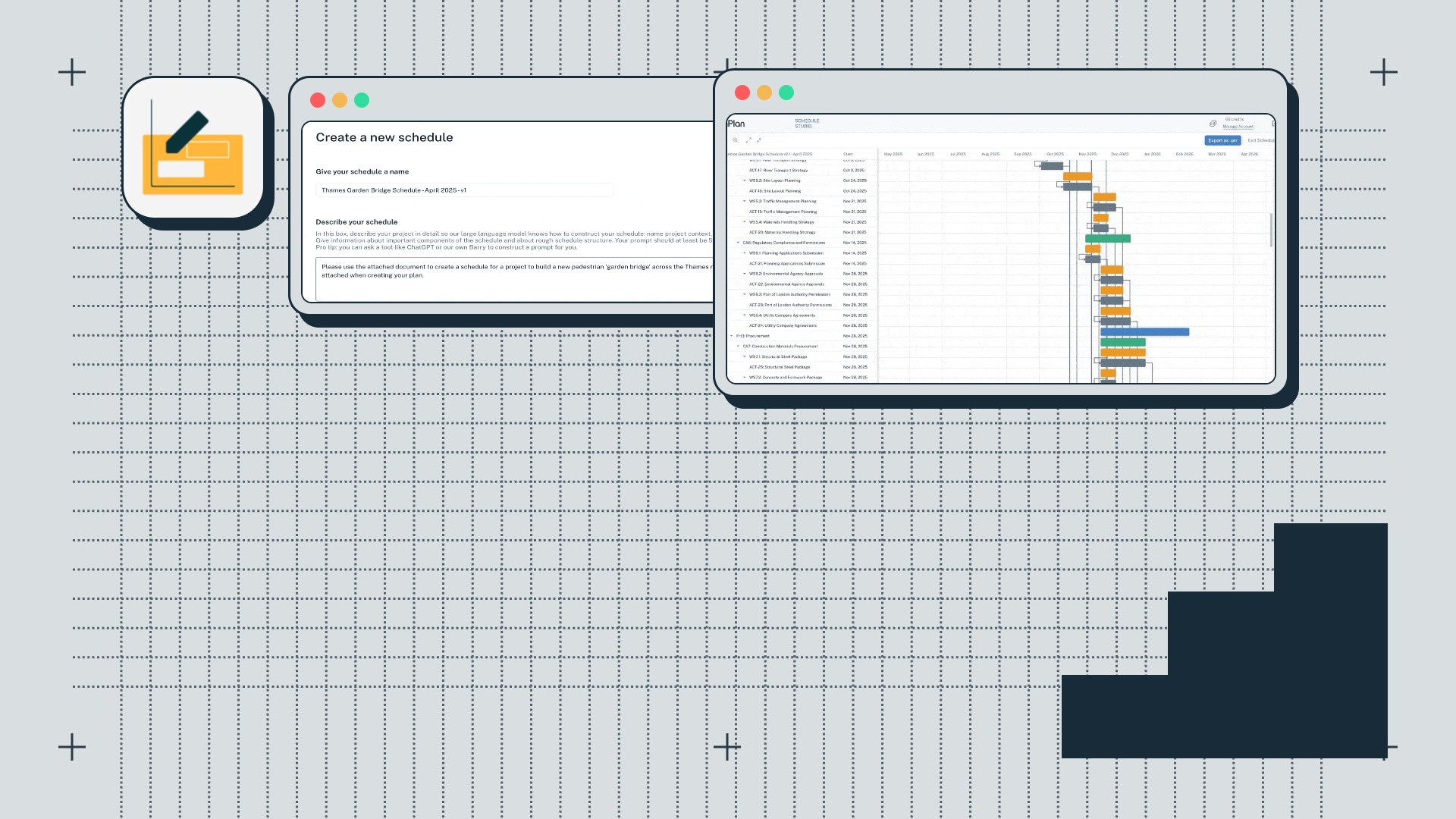
Schedule Studio turns scope documents into an editable, logic-linked first draft, and asks you to "validate the AI's assumptions before moving to detailed schedule generation" (Schedule Studio). The work breakdown structure checkpoint is, as our scope-to-schedule walkthrough puts it, "a direct opportunity to edit, add, remove or restructure before the schedule is built", which makes it the natural place to begin the scope trace. Durations and dependencies stay editable on the Gantt, and the draft exports to Primavera P6 so the planning team can carry on refining it in the tool they already use.
No AI tool finds missing scope for you, Studio included. Studio builds from what you give it, so a requirement in an appendix you did not upload, or in last week's clarification, will not appear unless someone adds it; finding missing scope remains the job of the checklist and the people on it. It also does not produce a resource-loaded programme, so the statement of principal equipment and resources NEC4 asks for, and any crane, crew or possession assumptions, stay with the planning team. Our article on who Schedule Studio helps, and how covers the wider use cases.
How should a bid team close the review?
Close it in one acceptance meeting before submission, with the planning team, the estimator and the bid lead in the room and the checklist on the screen. Walk the gap column first, confirm each decision, then have the bid lead state which dates and qualifications go into the tender. The programme you submit is then one your team has examined line by line, whoever produced the first draft.
Try Schedule Studio with your scope documents and run the checklist above on the draft it produces. Once the team has accepted the programme, the last question is how likely its committed dates are.
Insights Pro · Milestone forecasts and Driving Paths
Before the bid lead commits to a date, upload the accepted programme to forecast that milestone and see in Driving Paths which activities carry the risk.
Explore Insights ProFrequently asked questions
Which AI tools can help us spot missing scope in a draft construction programme?
AI tools help most by giving the team a structured, editable draft to review. A generative tool such as Schedule Studio builds a first draft from your scope documents and shows its scope assumptions before generating the schedule. It does not know what the tender requires unless someone traces it, so missing scope is found by mapping each requirement to an activity and logging the gaps.
Is a tender programme contractually binding under NEC4?
It can be. Under NEC4, a programme identified in Contract Data part two becomes the first Accepted Programme. If the client deletes that reference before signing, clause 50.5 allows 25% of the Price for Work Done to Date to be withheld until a compliant first programme is submitted.
Is a proposed schedule binding on a US federal construction contract?
The detailed schedule usually follows award: FAR 52.236-15 asks for it within five days after work commences, unless the contracting officer sets another period. The durations and milestones offered in the proposal still shape the dates the business is held to, and a contractor that falls behind must improve progress without additional cost to the Government.
Can Schedule Studio produce a resource-loaded tender programme?
No. Schedule Studio produces an editable, logic-linked first draft with a work breakdown structure, durations and dependencies, which you can export to Primavera P6. Resource loading, crew and equipment assumptions, and any statement of principal resources a contract asks for remain the planning team's work.
Sources
- US Government Accountability Office, Schedule Assessment Guide: Best Practices for Project Schedules (GAO-16-89G), December 2015
- US Government Accountability Office, decision B-407998.2 and B-407998.4, The Walsh-Vaughn JV, 21 May 2013
- Federal Acquisition Regulation 52.236-15, Schedules for Construction Contracts
- CECA and GMH Planning, NEC4 Bulletin 49: Programme at Tender Stage, January 2025
- GMH Planning, ECC clause 31.2 programme requirements
- Indiana Department of Transportation, Standard Specifications, Section 100, sections 101.43 and 101.54
- nPlan, Using AI to evaluate tenders for a unique highways project (case study, 2023)
- nPlan, Schedule Studio
- nPlan, Insights Pro
- nPlan, How to turn a scope document into a schedule in under one hour
- nPlan, Who Schedule Studio helps, and how